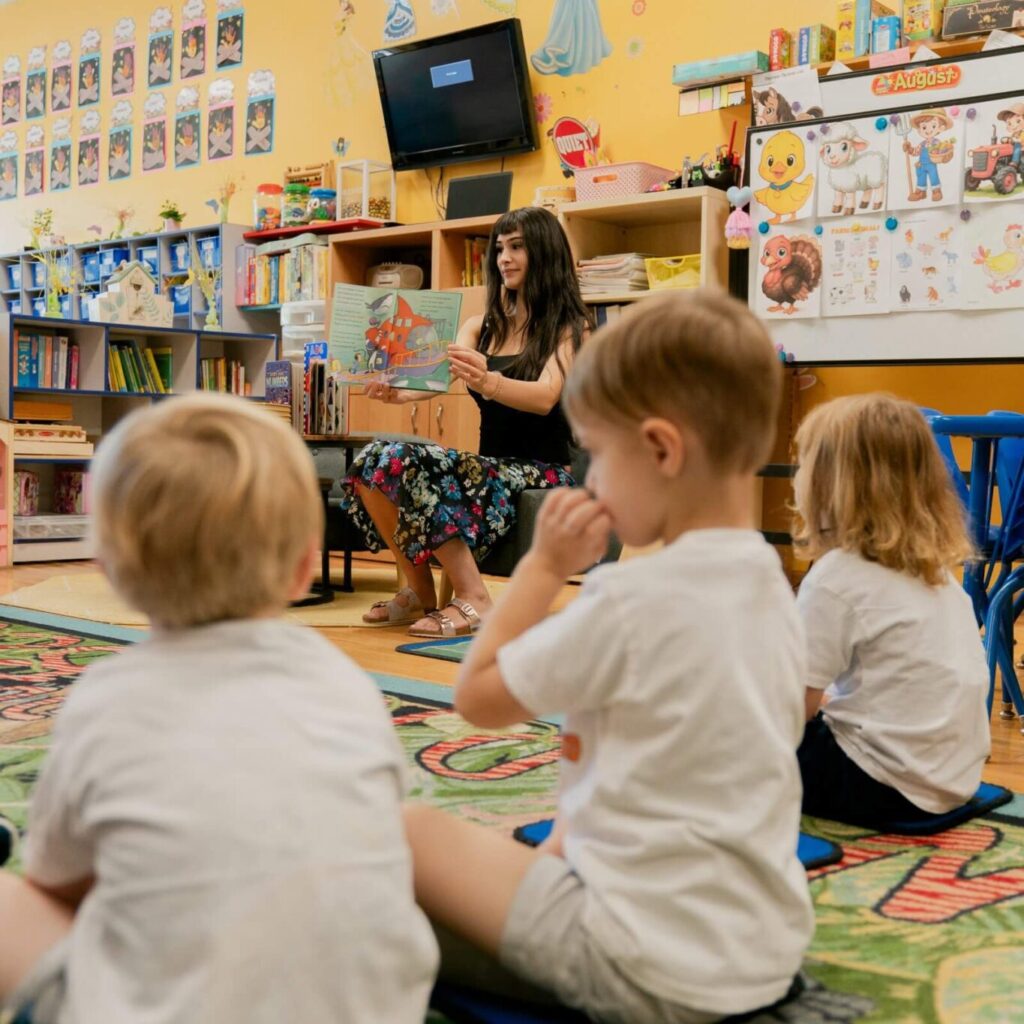
Bilingual preschool in Gladstone Park gives children between ages 2 and 5 consistent exposure to two languages during the period when the brain is most receptive to acquiring them. At Fantasy Island Schools for Kids, we serve families across the Northwest Side of Chicago, including Gladstone Park and Norwood Park, with a dual-language learning environment that goes beyond vocabulary drills and embeds both languages into daily routines, play, and peer interaction.
What Makes a Preschool Genuinely Bilingual
There is a meaningful difference between a preschool that offers a weekly designated language period and one that operates bilingually. True bilingual instruction means children hear, use, and respond in both languages throughout the school day, not just during a designated language period.
At our center, Both languages are present during circle time, during meals, during outdoor play, and during structured learning blocks. Children are not drilled. They absorb language through context, repetition, and relationship, which is exactly how their first language developed.
The Brain Science Behind Early Language Acquisition
The research on early bilingualism is consistent and has been for decades. Children who acquire two languages before age 5 develop what linguists call simultaneous bilingualism, a qualitatively different outcome from sequential bilingualism acquired later. Their brains organize language differently, and the cognitive benefits extend well beyond language itself.
Studies from the University of Chicago and Northwestern University, both institutions familiar to many Northwest Side families, have documented that bilingual children demonstrate stronger executive function, including better attention control and cognitive flexibility. These are the same competencies that predict kindergarten success and long-term academic performance.
The window for this kind of effortless acquisition begins narrowing around age 7. Preschool age is not early. It is optimal.
Gladstone Park and Norwood Park: Why Neighborhood Matters
Multilingual daycare in Norwood Park and the adjacent Gladstone Park community reflects the real linguistic diversity of these neighborhoods. The Northwest Side of Chicago is home to families from a wide range of language backgrounds, and bilingual early education is increasingly relevant to that reality.
For families where a second language is spoken at home, a bilingual preschool reinforces rather than replaces what children hear at home. For English-dominant families who want their children to develop genuine bilingual proficiency, preschool-age exposure is the most effective window available. Tutoring pursued later is far more expensive and far less effective.
What Multilingual Daycare Actually Looks Like Day to Day
A question we hear often from parents is: will my child be confused? The answer, grounded in both research and our direct experience, is no. Children are remarkably adept at code-switching once they understand that different people and different contexts call for different languages.
In our program, a typical morning might include a greeting in the second language, a read-aloud in English, a free play period where both languages are used organically, and a structured activity where the teacher models vocabulary in both languages simultaneously. There is no confusion. There is, instead, a child learning to hold two systems in mind at once, which is precisely the cognitive workout that produces lasting benefit.
Common Misconceptions About Raising Bilingual Children
| Misconception | What the Evidence Actually Shows |
| Bilingualism delays speech development | Bilingual children may develop each language slightly more slowly, but their total vocabulary across both languages meets or exceeds monolingual peers by age 5 |
| Children get confused by two languages | Language separation happens naturally as children associate each language with people and contexts |
| It is too late to start at age 3 or 4 | Ages 2 through 5 represent the peak acquisition window; starting at 3 or 4 still produces near-native outcomes |
| The home language will suffer | Bilingual exposure in a school setting supports, not undermines, the home language when families remain consistent at home |
Common General Questions
What if we only speak English at home? Is bilingual preschool still worthwhile?
Yes, and arguably more so. English-dominant families who want their children to gain real fluency have a narrow window in which preschool immersion is genuinely effective. Children who enter kindergarten with two to three years of bilingual preschool experience carry a language advantage that persists through middle and high school standardized language assessments.
How is your program different from hiring a private language tutor?
Tutoring is transactional. Bilingual preschool is environmental. Children acquire language through sustained, naturalistic exposure across different contexts and relationships. A child who hears a second language from a tutor for one hour per week will not develop fluency. A child who spends six hours per day in a bilingual environment builds the neural architecture for genuine proficiency.
Is bilingual preschool more expensive than standard preschool?
At our center, bilingual programming is integrated into our standard tuition structure. There is no premium surcharge. Families receive the same licensing-compliant, developmentally appropriate program, with the added benefit of a dual-language environment woven throughout the day.
The Crux
A genuinely bilingual preschool experience is one of the highest-return early investments a family in Gladstone Park or Norwood Park can make. The cognitive, linguistic, and social benefits are well-documented. The window is real and finite. We built our program to take full advantage of it, and the families we serve can see the results in their children every day.