
Core Multisensory Spanish Preschool Activities for Early Engagement
Young children do not acquire a second language by memorizing abstract grammar rules or staring at static flashcards. In early childhood, the brain processes language through physical kinesthetics, sensory pathways, and active social engagement. When we scaffold language learning across multiple senses, children build strong neural pathways that link Spanish words directly to concepts, emotions, and physical actions.
Whether your child is learning Spanish at home or participating in a dual-language classroom environment, combining speech with gross-motor play and tactile objects helps bridge receptive comprehension into spontaneous speech.
1. Total Physical Response (TPR) Movement and Vehicle Games
Total Physical Response (TPR) is one of the most reliable methods for early language acquisition. By pairing spoken Spanish vocabulary with distinct physical actions, children understand meaning immediately without needing word-for-word English translation.
A favorite theme for introducing TPR is transportation. In lessons like Los Medios de Transporte – You’ll love this FUN Spanish Preschool Lesson – Bilingual Bumble Bees, children explore six core vocabulary words (avión, barco, bicicleta, camión, coche, tren) through full-body movement:
- Avión (Airplane): Stretch arms wide like wings and zoom around the room.
- Barco (Boat): Press fingertips together overhead to make a sailboat mast and rock gently side to side.
- Bicicleta (Bicycle): Pump hands and feet in circular pedaling motions.
- Tren (Train): Chug arms at the elbows while stamping feet rhythmically.

You can turn these gestures into an interactive physical game like Semáforo Rojo, Semáforo Verde (Red Light, Green Light). Call out “¡Semáforo verde! Vamos en avión” so children fly across the rug, then call “¡Semáforo rojo!” so everyone freezes in place.
To reinforce pronunciation, drill the words using silly emotional voices: whisper tren like a timid mouse, boom camión like a happy giant, or say barco in a cheerful singing tone. This vocal variety keeps 3- to 5-year-olds giggling and engaged through multiple repetitions.
2. Interactive Spanish Flashcard & Story Games
Flashcards do not have to mean boring drills at a table. When transformed into active games, cards become tools for quick thinking and energetic play.
Here are three engaging ways to use visual cards:
- The Flyswatter Game (El Matamoscas): Tape four or five large picture cards to a low whiteboard or wall. Give two children clean plastic flyswatters. Call out a target word in Spanish (such as la manzana or el perro), and let the children gently swat the matching picture.
- Thief in the Market (El Ladrón del Mercado): Place five vocabulary cards face up on the rug. Ask children to close their eyes while you remove one card. When they open their eyes, they ask “¿Tienes…?” to guess the missing item, practicing natural phrases like “No tengo” and “Sí, aquí está”.
- Left or Right (¿Izquierda o Derecha?): Hide a mini picture card behind your back in one fist. Have a child guess which hand holds the card by saying “izquierda” or “derecha”.
You can also use silly props during storytelling. For example, stick a flashcard of an ear (oreja) onto your own nose (nariz) and pretend to be confused until the children eagerly shout out the correct Spanish body parts to help you fix it.
3. Spanish Preschool Activities Using Hands-On Sorting and Manipulatives
Manipulative activities develop fine motor coordination while reinforcing conceptual categories like colors, shapes, and community roles. Pairing physical objects with visual word cards provides the tactile input preschoolers need to anchor new vocabulary.
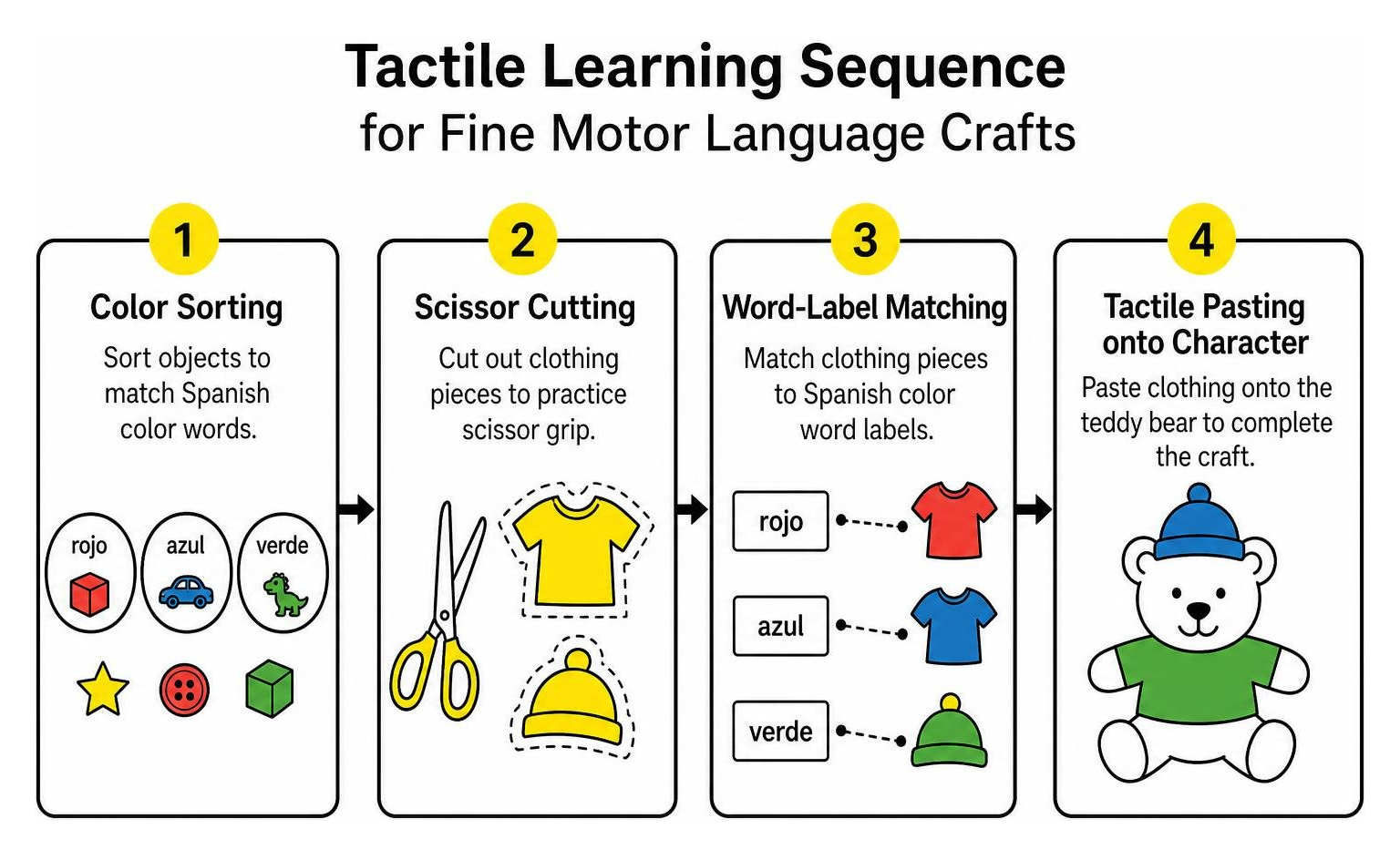
A wonderful example of tactile learning is the Actividad para kinder a segundo grado: Viste al oso de colores printable. In this activity, children dress a paper teddy bear with shirts and hats across nine core colors: rojo, amarillo, anaranjado, rosado, verde, azul, marrón, negro, and morado. By cutting out clothing pieces and matching them to Spanish labels, children practice scissor grip, follow multi-step directions, and connect written words to visual colors.
Other hands-on sorting solutions include:
- Dollar-Store Color Plates: Set out solid-colored paper plates labeled with Spanish color words. Give children baskets of mixed toys (blocks, plastic animals, buttons) to sort onto the matching plates while naming each color aloud.
- Community Helper Sorting Mats: Use themed picture cards representing community helpers (el bombero, la doctora, el policía) and have children sort miniature tools and vehicles onto the correct helper mat.
- Laminated Reusable Centers: Add hook-and-loop velcro dots to laminated sorting sheets so children can revisit matching games independently during free-choice time.
4. Thematic Sensory Bins and Tactile Transfer Stations
Sensory bins offer rich opportunities for natural, unforced dialogue. Repetitive pouring, scooping, and sifting soothe young nervous systems while providing a tangible context for spatial and descriptive vocabulary.
You can set up a pirate-themed sensory table using dry beans and chickpeas as hidden treasure, inspired by the creative framework in Mesa sensorial pirata con legumbres: trasvases, texturas y búsqueda del tesoro – Escuela Infantil Kekos. As children transfer legumes (trasvases) using wooden spoons, measuring cups, and small treasure chests, you can weave authentic Spanish spatial words into the play:
- Lleno (full) vs. Vacío (empty)
- Dentro (inside) vs. Fuera (outside)
- Mucho (a lot) vs. Poco (a little)
- Grande (big) vs. Pequeño (small)

Hide gold coins or plastic gems beneath the beans and prompt a classroom treasure hunt: “¿Dónde está el tesoro? ¡Busca dentro de la caja!” When children find an item, encourage them to call out “¡Aquí está!” or “¡La encontré!” Always ensure direct adult supervision during dry sensory play to maintain safety.
Creative and Cultural Spanish Preschool Activities for Cognitive Growth
Language and culture are naturally intertwined. Introducing authentic cultural stories, traditional artwork, and rhythmic musical rhymes gives young children an appreciation for diverse traditions while strengthening phonemic awareness.
5. Regional Folklore and Cultural Craft Projects
Cultural projects are most engaging when connected to hands-on art and early geometry. Rather than treating cultural units as passive history lessons, invite preschoolers to create authentic, tactile crafts inspired by traditional festivals.
A great model is the traditional Extremaduran festival craft detailed in Actividad 1, where children design colorful Jarramplas masks. This project combines cultural heritage with early geometry and motor skills:
- Shape Identification: Review basic geometric shapes in Spanish (círculo, cuadrado, triángulo) on a chart or digital whiteboard.
- Pattern Drawing: Children sketch geometric patterns inside the mask outline using pencils.
- Vibrant Coloring: Children fill their designs using solid paint sticks (pinturas en barra).
- Assembly: Older preschoolers cut along the perimeter lines, and the finished masks are laminated and attached to elastic bands for dramatic pretend play.
You can apply this same integrated approach to other cultural celebrations throughout the year, such as crafting decorative tissue-paper papel picado for spring cultural themes or building New Year goal mobiles (móviles de deseos) in January.
6. Melodic Rhyme and Circle Time Chant Routines
Preschoolers remember melodies long after spoken words are forgotten. Setting basic Spanish vocabulary to well-known nursery tunes creates predictable daily routines that lower language anxiety.
Try singing color or weather vocabulary to the familiar melody of “Are You Sleeping?” (Frère Jacques):
Rojo, red. Rojo, red.
Azul, blue. Azul, blue.
Amarillo, yellow. Amarillo, yellow.
Verde, green. Verde, green.
Other melodic routines to incorporate into morning circle time include:
- Daily Weather Wheel (¿Qué tiempo hace hoy?): Turn an interactive paper wheel while chanting: “¿Hace sol? ¿Hace frío? ¿Está lloviendo hoy?”
- Greeting Chants: Open circle time with rhythmic call-and-response songs like “Buenos días, amiguitos, ¿cómo están?”
- Fingerplays (Rimas de dedos): Use traditional rhymes like “Cinco ratoncitos de colita gris” with finger puppets to practice counting and animal sounds.
7. Cut-and-Paste Phonics and Word-Building Puzzles
As children approach ages 4 and 5, their interest in letters and sounds begins to bloom. Hands-on literacy manipulatives allow children to construct Spanish words visually and physically without the pressure of handwriting drills.

The manipulative approach highlighted in Observo y construyo palabras: fichas manipulativas de lectoescritura – Actividades de infantil y primaria offers a structured format for early literacy centers. Children look at a picture prompt (such as sol or gato), identify the initial sounds, cut out individual letter tiles at the bottom of the worksheet, and paste the letters in sequential order inside matching boxes.
Useful early Spanish literacy resources include:
- Rhyming Puzzles (Rompecabezas de rimas): Self-correcting two-piece puzzle cards pairing rhyming items (like queso and hueso).
- High-Frequency Word Mats (Palabras de uso frecuente): Building common sight words using playdough or magnetic letter tiles.
- Syllable Wheels (Las sílabas): Turning rotating paper discs to match consonant-vowel blends (ma, me, mi, mo, mu) to familiar picture cards.
Structured Implementation: Age Differentiation and Lesson Pacing
Even the most creative Spanish activities will fall flat if classroom pacing does not match the developmental attention span of early learners. Keeping activities brief, varied, and developmentally appropriate prevents frustration and keeps children eager to participate.
8. The 5-Minute Block Pacing Strategy and Classroom Flow
Preschoolers have short attention spans. If a teacher stays on a single task for too long, attention quickly wanders. Structuring a 30-minute preschool Spanish session into concise 5-minute blocks ensures steady momentum and high engagement.
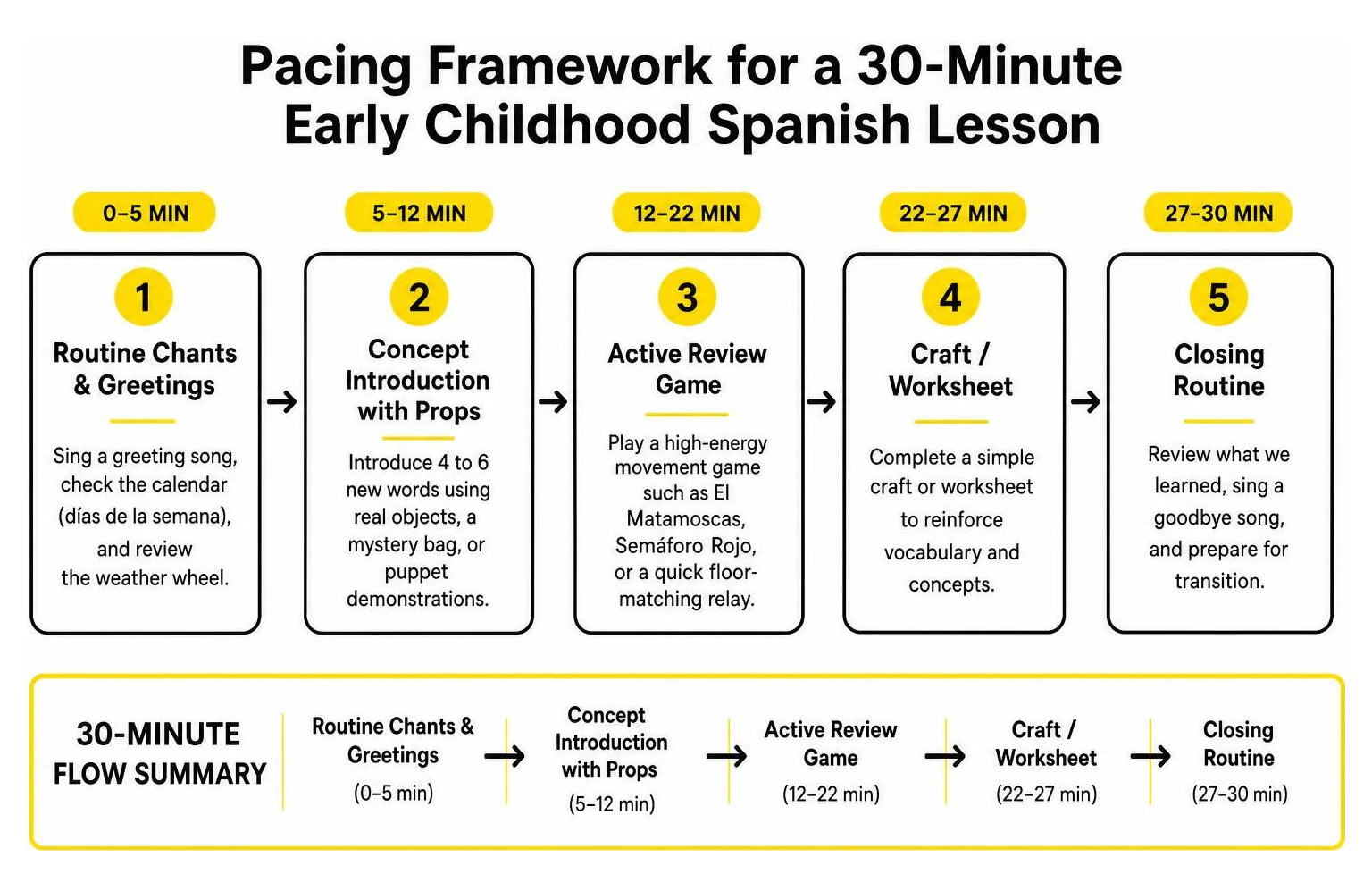
A balanced 30-minute Spanish lesson framework:
- Minutes 0–5 (Routine Chants & Greetings): Sing an energetic greeting song, check the calendar (días de la semana), and review the weather wheel.
- Minutes 5–12 (Concept Introduction with Props): Introduce 4 to 6 new words using real objects, a mystery bag, or friendly puppet demonstrations.
- Minutes 12–22 (Active Review Game): Play a high-energy movement game such as El Matamoscas, Semáforo Rojo, or a quick floor-matching relay.
- Minutes 22–27 (Hands-On Table Work): Transition to quiet focus with a cut-and-paste activity, tactile playdough mat, or coloring sheet.
- Minutes 27–30 (Closing Song & Transition): Sing a calm farewell song (“Adiós, amigos”) and celebrate daily participation.
Common Instructional Mistakes to Avoid
- Avoid Long Vocabulary Lists: Limit new vocabulary sets to 4–6 words per unit.
- Avoid Sitting Too Long: Alternate between floor circle time, standing movement, and seated tabletop tasks.
- Avoid Word-for-Word Translation: Use gestures, facial expressions, and props rather than constantly translating into English.
- Always Keep a Backup Ready: Keep an extra picture book, finger puppet, or action song handy in case a planned activity wraps up faster than expected.
9. Differentiating Spanish Preschool Activities Across Ages 3 to 5
A 3-year-old toddler explores the world primarily through sensory discovery and parallel play, while a 5-year-old Pre-K student is developing phonological awareness, cooperative social skills, and pencil control. Adapting Spanish activities to these distinct developmental stages ensures every child feels supported and successful.
For families exploring early immersion options, learning how top programs structure their bilingual curricula can provide helpful context, as discussed in our guide to The 5 Best Spanish Immersion Preschools Near Me Compared.
| Developmental Domain | 3-Year-Olds (Sensory & Gross Motor) | 4-Year-Olds (Guided Sorting & Social Play) | 5-Year-Olds (Pre-K Literacy & Fine Motor) |
|---|---|---|---|
| Language Target | Receptive identification of 2–3 words | Naming 4–6 words in simple phrases | Using complete carrier phrases (“Yo veo un…”) |
| Motor Focus | Whole-body TPR, large arm gestures | Assisted scissor cutting, peg sorting | Independent cutting, precise gluing, tracing |
| Activity Type | Tactile sensory bins, dancing, animal mimes | Matching games, simple memory pairs | Word-building puzzles, rhyming cards |
| Attention Span | 2–3 minutes per single micro-task | 4–5 minutes per activity segment | 7–10 minutes of sustained small-group focus |
10. Authentic Observational Assessment Without Formal Testing
Testing young children with quizzes or high-pressure verbal demands causes unnecessary stress and produces inaccurate results. Instead, early childhood educators assess Spanish language acquisition through systematic, continuous observation during daily play.
Teachers observe comprehension by tracking natural milestones across four practical achievement levels:
- Emerging Receptive Comprehension: The child responds accurately to physical cues (e.g., freezing on “rojo” or pointing to “el perro” in a picture book).
- Guided Verbal Expression: The child repeats target words during musical chants or answers simple choice prompts (e.g., “¿Quieres la manzana roja o verde?”).
- Spontaneous Vocabulary Use: The child unprompted uses Spanish words during imaginative free play (e.g., saying “¡Mira, un avión!” while building blocks).
- Carrier Phrase Integration: The child combines words into meaningful expressions (e.g., “Dame el lápiz azul, por favor”).
Documenting these milestones through work sample portfolios, observational notes, and photo records gives teachers and parents a clear, encouraging view of language growth without formal testing.
Frequently Asked Questions About Preschool Spanish Instruction
What are the most common mistakes to avoid when planning Spanish lessons for preschoolers?
The most common mistake is treating young children like older students. Rote flashcard drills, long grammar explanations, and direct translation lists fail because preschoolers learn through play, story, and movement. Keep lessons short, dynamic, and full of props.
How can teachers keep 3- to 5-year-olds focused during Spanish lessons?
Keep activities capped at roughly five minutes each, alternate active movement with seated tasks, use silly voices and puppets, and incorporate Total Physical Response (TPR) so children express language with their whole bodies.
What free or low-cost materials work best for preschool Spanish centers?
Inexpensive everyday items make wonderful learning centers: dollar-store colored paper plates for sorting games, dry beans and measuring cups for sensory bins, printed and laminated matching cards with velcro dots, and homemade weather wheels.
Conclusion
Teaching Spanish to preschoolers is an exciting, joyful journey. When we replace rote memorization with physical movement, cheerful songs, sensory exploration, and creative storytelling, children naturally build communicative confidence and receptive bilingual skills that last a lifetime.
At Fantasy Island Schools for Kids, founded in 2009 by Beata Bielic and located at 6100 N Milwaukee Ave, Chicago, IL 60646, we believe early childhood is the ideal window for language immersion and cognitive growth. Alongside our comprehensive multilingual curriculum and dedicated Polish-language instruction, we proudly serve families across Chicago’s Northwest Side, including Norwood Park, Edison Park, and surrounding nearby communities.
Our comprehensive programs serve children ages 2 to 6 with full-time and part-time options, operating Monday through Friday from 7 AM to 6 PM. Weekly tuition ranges between $300 and $400 and includes our Gifted Enrichment Program, weekly music instruction, and freshly prepared on-site meals at no extra charge. We also accept CCAP (Illinois Child Care Assistance Program) and Illinois Action for Children; families can contact our team or Illinois Action for Children for details about assistance.
Discover how our nurturing multilingual environment can support your child’s early milestones. Explore our preschool program today to learn more and schedule a tour with our dedicated teaching team.
