

Core Categories of 3 Year Old Milestones
By their third birthday, most children reach key 3 year old milestones including speaking in 3-to-5-word sentences, pedaling a tricycle, counting up to 3 objects, following 2- to 3-step directions, and engaging in cooperative play with peers.
Understanding your child’s growth is all about observing how they communicate, interact, think, and move through their daily world. While every child develops at their own unique pace, clinical guidelines such as the Milestones by 3 Years | Learn the Signs. Act Early. | CDC establish clear baseline skills that 75% or more of children master by their third birthday. Let’s look closely at what these emerging skills look like in real life.
Cognitive and Language 3 Year Old Milestones
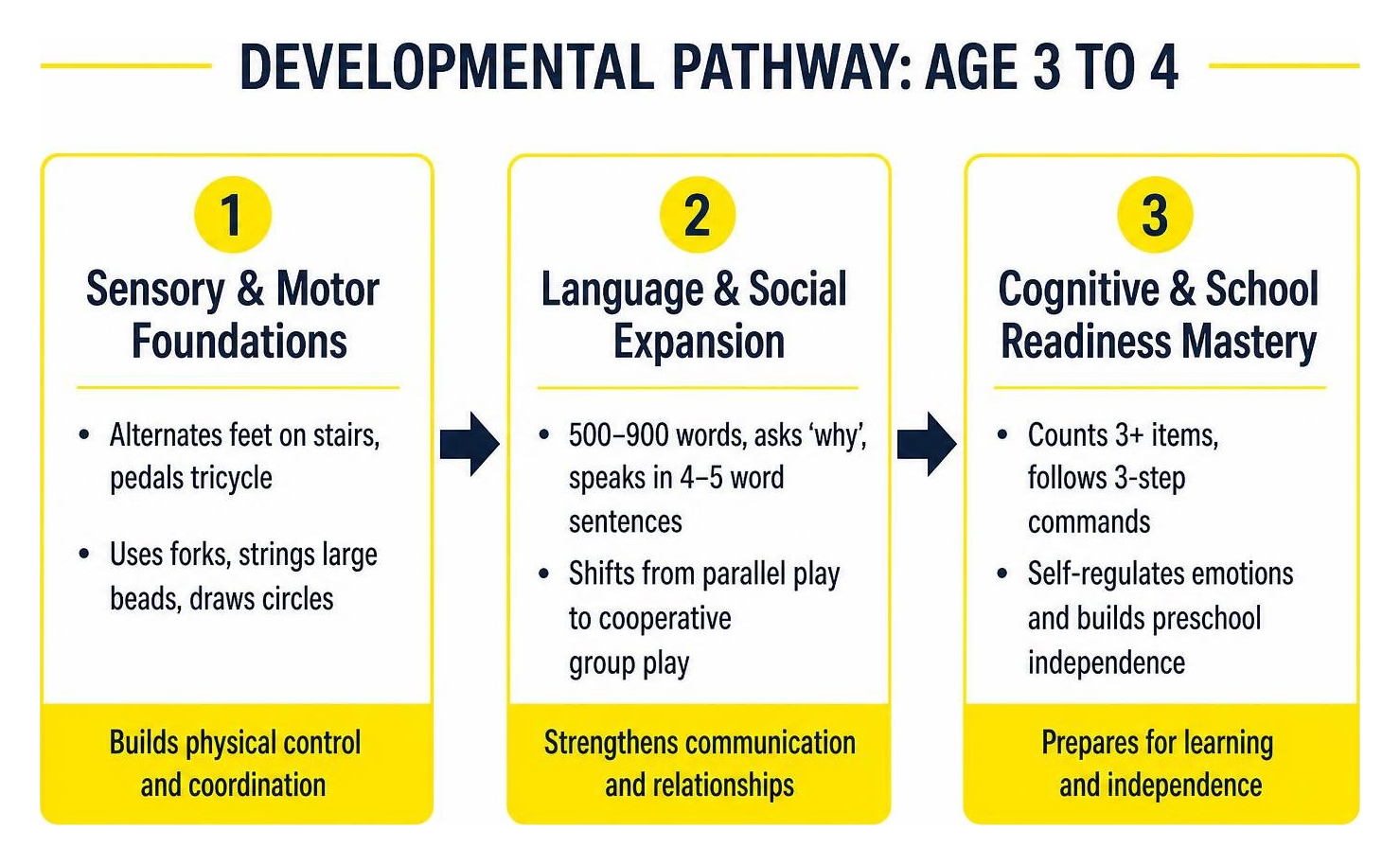
Around age three, children experience an incredible surge in cognitive processing and verbal expression. A child’s vocabulary typically expands to between 500 and 900 words. They progress from two-word toddler combinations to complete 3-to-5-word sentences, often using plurals and pronouns like he, she, and we.
At this stage, you will notice a burst of natural curiosity marked by endless “who,” “what,” “where,” and “why” questions. These questions demonstrate developing causal reasoning. Children begin to understand spatial prepositions such as in, on, and under, and they can easily state their first name, age, and sex when asked.
Cognitively, 3-year-olds can:
- Count up to 3 objects accurately rather than merely reciting numbers by rote.
- Grasp the concrete concept of “two” (such as recognizing when they have two apple slices).
- Follow 2- to 3-step instructions, such as “Pick up your shoes and put them by the door.”
- Complete simple 3-to-4-piece puzzles and sort items by color or basic geometric shape.
- Demonstrate an attention span of roughly 8 to 9 minutes on a single structured task.
- Understand basic safety warnings, such as avoiding a hot stove.
Fine motor manipulation also sharpens alongside brain development. Most three-year-olds can build a block tower of more than 9 cubes, turn book pages one at a time, and unscrew simple jar lids or turn door handles. If you would like a deeper breakdown of how analytical thinking grows throughout early childhood, explore The Definitive Guide to Toddler Cognitive Development Milestones for helpful insights.
Social, Emotional, and Physical 3 Year Old Milestones
Socially, the third year marks an important transition from parallel play (playing side-by-side without interacting) toward true cooperative play. Three-year-olds begin to notice peers, actively join them in games, and practice basic turn-taking and sharing, though strong feelings of toy possessiveness (“mine!”) are still completely normal.
Emotionally, 3-year-olds are forming a clearer sense of self. They begin to conceptualize themselves as individuals with distinct thoughts, feelings, and bodies. Separation anxiety softens: a typical 3-year-old can calm down within 10 minutes after a caregiver departs at morning drop-off. They also begin demonstrating real empathy, often comforting a crying classmate or offering a favorite toy to a friend.
As symbolic thinking takes off, rich make-believe play emerges. Children might transform an empty cardboard box into a spaceship or pretend to be parents, doctors, or animals. Because fantasy and reality frequently blur at this age, imaginative fears—such as fears of the dark, monsters under the bed, or going down the bathtub drain—often make their first appearance.
On the physical side, gross motor coordination advances dramatically:
- Walking up and down stairs using alternating feet rather than stepping with both feet onto each stair.
- Pedaling a 3-wheeled tricycle smoothly.
- Running steadily with fewer trips and falls, jumping in place with both feet leaving the ground, and balancing on one foot for a few seconds.
- Catching and kicking a large ball.
For fine motor self-care, children at age three can use a fork to feed themselves, string large beads or macaroni, draw a circle after being shown how, and put on loose clothing such as pants or a jacket with minimal help. To learn more about emotional regulation and building peer connections, read All About Social Emotional Development in Toddlers Key Milestones.
Physical Growth, Sleep, and Daily Activity Guidelines
Tracking physical health and establishing balanced daily routines provide the foundation your child needs to reach their developmental milestones.
Healthy Height, Weight, and Dentition Targets
Growth slows down compared to the rapid gains of infancy and toddlerhood, giving children a leaner, taller preschooler build. According to pediatric references such as the Developmental milestones record – 3 years: MedlinePlus Medical Encyclopedia, typical physical benchmarks include:
- Weight Gain: An average gain of 4 to 6 pounds (approximately 1.8 to 2.7 kg) per year.
- Height Growth: An increase of about 2 to 3 inches (5 to 7.5 cm) per year.
- Adult Height Milestone: By their third birthday, children have reached roughly 50% of their future adult height.
- Dentition: Most children have all 20 primary (“baby”) teeth fully erupted.
- Vision: Visual acuity refines significantly, approaching 20/30 clarity.
Growth patterns are largely driven by genetics and steady nutrition. Temporary food “jags”—where a child insists on eating only one particular food for days—are common at this age. Serving balanced meals and allowing your child to decide how much to eat helps establish healthy eating habits without unnecessary mealtime stress.

Sleep Schedules and Active Movement Standards
Adequate rest and active play are essential for brain development, emotional regulation, and physical endurance:
- Sleep Needs: 3-year-olds need 11 to 13 hours of total sleep per day. This typically includes 10 to 11 hours of nighttime sleep and an optional 1-to-2-hour afternoon nap. If your child begins dropping their nap, transition them to a daily quiet rest period.
- Bedtime Routines: Maintain a predictable 20-to-30-minute winding-down routine (bath, brushing teeth, reading two stories) to prevent bedtime resistance.
- Physical Activity: Guidelines recommend at least 30 minutes of structured, adult-led physical activity (like movement games or obstacle courses) and at least 60 minutes of unstructured active free play daily.
- Inactivity Limits: Children should not remain sedentary or inactive for more than 1 hour at a time while awake.
- Screen Time: Digital media should be limited to no more than 1 hour per day of high-quality children’s programming, watched together with an adult to encourage active conversation and comprehension.
Supporting Early Childhood Development and School Readiness
Parents and caregivers can nurture early skills through simple, intentional interactions woven into daily home routines.
Daily Routines, Play, and Emotional Regulation
Supporting your child’s emerging independence builds confidence and prepares them for structured learning environments:
- Expand on Their Language: When your child says short phrases like “Big truck,” model rich vocabulary by replying, “Yes, that is an enormous yellow dump truck carrying heavy rocks!”
- Offer Positive Binary Choices: Avoid open-ended power struggles by offering two acceptable options: “Would you like to put on your blue sneakers or your red shoes today?”
- Encourage Self-Care Tasks: Provide child-sized cups, utensils, and loose-fitting clothing so your child can practice dressing, handwashing, and tidying up their toys.
- Support Problem Solving: When a toy tower falls, resist the urge to fix it immediately. Ask, “What do you think will happen if we put the widest block on the bottom?”
- Validate Big Feelings: Tantrums happen because a 3-year-old’s emotions can outpace their language skills and impulse control. Help them label their feelings: “You look frustrated that playtime is over. Let’s take two deep breaths together.”
- Incorporate Bilingual & Sensory Play: Introducing dual-language songs, rhymes, and hands-on sensory bins builds cognitive flexibility and fine-motor strength. At Fantasy Island Schools for Kids, we integrate bilingual Polish-English instruction, early music education, and sensory exploration to help children develop strong communication and social skills naturally.
Assessing Red Flags and Developmental Screening
Every child develops on their own timeline, but certain signs warrant an evaluation with your pediatrician, a specialist, or your local school district’s early intervention program.
| Developmental Area | Typical 3-Year-Old Benchmark | Signs of Potential Delay (Red Flags) |
|---|---|---|
| Speech & Language | 500–900 words; 3–5 word sentences; 75% understood by strangers | Fewer than 50 words; cannot speak in sentences; speech is unintelligible; does not ask questions |
| Gross & Fine Motor | Pedals tricycle; walks up stairs alternating feet; stacks 9+ blocks | Cannot jump in place; frequent falling; cannot grasp a crayon; cannot stack 4 blocks |
| Cognitive & Play | Counts 3 items; follows 2–3 step commands; pretend play | Cannot follow simple 2-step directions; shows no interest in toys or pretend play |
| Social & Emotional | Joins peers; calms within 10 min of drop-off; shows empathy | Extreme separation distress lasting >30 min; avoids all eye contact or peer interaction |
| Behavioral Regulation | Brief, occasional tantrums with identifiable triggers | Tantrums regularly lasting >15 minutes or occurring >3 times daily |
| General Health | Continuous progression in physical and cognitive skills | Any noticeable loss or regression of previously mastered motor or speech skills |
If you notice any of these red flags or have questions about your child’s overall learning progress, speak with your pediatrician or early childhood educator. Early screening provides the right support at the right time. For families preparing for the next step, our guide on 5 Signs That Your Child Is Ready for Kindergarten explains what teachers look for as children grow toward school readiness.
Frequently Asked Questions About 3-Year-Old Development
How many words should a typical 3-year-old speak?
Most 3-year-olds use an expressive vocabulary of 500 to 900 words and speak in sentences of 3 to 5 words. They should use pronouns (I, you, me, he, she) and basic plurals. An unfamiliar listener should be able to understand approximately 75% of what a three-year-old says.
When are temper tantrums a concern at age 3?
While occasional emotional meltdowns are a normal part of learning self-regulation, tantrums are considered a potential concern if they consistently last longer than 15 minutes, occur more than 3 times a day, or involve severe aggression toward themselves or others. In such cases, consulting your pediatrician can help rule out underlying sensory or communication frustrations.
What gross motor skills should a 3-year-old master?
A 3-year-old should be able to run smoothly, pedal a 3-wheel tricycle, jump off the ground with both feet, balance on one foot for a few seconds, kick a stationary ball, and walk up stairs alternating feet without holding both feet on a single step.
Conclusion
The third year of life is an exciting window of rapid cognitive discovery, language growth, and social connection. Watching your child build their first block castle, ask thoughtful questions, and make their first real friends are milestones worth celebrating. By keeping these developmental benchmarks in mind, establishing consistent daily routines, and offering warm encouragement, you give your child the tools they need to flourish.
At Fantasy Island Schools for Kids, we have partnered with families since 2009 to turn these crucial developmental years into a joyful, enriching experience. Founded by Beata Bielic and located at 6100 N Milwaukee Ave, Chicago, IL 60646, our school provides high-quality early childhood education for children ages 2 to 6. Our programs feature an engaging Gifted Enrichment Program, fully certified Early Childhood Education teachers trained in trauma-informed care and CPR, a vibrant multilingual curriculum including Polish-language instruction, weekly music classes, a spacious multi-sensory play environment, and freshly cooked on-site meals included daily.
We offer flexible full-time and part-time enrollment with hours from 7:00 AM to 6:00 PM, Monday through Friday, with tuition typically ranging from $300 to $400 per week. We proudly accept the Illinois Child Care Assistance Program (CCAP) and work closely with Illinois Action for Children to ensure accessible, premier care for families across Chicago’s Northwest Side and nearby communities like Norwood Park and Edison Park.
If you are looking for a nurturing, developmentally rich preschool environment to support your 3-year-old’s growth, we invite you to connect with us. Visit Fantasy Island Schools for Kids to schedule a private tour today!
