

Understanding Toddler Cognitive Development: Brain Growth and Piaget’s Stages
Cognition refers to the complex mental toolkit our brains use to take in, process, store, and retrieve information from the world around us. In young children, cognitive development represents the ongoing process of building, updating, and refining these mental abilities. Throughout toddlerhood, a child’s brain undergoes rapid structural transformations, particularly within the prefrontal cortex—the region responsible for high-level decision making, impulse control, working memory, and logical reasoning. While the prefrontal cortex continues maturing well into a person’s mid-to-late twenties, its foundational pathways are wired during these energetic early years.
When developmental psychologists talk about how children think, Jean Piaget’s groundbreaking work remains a central baseline. Piaget outlined four distinct stages of intellectual growth, two of which directly intersect with toddlerhood:
- The Sensorimotor Stage (Birth to 2 Years): During this phase, infants and toddlers construct knowledge purely through physical actions, direct sensory exploration, and motor manipulation. They learn cause and effect by banging toys, dropping spoons from high chairs, or squeezing soft blocks.
- The Preoperational Stage (Ages 2 to 7 Years): As toddlers approach age 2, they cross into the preoperational stage, where symbolic thought begins to take root. Children start using mental representations—such as spoken words, gestures, and drawings—to stand for real-world objects, people, and experiences that are not physically present.
To navigate their expanding worlds, toddlers rely on two main cognitive processes described by Piaget: assimilation and accommodation. Assimilation occurs when a toddler fits new experiences into an existing mental concept (or “schema”). For instance, a child who knows that the family dog is a four-legged furry animal might spot a sheep for the first time and call it a “doggy.” However, when they notice the sheep barks differently and eats grass, accommodation takes over—the toddler modifies their existing mental schema to create a brand-new category for sheep.
Another pivotal cognitive milestone during early sensorimotor growth is object permanence. Emerged around 6 months of age, object permanence is the understanding that objects and people continue to exist even when they are hidden from sight, touch, or hearing. By 18 to 24 months, toddlers master this concept completely, enabling them to search systematically for hidden toys without getting confused. To dive deeper into these psychological stages, parents can review Understanding Cognitive Development: Different Stages and Piaget’s Theory – BBC Tiny Happy People.
The Science of Synaptogenesis and Neural Plasticity
The rapid biological growth behind toddler cognitive development is driven by synaptogenesis—the formation of connection points (synapses) between brain neurons. Between ages 1 and 3, a toddler’s brain generates an astonishing 700 to 1,000 new synaptic connections per second. This explosive rate of neural wiring will never occur again at any other point in human life. By the time a child turns 3 years old, their brain has formed nearly double the number of synaptic connections present in an adult brain.
This extraordinary neural plasticity means that a toddler’s brain architecture is uniquely sensitive to environmental experiences and scaffolding. Scaffolding occurs when parents, teachers, and caregivers provide supportive guidance that allows a child to master a skill just beyond their current independent capacity.
Research highlights just how capable toddler memory systems are during this window. In deferred imitation experiments, researchers discovered that a 14-month-old child who observes an adult perform a single novel action—such as pressing a hidden panel to turn on a light—can accurately reproduce that exact multi-step action up to a full week later from memory alone, without any intervening practice.
Piaget’s Framework Applied to Toddler Cognitive Development
Applying Piaget’s theories to modern home and classroom settings helps explain why toddlers think and act the way they do. During the preoperational stage, young children rely heavily on mental representations, which fuel early pretend play. A toddler might hold a wooden block to their ear and chatter away as if it were a smartphone, or offer a doll a plastic cup of imaginary tea.
Two major characteristics define preoperational toddler cognition:
- Egocentrism: This is not selfishness; rather, it is the cognitive inability to conceptualize the world from another person’s perspective. For example, a 2-year-old might hand you their own favorite security blanket when they notice you are feeling sad, believing that what comforts them must automatically comfort you.
- Magical Thinking: Toddlers frequently blur the boundaries between internal imagination and physical reality. They may believe that their angry thoughts caused a thunderstorm or that an imaginary monster lives under the bed.
While Piaget originally theorized that egocentrism lasts well into early school years, modern eye-tracking studies and clinical research show that children begin mastering Theory of Mind—the realization that other people hold distinct thoughts, feelings, beliefs, and intentions—much earlier, typically between ages 3 and 5. For detailed clinical frameworks on early childhood intellectual evaluation, caregivers can reference the authoritative research provided in Cognitive Development – StatPearls – NCBI Bookshelf.
Key Cognitive Milestones from 12 to 36 Months
Tracking milestone benchmarks gives caregivers clear visibility into how problem-solving, memory, and reasoning develop across early childhood. Pediatricians evaluate these benchmarks during routine wellness checkups using clinical surveillance and standardized screening questionnaires.
| Age Window | Core Cognitive Benchmarks | Problem-Solving & Logic Skills | Language & Symbolic Integration |
|---|---|---|---|
| 12 to 18 Months | Finds hidden objects; uses household tools functionally; imitates adult gestures | Trial-and-error exploration; understands cause and effect (shaking a rattle makes noise) | Receptive vocabulary reaches ~50 words; points to express desire; understands simple commands |
| 24 Months (2 Years) | Sorts shapes/colors; stacks 4+ blocks; completes simple puzzles; mirror self-recognition | Organizes items by type; uses stools to reach high items; demonstrates early planning | Expressive vocabulary hits 50–300+ words; combines 2-word phrases; engages in simple pretend play |
| 36 Months (3 Years) | Operates moving toy parts; understands simple time concepts; counts 3 items | Follows 2- to 3-step directions; categorizes by size/color; solves complex shape sorters | Uses descriptive sensory words (hard, heavy, loud); engages in multi-role fantasy play |
For a complete breakdown of age-based health recommendations and physical safety guidelines alongside mental benchmarks, parents can consult Toddler Developmental Milestones (Age 1 to 3 Years Milestones).
12 to 18 Months: Functional Exploration and Object Permanence
Between 12 and 18 months, toddlers transition away from pure infant sensory exploration toward intentional cause-and-effect experiments. Rather than simply mouthing or banging every object they touch, they begin demonstrating functional tool use: using a spoon to scoop food, holding a cup upright, or using a toy hammer on a peg box.
During this stage, problem-solving happens predominantly through physical trial and error. If a toy falls behind a couch, an 18-month-old will physically test different physical routes to retrieve it. Object permanence is fully established, meaning hidden objects trigger active searching behavior. Toddlers also display a rapidly expanding receptive vocabulary—comprehending up to 50 words and following simple one-step instructions like “bring me the ball”—long before they can pronounce those same words verbally.
2 Years Old: Symbolic Thinking and Language Growth in Toddler Cognitive Development
At 24 months, toddler cognitive development accelerates as language acquisition and executive functioning merge. Vocabulary typically grows to anywhere between 50 and 300+ expressive words, with toddlers regularly putting two words together (such as “more milk” or “big dog”).

This stage brings major leaps in abstract cognitive organization:
- Categorization and Sorting: Toddlers can sort physical items into basic groups, such as separating red blocks from blue blocks or animals from toy cars.
- Self-Awareness: Between 18 and 24 months, children pass the classic mirror mark test, recognizing that the reflection in a mirror is themselves rather than another child.
- Emerging Executive Function: Two-year-olds begin demonstrating basic working memory and motor planning, such as dragging a small step stool across the kitchen to reach an apple on a high counter.
To explore empirical research detailing how language growth directly strengthens early executive control systems, readers can review Child Vocabulary and Developmental Growth in… : Developmental Science.
3 Years Old: Complex Problem Solving and Early Logic
By age 3, a toddler’s cognitive processing capacity expands significantly. Three-year-olds can hold multi-step instructions in their mind, allowing them to follow compound directions such as “put your shoes in the closet and then pick up your sweater.”
Early mathematical and spatial logic also emerges during this year. A typical 36-month-old child can count up to 3 objects by hand, compare two items by relative size (“bigger” vs. “smaller”), identify basic geometric shapes, and understand simple temporal concepts (“today,” “after nap time”). In addition, three-year-olds begin using descriptive sensory language, incorporating words like “loud,” “heavy,” “hard,” and “dark” to articulate their observations. Their pretend play transitions from basic single-action scripts (feeding a doll) into rich, creative scenarios involving multiple roles and detailed storylines.
How Play and Daily Activities Boost Cognitive Growth
Play is the primary mechanism through which toddlers construct mental schemas, test hypothesis, and master complex executive skills. However, not all play influences brain development in the same way. Developmental research shows that guided play produces the strongest gains in early vocabulary, spatial reasoning, and cognitive flexibility.
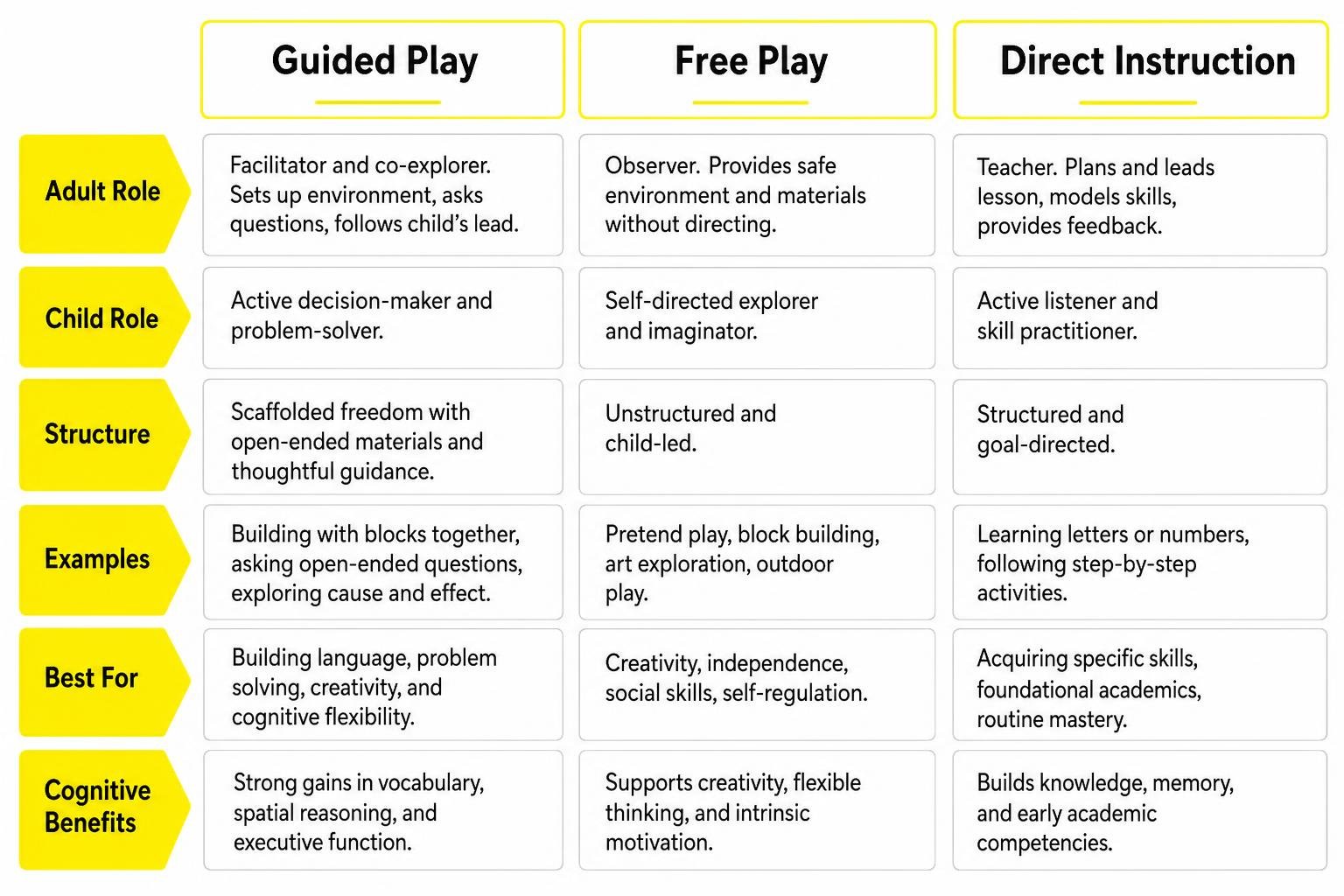
In guided play, adults thoughtfully structure an enriched learning environment—offering open-ended sensory materials, puzzles, or loose parts—and then hover quietly, asking open-ended questions (“What do you think happens if we build the tower wider at the bottom?”) while allowing the child to direct their own problem-solving process.
Daily routines offer fantastic natural opportunities for cognitive enrichment:
- Bath Time Physics: Using plastic cups, funnels, and scoops lets toddlers experiment directly with concepts like volume, floating, sinking, pouring, and cause-and-effect displacement.
- Interactive Storybook Reading: Pausing while reading familiar picture books to ask “What do you think will happen next?” or letting your toddler fill in rhyming phrases builds predictive reasoning and working memory.
- Loose Parts and Sorting Games: Providing open-ended natural items like large wooden pegs, plastic containers, fabric scraps, and river stones encourages creative categorization, spatial engineering, and mathematical grouping.
Caregivers looking for more practical, evidence-based home play ideas can check out Cognitive Development in Toddlers: Milestones and Support.
The Impact of Screen Time on Brain Development
As digital devices become increasingly common, parents often wonder how media exposure affects young children’s cognitive growth. Major pediatric organizations, including the American Academy of Pediatrics (AAP), advise avoiding passive screen media (excluding interactive video calls with family) for children under 18 to 24 months. For toddlers aged 2 to 3 years, guidelines recommend limiting high-quality programming to no more than 1 hour per day, ideally co-viewed with an adult.
The main concern with early screen exposure isn’t that digital media is inherently toxic, but rather the displacement effect. Every hour a toddler spends staring passively at a tablet screen is an hour taken away from real-world sensory play, physical movement, object manipulation, and—most importantly—back-and-forth conversational interaction with responsive caregivers.
Children under age 3 suffer from a cognitive phenomenon known as the video deficit effect: they have difficulty transferring 2D information viewed on a screen into 3D real-world applications. Interactive human eye contact and contingent verbal feedback loops build neural pathways in ways passive digital screens simply cannot replicate.
Everyday Play Ideas for Building Executive Function
Executive function refers to the brain’s command center: the suite of mental capacities that includes working memory, inhibitory control (impulse regulation), and cognitive flexibility (the ability to switch rules or adapt to change). Strong executive function in early toddlerhood is a powerful predictor of later academic readiness and emotional self-regulation.
Here are simple, age-appropriate games that build executive function through fun interaction:
- Rule-Reversing Sorting Games: Give your toddler yellow and red blocks. First, ask them to put yellow blocks in bucket A and red blocks in bucket B. Once they master that pattern, reverse the rule—put red blocks in bucket A and yellow blocks in bucket B. This forces the brain to practice inhibition and switch mental gears.
- Gentle Stop-and-Go Games: Adapted variations of “Simon Says” or simple musical games where toddlers dance while music plays and freeze when the sound stops build physical impulse control and listening attention.
- Rhythmic Music and Singing Classes: Participating in structured music groups—where toddlers tap rhythm sticks, stop on cue, and repeat melodic patterns—simultaneously engages auditory processing, motor planning, and social cooperation.
Recognizing Early Signs of Cognitive Delays and Knowing When to Act
Because every child develops along their own unique trajectory, minor variations in milestone timing are entirely normal. However, active clinical monitoring helps spot potential cognitive or language delays early, ensuring children receive timely support when intervention is most effective. The American Academy of Pediatrics recommends using validated screening tools—such as the Ages and Stages Questionnaire (ASQ) or the Survey of Well-being of Young Children (SWYC)—at routine 9, 18, and 30-month pediatric checkups.

Red Flags and Warning Signs by Age
Parents should consult their child’s pediatrician if they observe any of the following developmental warning signs:
- By 12 Months: Absence of back-and-forth babbling; lack of communicative gestures like pointing, waving, or reaching; failure to respond to their own name; lack of joint attention (not looking at an object when a parent points to it).
- By 18 Months: Inability to point to show interest in objects; fewer than 6 spoken words; lack of interest in cause-and-effect exploration; failure to notice or search for hidden items.
- By 24 Months (2 Years): Having fewer than 50 expressive words; no spontaneous two-word phrase combinations (excluding exact echoed phrases); inability to follow simple one-step directions; lack of simple pretend play (such as feeding a doll or rolling a car).
- By 36 Months (3 Years): Frequent falling or difficulty handling small objects; inability to follow 2-step instructions; lack of interest in interactive play or peers; failure to speak in simple sentences; loss of clear speech clarity.
- At Any Age: Any sudden or gradual regression of previously acquired speech, language, motor, or social skills.
Early Intervention Protocols and Educational Support
When a developmental screening or parental observation indicates a potential cognitive or communication delay, early childhood guidelines emphasize immediate support over “watchful waiting.” Early intervention services focus on addressing individual developmental needs through tailored educational and therapeutic strategies.
Under federal guidelines set by the Individuals with Disabilities Education Act (IDEA), state Early Intervention programs offer developmental evaluations for infants and toddlers from birth to age 3.
If a child qualifies, specialists collaborate with the family to create an Individualized Family Service Plan (IFSP). Early intervention services—including speech-language therapy, occupational therapy, and specialized early childhood instruction—yield the greatest benefits when initiated early during this period of high synaptic plasticity.
Frequently Asked Questions About Toddler Cognitive Development
How many words should a 2-year-old know for normal cognitive development?
By 24 months, average expressive vocabularies range between 200 and 300 words. However, the strict clinical lower threshold for typical language development is at least 50 words combined with the spontaneous ability to combine two words together (e.g., “more juice” or “go park”). It is completely normal for a toddler’s receptive vocabulary (words they fully understand) to be vastly larger than their expressive vocabulary (words they can say out loud). If a 2-year-old uses fewer than 50 words or communicates solely through gestures, a developmental language evaluation is recommended.
Does nature or nurture play a bigger role in early brain development?
Early brain growth relies on a continuous interaction between nature and nurture. Genetics provides the fundamental biological blueprint for brain structure and developmental timing. However, environmental nurture determines how those genetic capabilities unfold. Responsive caregiving—often described as “serve-and-return” interactions—literally shapes neural circuitry. When a toddler points at a dog (serve) and an adult responds with eye contact, warm laughter, and descriptive words (“Yes, that’s a fluffy brown dog!”) (return), that responsive feedback loop strengthens brain connections related to language, memory, and emotional security.
How can parents address toddler fears stemming from magical thinking?
Because toddlers in Piaget’s preoperational stage cannot yet apply logical reasoning, attempting to dismiss their fears with strict adult logic (“Monsters aren’t real, so there’s nothing under your bed”) is rarely effective. Instead, leverage their natural magical thinking with creative, comforting solutions:
- Use Imaginative Spray: Fill a clean spray bottle with water and a tiny drop of lavender scent, labeling it “Monster Spray.” Spritzing under the bed validates their perspective while offering an imaginative tool that matches their cognitive level.
- Provide Concrete Validation: Speak simply and calmly (“I hear that you are scared of the dark closet. Let’s leave the nightlight on together.”).
- Avoid Abstract Euphemisms: When explaining difficult concepts like the loss of a pet, use clear, concrete terms rather than confusing euphemisms like “went to sleep,” which can make magical thinkers fear going to bed at night.
Supporting Toddler Cognitive Development in Everyday Life
Supporting healthy cognitive development isn’t about buying fancy flashcards or forcing academic drills on young toddlers. Instead, brain growth flourishes through warm, responsive human interactions, rich multi-sensory environments, and dedicated space for open-ended play. Tracking cognitive milestones helps ensure your child stays on a healthy path, while giving you early insight if extra support is ever needed.
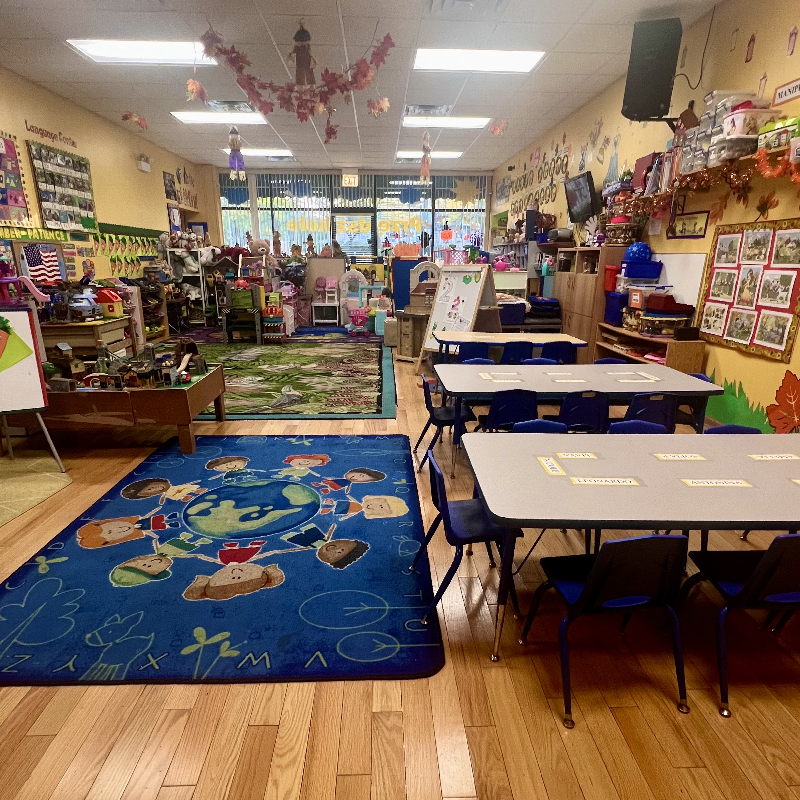
For families on Chicago’s Northwest Side looking for an enriching early learning environment, Fantasy Island Schools for Kids offers a balanced approach to early childhood education. Founded in 2009 by Beata Bielic, our center is located at 6100 N Milwaukee Ave, Chicago, IL 60646. We serve children ages 2 to 6 across neighboring communities, including Norwood Park, Edison Park, Gladstone Park, Jefferson Park, Sauganash, Edgebrook, Portage Park, Niles, Park Ridge, Skokie, Norridge, and Harwood Heights.
Operating Monday through Friday from 7:00 AM to 6:00 PM with full-time and part-time options, our curriculum is designed to support natural learning styles. Our program features:
- A dedicated Gifted Enrichment Program tailored to foster early problem-solving, mathematical thinking, and spatial logic.
- A multilingual learning environment staffed by native Polish and English educators, offering children the cognitive advantages of early bilingual exposure.
- An expansive multi-sensory play space designed for hands-on, active discovery.
- Weekly music classes led by a dedicated music teacher to build early rhythm, memory, and impulse control.
- Freshly cooked on-site meals served daily at no extra charge.
- Certified early childhood teachers trained in First Aid, CPR, and trauma-informed care.
With weekly tuition typically ranging from $300 to $400 (inclusive of meals, music, and gifted programming), our school actively accepts CCAP (Illinois Child Care Assistance Program) and Illinois Action for Children subsidies to help make quality education accessible. Many of our graduates successfully go on to enter Chicago public school gifted and selective enrollment programs.
Whether you are navigating milestone checkups at home or exploring early learning centers, every conversation, song, puzzle, and pretend game you share with your child contributes directly to their developing mind. To learn more about our programs or to schedule a tour, visit Enrolling in Gifted Early Education at Fantasy Island Schools for Kids.
