

Enrichment Activities That Challenge Gifted Preschoolers Through Play
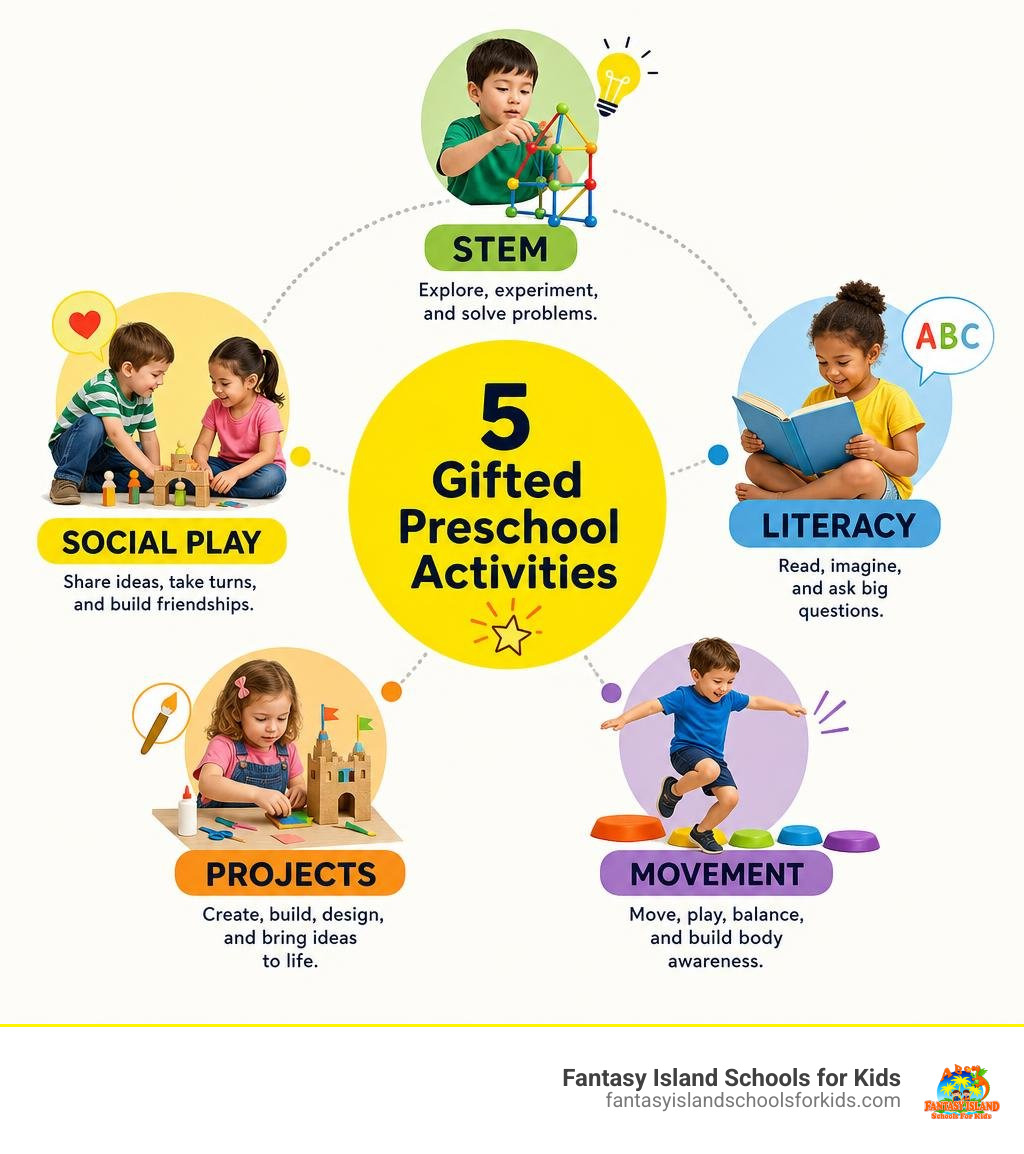
Activities for gifted preschoolers work best when they combine real challenge with hands-on play, conversation, movement, and time to rest. Look for activities that let your child ask questions, test ideas, create something new, and try again when the first attempt does not work.
Quick examples include:
- Building complex block structures, ramps, bridges, and patterns
- Sorting objects by more than one rule, such as size, color, and shape
- Reading nonfiction books and discussing big questions
- Playing clue-making, scavenger hunt, and strategy games
- Conducting simple science tests with magnets, water, plants, or shadows
- Exploring a strong interest through library books, art, maps, and local outings
Gifted preschoolers may learn quickly, use unusually detailed language, notice patterns early, or become deeply focused on a favorite topic. But advanced thinking does not mean they need constant instruction. Young children still need imaginative play, outdoor movement, friendships, predictable routines, and screen-free downtime.
I am Beata Bielic, Executive Director of Fantasy Island Schools for Kids, founded in 2009 in Chicago, and I have spent more than 17 years supporting early learners through experiential, multilingual education. In this guide, I will share practical activities for gifted preschoolers that build curiosity while supporting the whole child.
Understanding Early Identification and Cognitive Needs
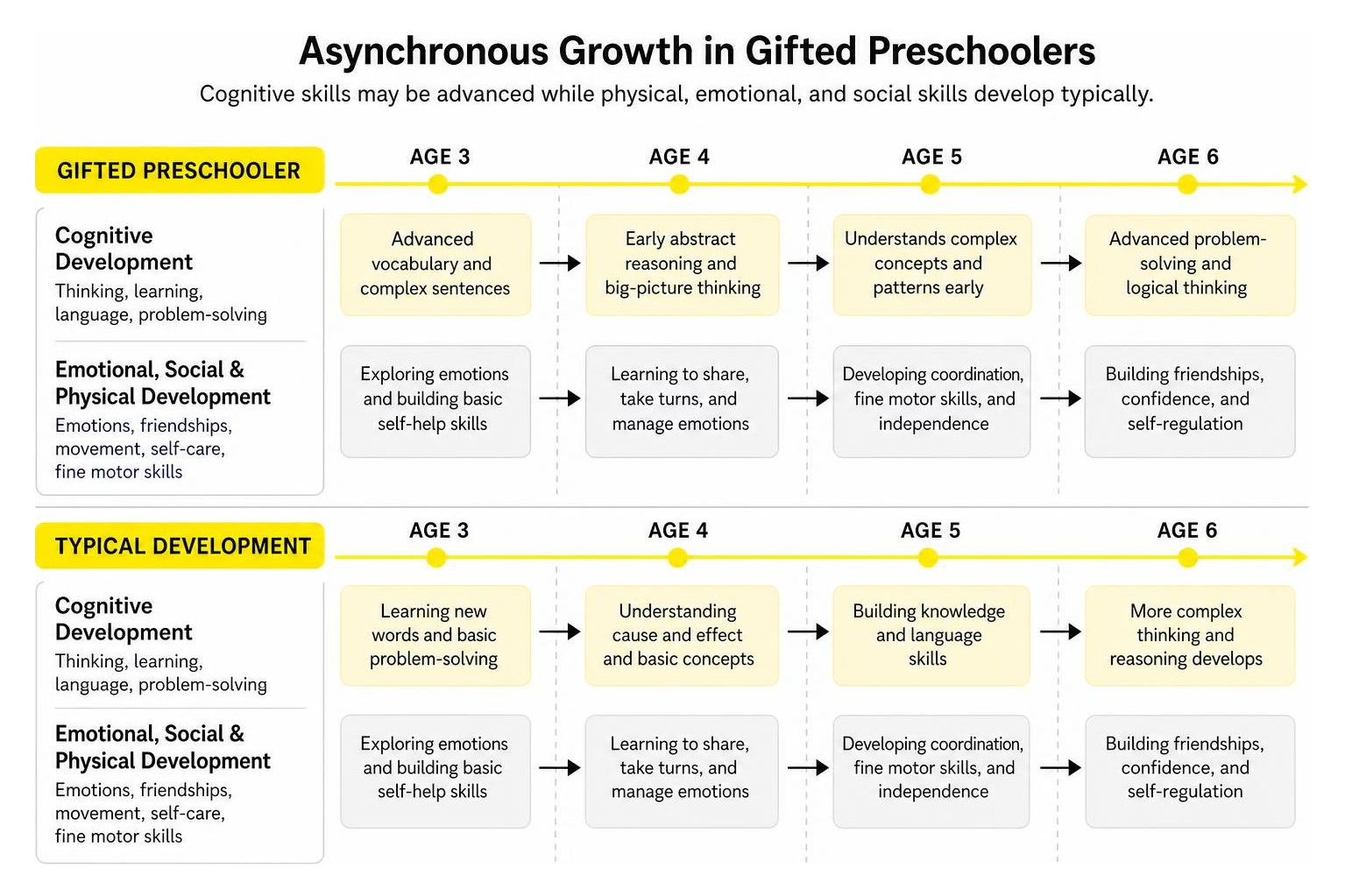
Understanding how early childhood development unfolds in exceptionally bright children is the first step toward finding the right activities for gifted preschoolers. Research shows that more than 80% of parents can identify their child’s giftedness by age 4 or 5. Intellectually gifted children generally score in the top 5% in intelligence, but their development is often asynchronous. A 3- or 4-year-old might possess the vocabulary and abstract reasoning of an 8-year-old, while still processing emotions and fine motor skills like a typical toddler.
When parents understand these distinct traits, they can better evaluate what are the benefits of a gifted curriculum? for their child’s unique growth. Feeding simple, repetitive information to a highly capable child is like feeding an elephant one blade of grass at a time—it simply does not satisfy their intellectual hunger.
Informal Identification at Home
Parents are often the first to notice signs of early giftedness long before formal schooling begins. You might notice your 3-year-old skipping standard developmental speech benchmarks to speak in complex, complete sentences. During everyday errands—like a trip to the local grocery store—a gifted preschooler might read aisle signs, notice price differences, compare weight measurements, or ask detailed questions about international fruit transportation.
Observing how your child interacts with their surroundings gives you vital clues about their need for deeper intellectual stimulation at home and in Pre-K.
Formal Psychometric Evaluation
When families seek formal confirmation to guide educational choices, standardized assessments can provide clear insights. The Wechsler Preschool & Primary Scales of Intelligence (WPPSI) is specifically designed and normed for children ages 2.5 to 7.6 years old and has been trusted in early childhood education for over 50 years.
Other tools, such as the Stanford-Binet V, can reliably evaluate intellectual capabilities starting as early as age 2.5. Formal testing helps pinpoint a child’s unique cognitive profile, identifying spatial, verbal, and logical strengths so educators and parents can tailor activities to match their exact pace.
High-Impact STEM and Logic Activities for Gifted Preschoolers

Science, technology, engineering, and mathematics (STEM) activities offer ideal opportunities for young learners to test hypotheses, analyze outcomes, and build logical reasoning skills. Highly capable early learners crave more than simple mechanical toys; they want to understand cause-and-effect relationships and master structural principles. Integrating structured 8 Engaging Pattern Games for Preschoolers into daily routines keeps early mathematical thinking vibrant and hands-on.
Spatial Reasoning and Geometry Activities for Gifted Preschoolers
Spatial intelligence directly supports future mathematical performance. Gifted young learners thrive when introduced to complex 2D and 3D geometric concepts early.
- 3D Shape Building: Move beyond simple flat shapes by introducing spheres, cylinders, cubes, and triangular prisms. Provide playdough for corners (vertices) and wooden sticks for edges, encouraging children to construct 3D towers and bridges.
- Multi-Attribute Sorting: Lay out hula hoops to create interactive Venn diagrams on the floor. Ask your child to sort buttons, blocks, or leaves by multiple criteria simultaneously, such as “red AND circular” or “smooth AND green.”
- Pattern Extension and Growing Patterns: Challenge your child to identify, extend, and construct repeating patterns (AB, AAB, ABC) as well as growing plus-one block towers.
Connecting 2D faces to 3D objects through hands-on geometry play provides rich spatial training. Explore detailed spatial games in Shape Activities for Preschoolers: Hands-On Geometry Fun, and learn more about how the amazing ways preschool expands children’s brains through early geometric mastery.
Scientific Inquiry and Experiential Learning
Scientific thinking in early childhood should focus on genuine inquiry, observation, and experimentation rather than memorizing dry facts.
- Germ UV Light Test: Teach hygiene and microbiology by applying washable fluorescent lotion to your child’s hands and using a safe ultraviolet light to reveal “invisible germs.” Have them wash with soap and re-examine under the light to observe the results.
- Hands-On Tinkering: Provide safe safety goggles and child-safe tools to let your child carefully disassemble old, broken household electronics (such as an inactive computer keyboard or clock). Exploring inner gears, circuit boards, and wires satisfies deep curiosity about mechanical systems.
- Photosynthesis & Botanical Science: Place clear plastic cups with damp cotton and seeds near light sources, varying water levels and light exposure to track sprout development, introducing terms like photosynthesis and chlorophyll naturally.
Literacy, Language, and Physical Play Enrichment

Language development in gifted early learners often outpaces physical handwriting capability. Enrichment activities should encourage rich vocabulary, perspective-taking, and semantic comprehension through interactive play. Games like Little Clue Maker for Toddlers & Preschoolers — TinyStepper reverse traditional roles, empowering children to hide an object and invent descriptive, multi-step clues for parents or classmates to follow.
Relational Vocabulary and Physical Movement
Combining physical movement with vocabulary challenge engages the motor and language systems together, creating stronger neural memory traces for new words.
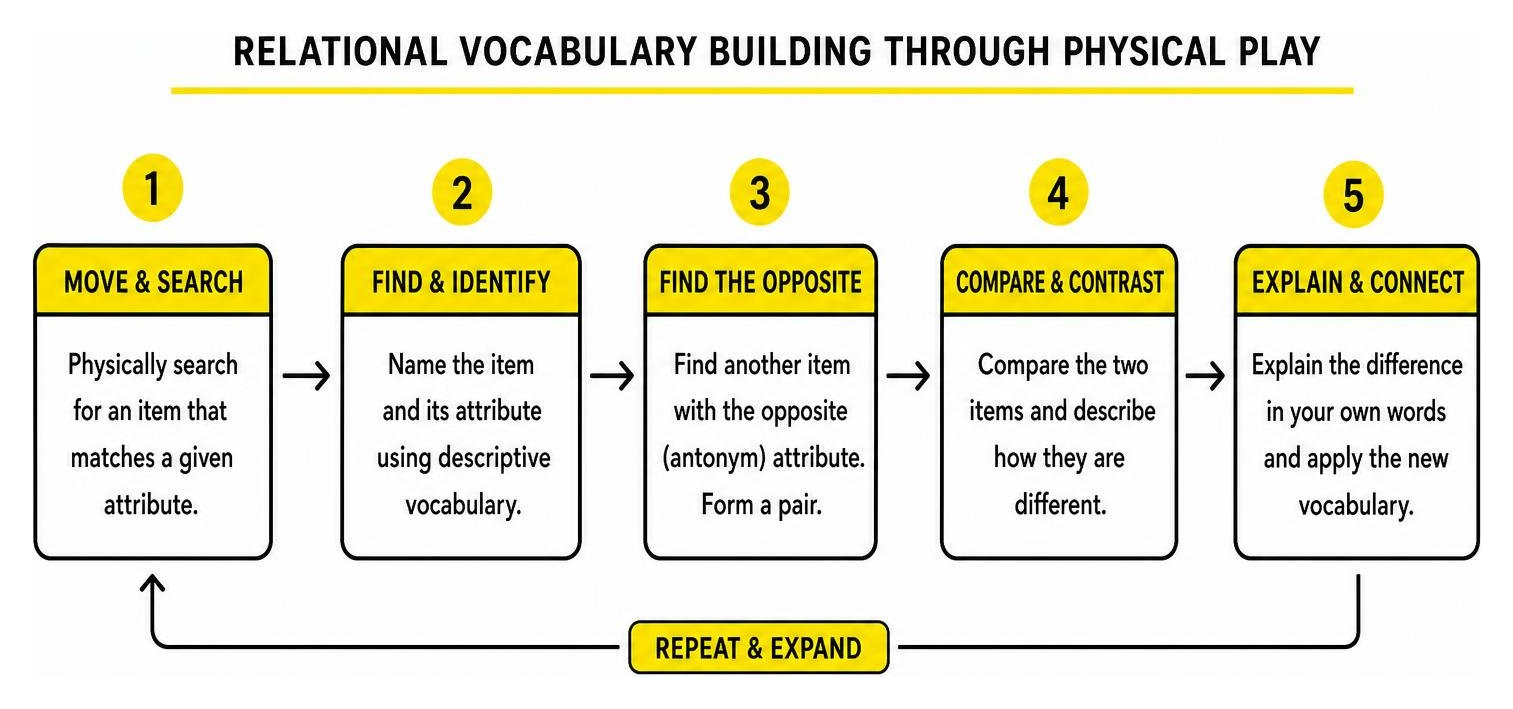
Activities like Opposite Hunt for Toddlers & Preschoolers — TinyStepper encourage children to race through the home or outdoor garden gathering contrasting pairs—such as heavy vs. light, rough vs. smooth, or opaque vs. transparent. Antonym comprehension typically emerges between 30 and 48 months, making active physical scavenger hunts a wonderful way to build semantic knowledge while releasing physical energy.
Interactive Reading and Language Activities for Gifted Preschoolers
Reading with gifted preschoolers works best when treated as an active conversation rather than a passive listening exercise.
- Character Voicing and Dramatic Play: Assign roles during shared book reading where you read the narrator text and your child voices specific character dialogue using distinct vocal tones and emotional expressions.
- Deep Comprehension Bookmarks: Use custom bookmarks featuring open-ended prompts, such as “Why do you think the character made that choice?” or “What would happen if the story had a different ending?”
- Non-Fiction Deep Dives: Stock your home library with high-level non-fiction books on topics like oceanography, architecture, astronomy, or ancient history to satisfy their need for factual background knowledge.
Combining rich literature with open-ended conversation keeps language learning fresh. Discover helpful ideas in Boredom Busters and Ideas for At-Home Learning, and see how early reading accelerates progress when you unlock your child’s potential with best pre-k school.
Deep-Dive Projects, Field Trips, and Technology Balance
Gifted preschoolers frequently develop intense passion interests (such as space travel, marine engineering, or dinosaurs). Supporting these interests through structured sequencing and balanced tools ensures meaningful engagement without mental overload. The Core Knowledge Preschool Sequence highlights how organizing learning content sequentially helps young children build enduring cumulative knowledge.
| Activity Type | Key Benefits | Best Tools & Examples | Recommended Pacing |
|---|---|---|---|
| Tactile Projects | Fine motor skills, spatial depth, sensory processing | DIY Prop Boxes, 3D block builds, real tinkering, nature trays | Daily open-ended play |
| Experiential Outings | Contextual understanding, social dialogue, real-world connection | Local aquariums, behind-the-scenes community visits, park walks | 1-2 outings per week |
| Smart Technology | Visualizing abstract concepts, spatial mapping, introductory coding | NASA telescope feeds, Google Earth exploration, Code.org basics | Short 15-20 min sessions |
Structured Real-World Outings and Passion Projects
Turn simple community outings into rich learning adventures by using a structured six-element framework:
- Purpose & Background Knowledge: Before heading out, discuss what you plan to discover and read a non-fiction book about the topic.
- Destination Outing & Execution: Visit a local bakery, fire station, or science center. Encourage your child to ask staff members their own detailed questions.
- Creative Product & Sharing: Upon returning, help your child build a model, paint a mural, or record a “news anchor broadcast” video describing what they discovered.
These experiential projects show children how academic concepts operate in everyday life. Learn how deep-dive learning prepares children for future academic growth in how preschools shape future academic success.
Smart Technology and Screen-Free Downtime
Technology can open doors to abstract concepts when used intentionally, but it must be balanced with essential brain downtime.
- High-Quality Tech Tools: Use open-access feeds like NASA’s James Webb Space Telescope imagery to view distant nebulas, explore geographical features using Google Earth, or practice basic logic sequencing on child-friendly coding apps.
- Essential Incubation Downtime: Resist the urge to over-schedule every hour of your child’s day. Dedicated, screen-free “incubation time” gives young minds space to daydream, synthesize new information, and invent original ideas independently.
Creating an Environment that Fosters Resilience and Social Growth
Because gifted preschoolers learn quickly, they often run the risk of developing early perfectionism. If activities are always easy, a child may become anxious or reluctant when facing a genuine challenge. Creating an environment that celebrates mistake-making as a natural part of learning builds lifelong resilience and social-emotional confidence. Small classroom settings, like those detailed in Small class preschool Norwood Park better learning, allow educators to give each child personalized attention.
Fostering Safe Failure and Growth Mindset
Encourage safe risk-taking by intentionally introducing activities where success requires multiple iterations.
- Trial-and-Error Engineering: Challenge your child to construct a marble run or bridge using cardboard tubes and tape. When the structure collapses, respond enthusiastically: “Look at what we learned! What can we adjust on our next attempt?”
- Model Curiosity & Emotional Regulation: When you make a mistake, name it aloud and demonstrate how to remain calm, adjust your approach, and try again.
- Cooperative Board Games: Play strategy board games where winning relies on strategic planning, helping children practice turn-taking, fair play, and managing disappointment constructively.
Choosing the Right Gifted Preschool Environment
Finding the right early learning setting ensures your child receives both intellectual acceleration and essential social-emotional grounding. Look for programs offering:
- Differentiated & Accelerated Pacing: A flexible curriculum that scales depth and complexity up or down based on individual developmental readiness.
- Multilingual Language Exposure: Research confirms that early immersion in foreign languages (such as Polish or Spanish) enhances cognitive flexibility, problem-solving ability, and executive functioning in young minds.
- Small Class Sizes & Trained Educators: Classrooms led by certified early childhood educators who understand asynchronous development, double-exceptionality (2e), and social-emotional needs.
If you are exploring local options, review guides on the Best private preschools in Chicago and explore comprehensive Preschool programs in Chicago to find the right fit for your family.
Frequently Asked Questions About Gifted Preschoolers
How can I tell if my 3- or 4-year-old is intellectually gifted?
Gifted preschoolers often demonstrate rapid milestone progression, complex language, early pattern recognition, deep focus, and an insatiable curiosity about abstract topics like time, space, or mechanics. Parents frequently recognize these traits by ages 4 to 5 during daily conversations and routine activities.
How do I prevent boredom in a gifted preschooler without over-scheduling them?
Focus on deep, open-ended activities rather than packed schedules. Provide creative prop boxes filled with recycled building materials, offer rich strategy games, visit local science museums, and protect daily “incubation downtime” where your child can daydream and direct their own play without screens.
What should parents look for in a preschool program for gifted young learners?
Look for small class sizes, experienced teachers trained in early child development, an experiential curriculum that offers individual learning acceleration, multilingual language enrichment, and a warm environment that prioritizes social-emotional resilience alongside academic challenge.
Conclusion
Nurturing a gifted preschooler is a rewarding journey that blends intellectual challenge with warm emotional encouragement. By providing engaging activities for gifted preschoolers – from hands-on spatial puzzles and physical vocabulary hunts to deep-dive community field trips – you build a strong foundation for lifelong learning while honoring their fundamental need to play, explore, and rest.
At Fantasy Island Schools for Kids, founded in 2009 by Beata Bielic and located at 6100 N Milwaukee Ave, Chicago, IL 60646, we believe every bright young learner deserves an inspiring environment tailored to their unique pace. We serve families across Chicago’s Northwest Side and surrounding suburbs, including Norwood Park, Edison Park, Gladstone Park, Jefferson Park, Sauganash, Edgebrook, Portage Park, Niles, Park Ridge, Skokie, Norridge, and Harwood Heights.
Our programs serve children ages 2 to 6 with flexible full-time and part-time options, operating Monday through Friday from 7 AM to 6 PM. With tuition ranging around $300-$400 per week, families enjoy comprehensive enrichment including our specialized Gifted Enrichment Program, weekly music lessons with a dedicated music teacher, multilingual immersion in Polish and English, and freshly cooked on-site meals at no extra cost. We also accept CCAP (Illinois Child Care Assistance Program) and Illinois Action for Children; families can contact the school or Illinois Action for Children for details about assistance. Visit our Preschool page to schedule a tour and see how our curriculum is designed to help your child thrive!
