

Updated October 2026. CPS Pre-K applications for 2026-27 are open through Chicago Early Learning.
Free Preschool Chicago: A Quick Starting Point
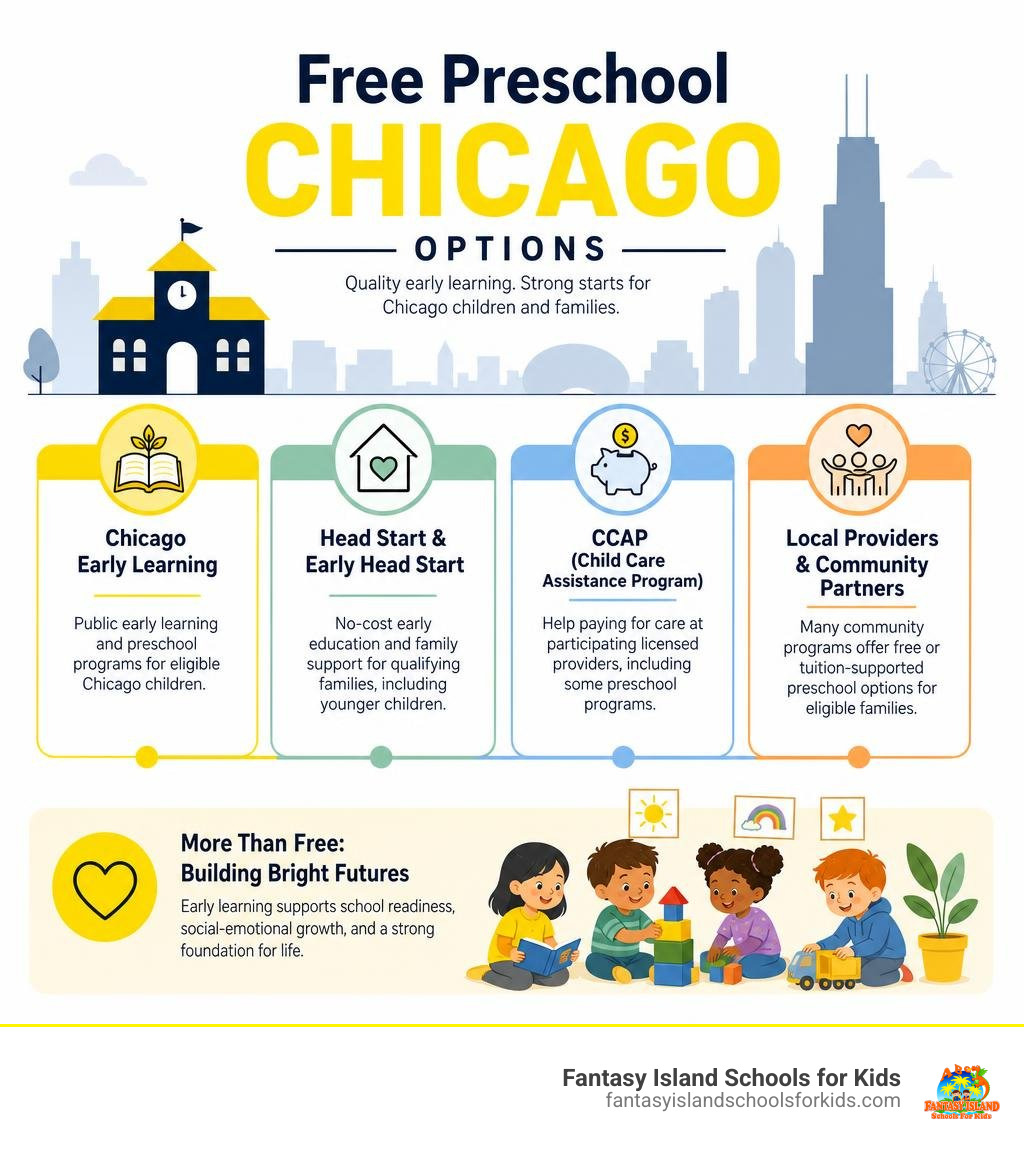
Free preschool Chicago options may be available through Chicago Early Learning programs, Head Start, and child care assistance such as Illinois’ Child Care Assistance Program (CCAP). Availability, eligibility, and enrollment dates vary by your child’s age, household income, and the program you choose.
| Where to start | What it may help with |
|---|---|
| Chicago Early Learning | Public early learning and preschool programs for eligible Chicago children |
| Head Start and Early Head Start | No-cost early education and family support for qualifying families, including younger children |
| CCAP and Illinois Action for Children | Help paying for care at participating licensed providers, including some preschool programs |
Finding the right setting is about more than cost. You may also want to compare safety, hours, teacher experience, meals, language support, and whether the program fits your family’s work schedule. This guide explains the main pathways, how Illinois Action for Children helps families and providers, and where to look for local enrollment support.
I am Beata Bielic, Executive Director of Fantasy Island Schools for Kids, founded in 2009 at 6100 N Milwaukee Ave in Chicago. With more than 17 years in early childhood education, I have helped families understand free preschool Chicago pathways, including CCAP and Illinois Action for Children support, while choosing care that fits their child’s needs.
Overview of Free Preschool Chicago Programs and Illinois Action for Children
Navigating early learning options across Chicago can feel overwhelming when you are trying to balance work schedules, family budgets, and educational quality. Fortunately, Chicago families have access to robust early care networks designed to make quality early childhood education accessible for children from birth to age five. A central engine behind many of these opportunities is Illinois Action for Children, a foundational advocacy and support organization originally established in 1969 as the Day Care Crisis Council of Metropolitan Chicago by community leader Sylvia Cotton.
Today, Illinois Action for Children helps connect tens of thousands of working families with vital early childhood resources. The organization supports nearly 200,000 children and families every year—including 197,561 families directly guided toward high-quality early care and education opportunities. Across all direct programs and systemic support services, over 107,000 children benefit from their administrative and community work annually.
When parents search for free preschool Chicago choices, they usually discover two primary routes:
- Directly funded public programs: Citywide initiatives like Chicago Early Learning, Preschool for All (PFA), and federal Head Start or Early Head Start classrooms operating within public schools and community centers.
- Childcare subsidies (CCAP): State-supported funding managed through Illinois Action for Children that helps eligible families pay for care at licensed private preschools and early learning centers.
Exploring comprehensive Preschool Programs in Chicago reveals how these state and local initiatives work together so every young learner gets off to a confident start.
Early Learning Pathways in Free Preschool Chicago Communities
To choose the right path, it helps to understand how different early childhood programs operate across Chicago’s diverse neighborhoods:
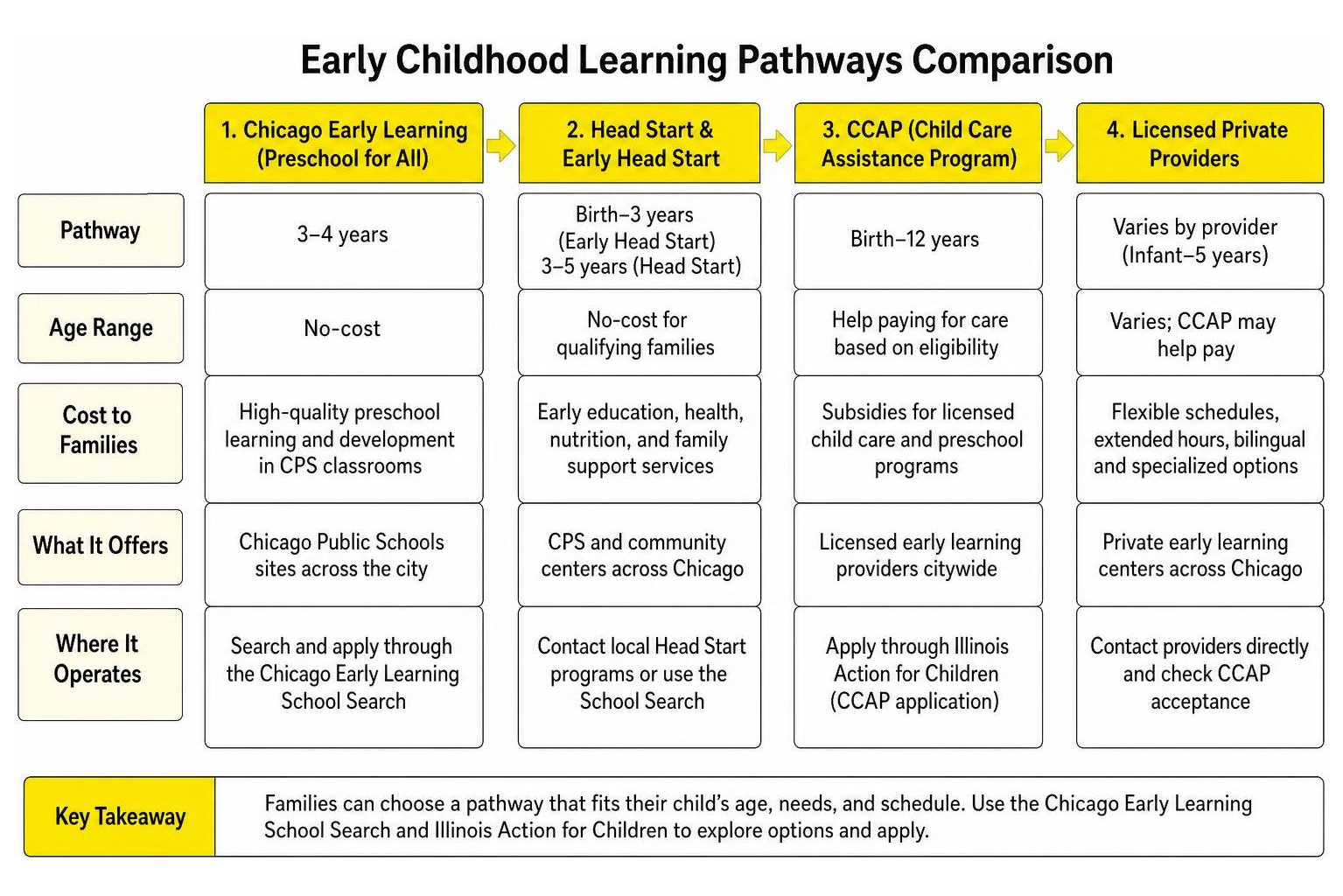
- Chicago Early Learning (Preschool for All & Head Start): These programs primarily serve children aged 3 and 4 (and birth to 3 for Early Head Start). Hosted in Chicago Public Schools (CPS) as well as community-based organizations, these classrooms follow rigorous early childhood learning standards focused on literacy, math, emotional growth, and social development.
- Subsidized Licensed Early Learning Centers: Many families require full-day coverage, extended hours (such as 7 AM to 6 PM), or specialized environments like bilingual instruction and smaller class sizes that public school schedules might not offer. Licensed centers accepting the Child Care Assistance Program (CCAP) allow families to apply state assistance toward full-time or flexible part-time care. Looking into options like Chicago Preschool Part-Time Daycare Programs helps parents find schedule combinations that work seamlessly for working households.
How to Search and Enroll in Free Preschool Chicago Options
Finding a program close to home starts with exploring centralized city resources and local community options. The primary portal for citywide public programs is the official School Search | Chicago Early Learning tool.

When using online search tools and preparing applications, keep the following guidelines in mind:
- Filter by location and age: Enter your home address or work ZIP code to see nearby options in neighborhoods like Norwood Park, Jefferson Park, Portage Park, or Edison Park.
- Review schedule models: Check whether programs offer half-day (typically 2.5 to 3 hours) or full school-day (around 6 to 7 hours) schedules. If you need extended coverage before 8 AM or after 3 PM, subsidized licensed private centers are often ideal.
- Gather required document copies: Prepare proof of Chicago residency (utility bills, lease), child’s proof of age (birth certificate), and proof of household income (recent pay stubs, tax documents).
- Explore community-based choices: Do not hesitate to visit local licensed centers in person. Touring classrooms gives you direct insight into teacher qualifications, cleanliness, daily curriculum, safety protocols, and meal programs.
How Families Find and Apply for Free Early Learning Close to Home
Securing high-quality early education close to home brings immense peace of mind. For working parents across Northwest Chicago and surrounding suburbs like Niles, Skokie, Park Ridge, Norridge, and Harwood Heights, convenience and warm, personalized care are top priorities.
While public school preschool programs offer fantastic seasonal classrooms, many parents discover that tuition assistance through CCAP allows them to enroll their children in comprehensive licensed early learning centers offering extended care hours, freshly prepared meals, and rich enrichment activities.
Navigating Local Programs and CCAP Subsidies
The Illinois Child Care Assistance Program (CCAP) helps eligible working or student parents afford high-quality child care and preschool education. Managed regionally in Cook County by Illinois Action for Children, CCAP bridges the gap between household budgets and the actual cost of professional early childhood care.
Eligibility for CCAP is generally determined by household income, family size, and qualifying parent activity (such as working, attending college, or participating in vocational training). Rather than capping options at public school hours, approved CCAP funds can be applied toward participating licensed private programs.
Because state eligibility criteria, income thresholds, and co-pay structures are updated regularly by state administrators, we always recommend reaching out directly to child care providers or contacting Illinois Action for Children for exact application details and current qualification guidelines. At Fantasy Island Schools for Kids, we proudly accept CCAP and Illinois Action for Children assistance, assisting parents step-by-step through the application and documentation workflow.
Utilizing Chicago Early Learning Resources
Beyond online application portals, families can take advantage of neighborhood community hubs and localized application support:
- Community Referral Specialists: Illinois Action for Children operates family resource centers where parents can sit down with specialists to review local center openings, CCAP paperwork, and child development resources.
- Family Engagement & Home Visits: Certain Early Head Start and local early learning programs offer home visiting options or parent coaching, connecting parents with early literacy activities and child wellness guidance.
- In-Person Site Visits: Nothing replaces touring a school yourself. When evaluating centers in communities like Gladstone Park, Sauganash, or Edgebrook, ask directors about teacher credentials, First Aid/CPR certifications, staff retention, child-to-teacher ratios, and daily communication methods.
Advocacy, Policy, and Research Driving Early Education Access
Expanding access to free preschool Chicago opportunities requires ongoing legislative support, community advocacy, and actionable research. Quality early education does not happen by accident; it takes deliberate investment and strong policies to ensure every neighborhood has high-quality learning environments.
Systemic Policy Reform and Advocate Coalitions
Illinois Action for Children plays a leading role in pushing state and local government for systemic early childhood reform. Through its advocacy network, over 8,868 dedicated advocates—including parents, educators, and civic leaders—work to educate public officials on the critical importance of early learning funding.
Key advocacy goals driving early education access include:
- Increasing state funding allocations: Securing higher reimbursement rates for providers so centers can attract and retain master-degreed, trauma-informed educators.
- Streamlining CCAP access: Lowering bureaucratic hurdles for working families so child care approvals happen faster and with less stress.
- Expanding birth-to-five infrastructure: Ensuring state investments cover infancy through age five, bridging the gap before kindergarten entry.
- Centering community voices: Bringing parent experiences directly into policy discussions in Springfield and City Hall.
Research-Driven Insights and Provider Investment
Policy decisions are strongest when backed by rigorous real-world data. Research conducted by early childhood policy groups highlights exactly where additional investments produce the greatest impact for children.
When surveyed on funding priorities, child care providers and community leaders consistently emphasize three main areas for increased investment:
- Teacher compensation and professional development: Ensuring early educators earn competitive wages matching their vital role in brain development.
- Facility enhancements and multi-sensory spaces: Investing in safe, modern indoor and outdoor play spaces that ignite children’s curiosity and physical growth.
- Comprehensive family services: Providing multi-lingual support, developmental screenings, and healthy nutritional programs directly within early learning centers.
Financial transparency is essential in this work: 90 cents of every dollar donated or granted to Illinois Action for Children directly supports these early childhood programs, policy advocacy, and community research.
Community Events, Provider Support, and Family Involvement
Building a thriving early education ecosystem requires supporting the entire community—giving teachers top-tier resources, providing parents with developmental tools, and creating fun community gathering spaces.
Educator Resources and Professional Development
High-quality preschool classrooms rely on well-supported teachers. Through targeted provider services, early learning organizations deliver vital professional development, health and safety workshops, and classroom quality grants to local child care centers.
Currently, over 1,300 young children from birth to age five receive direct, high-quality care through specialized early learning partner programs supported by these community initiatives. Educators receive ongoing training in:
- Trauma-informed care practices: Helping children build emotional resilience and self-regulation in a safe, nurturing setting.
- Multilingual learning strategies: Supporting dual-language learners so children retain home languages while acquiring fluent English skills.
- Gifted enrichment techniques: Implementing experiential, play-based curricula that challenge children’s problem-solving skills and critical thinking.
Parent Workshops and Community Engagement
Parent involvement is one of the strongest predictors of a child’s long-term academic success. Initiatives like Parent University Chicago-West bring families together for free educational workshops, child development resources, and community networking.
Parents can get involved in expanding early childhood quality by:
- Attending family learning events: Joining free neighborhood workshops on positive guidance, early literacy, transition to kindergarten, and healthy childhood nutrition.
- Joining advocate networks: Sharing their early child care stories with legislators to help protect state funding for CCAP and public pre-K.
- Volunteering and supporting local programs: Partnering with neighborhood early learning centers for seasonal open houses, cultural celebrations, and holiday events.
Frequently Asked Questions About Free Early Education in Chicago
How do Chicago families qualify for free early childhood education programs?
Qualification depends on the specific program route you select:
- Chicago Early Learning / Preschool for All (PFA): Free 4-year-old pre-K in public schools is widely available, with priority placement based on income, community need, and developmental factors.
- Head Start / Early Head Start: Eligibility is primarily based on household income falling at or below federal poverty guidelines, as well as specific family need criteria.
- Child Care Assistance Program (CCAP): Working or student parents qualify based on family size, monthly household income, and weekly activity hours. Rather than checking fixed charts online, parents are encouraged to contact licensed providers or Illinois Action for Children directly to determine exact eligibility and application steps.
What role does Illinois Action for Children play in local preschool access?
Illinois Action for Children acts as the central administrative and advocacy hub for early care in Cook County. They manage CCAP subsidy applications, connect parents with local child care referrals, offer professional development and grants to child care providers, and advocate for state-level legislative policies that increase early childhood funding across Illinois.
How can parents participate in community learning events and workshops?
Parents can register for free workshops, local family fairs, and Parent University sessions through Illinois Action for Children’s community calendar or by asking their local preschool director. Many events offer complimentary meals, child-friendly learning activities, and valuable take-home developmental resources.
High-Quality, Affordable Early Education at Fantasy Island Schools for Kids
While exploring public free preschool Chicago choices, many families discover that their work schedules demand flexible 7 AM to 6 PM hours, language support for children who speak Polish or Ukrainian, or specialized gifted enrichment. That is where Fantasy Island Schools for Kids provides the perfect solution.
Founded in 2009 by Executive Director Beata Bielic, Fantasy Island Schools for Kids is located at 6100 N Milwaukee Ave, Chicago, IL 60646. We proudly serve families across Chicago’s Northwest Side and surrounding communities, including Norwood Park, Edison Park, Gladstone Park, Jefferson Park, Sauganash, Edgebrook, Portage Park, Niles, Park Ridge, Skokie, Norridge, and Harwood Heights.
Our school offers full-time and part-time enrollment options for children ages 2 to 6, operating Monday through Friday from 7:00 AM to 6:00 PM. We believe top-tier early childhood education should be accessible and affordable for working parents. Weekly tuition ranges between approximately $300 and $400 per week—and that tuition is truly all-inclusive, covering:
- Freshly cooked on-site meals prepared daily at no extra charge.
- Weekly music classes led by a qualified music instructor.
- Our signature Gifted Enrichment Program, designed to ignite intellectual curiosity through hands-on experiential learning.
- Polish- and Ukrainian-speaking teachers, with Polish classes every Friday, so children who speak those languages at home feel supported while they learn in English.
To keep high-quality private pre-K and early education affordable, we fully accept CCAP (Illinois Child Care Assistance Program) and Illinois Action for Children subsidies. Our experienced office team is always happy to guide parents through the documentation process so your family can maximize available state benefits.
Parents frequently tell us how much they appreciate our warm, safe environment, large multi-sensory indoor play space, and exceptional teacher stability. All of our lead teachers hold Early Childhood Education certifications, are First Aid/CPR certified, and receive specialized training in trauma-informed care. Most importantly, many of our graduates consistently transition into top-tier Chicago public school gifted programs and private elementary classrooms with remarkable academic and social confidence.
If you are exploring early childhood options and want to see how state assistance or private enrollment can give your child an extraordinary early foundation, we invite you to learn more about our Affordable Daycare Solutions That Every Chicago Parent Needs to Know or explore our complete Kindergarten curriculum.
Ready to see our vibrant classrooms in action? Contact Beata Bielic and our administrative team today, or visit our Kindergarten Program Page to schedule a tour online now!
Looking for full-day care with meals included? Fantasy Island Schools for Kids accepts CCAP, including families assisted by Illinois Action for Children. See our tuition and CCAP page, our preschool program, or schedule a tour.