

How to Choose a Gifted Child Preschool Curriculum
A strong gifted child preschool curriculum gives your child more than early reading or harder worksheets. Look for a program that follows your child’s interests, lets them move ahead when they are ready, and builds social skills, movement, creativity, and rest into every week.
Start by asking these three questions:
- Does the curriculum offer open-ended math, science, language, art, and music activities with room for deeper questions?
- Can teachers adjust the pace and level of challenge without pushing your child through a rigid grade-level plan?
- Does the day still protect play, friendships, physical activity, and emotional support?
Giftedness at ages 3 to 5 can show up as unusually strong memory, rich vocabulary, intense curiosity, creative problem-solving, or a drive to understand how things work. These signs are useful, but no single behavior or test tells the whole story. The best early-learning settings observe children over time and create inviting, hands-on experiences where different strengths can appear.
A thoughtful curriculum treats young advanced learners as children first. Your child may be ready for complex ideas while still needing help with turn-taking, handling frustration, or taking a movement break. The goal is not to rush childhood. It is to offer the right amount of challenge, choice, and support.
I am Beata Bielic, Executive Director of Fantasy Island Schools for Kids, which I founded in 2009 at 6100 N Milwaukee Ave in Chicago. With a master’s degree in psychology and more than 17 years in early childhood education, I help guide an experiential gifted child preschool curriculum designed for children ages 2 to 6.
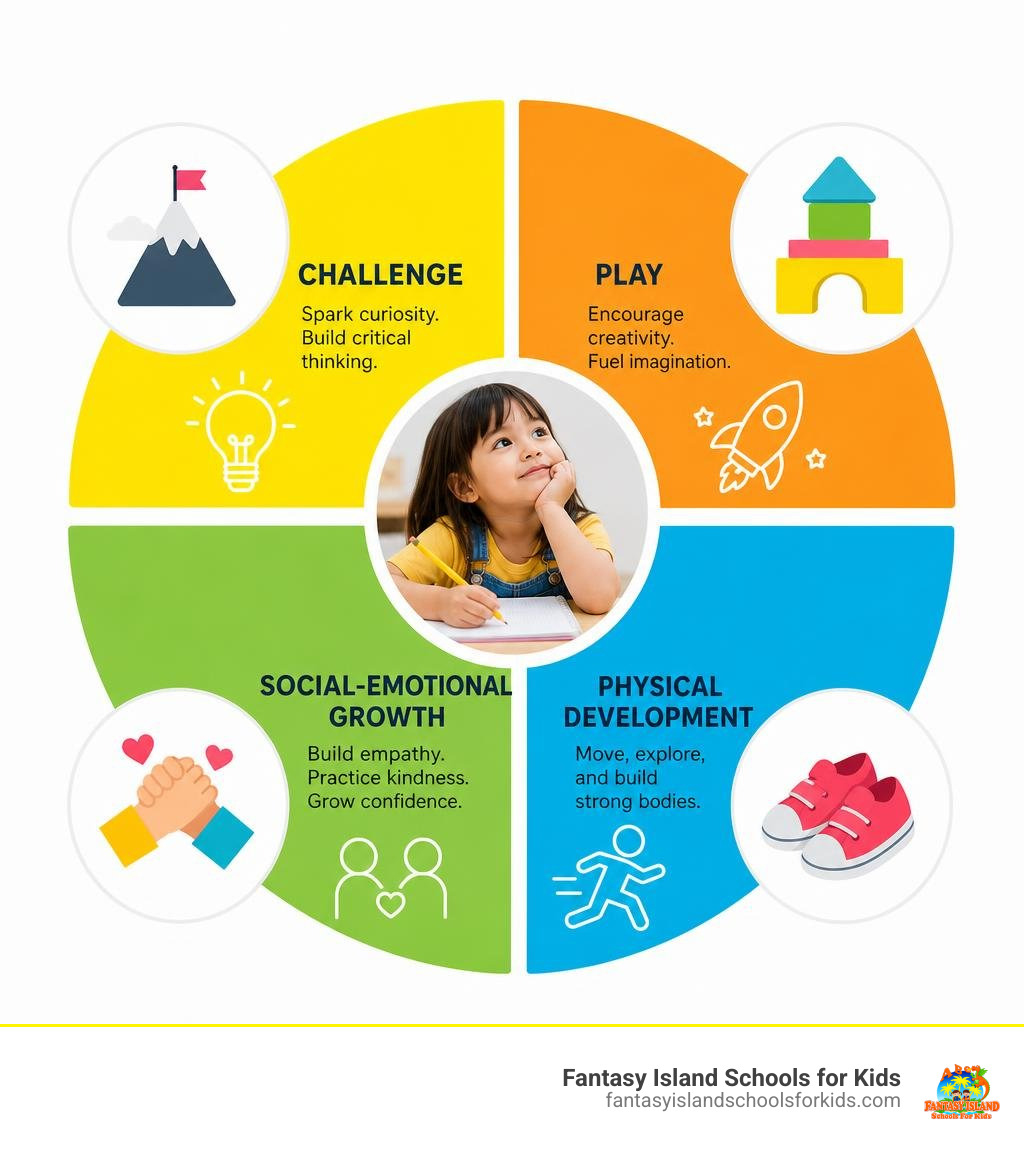
Gifted child preschool curriculum terms simplified:
Identifying Advanced Learners and Early Cognitive Milestones
Recognizing advanced cognitive development in early childhood begins with careful observation. More than 80% of parents can identify their child’s giftedness by age 4 or 5, often noticing that their child grasps concepts rapidly or connects ideas in unexpected ways. While standard milestones provide a helpful baseline, gifted children—generally falling within the top 5% of cognitive development—frequently master foundational skills far ahead of traditional schedules.
Understanding these patterns is easier when parents and educators track the definitive guide to toddler cognitive development milestones. When a 3-year-old begins sorting objects by multiple abstract attributes, understanding cause-and-effect relationships, or asking deep questions about the natural world, standard developmental screenings need to adapt to capture that child’s true cognitive baseline.
Formal assessments, such as the Wechsler Preschool & Primary Scale of Intelligence (WPPSI)—which is normed for children ages 2.5 to 7.6 years old and has been utilized for over 50 years—along with the Stanford-Binet V and Woodcock-Johnson IV, can offer standardized insight for children as young as age 2. However, early childhood educators understand that standardized testing is only one piece of the puzzle. Young children thrive when assessment is embedded organically within daily play and experiential discovery.
Behavioral and Assessment Indicators for Early Giftedness
Young gifted children exhibit a distinct set of behavioral traits that set them apart from age-level expectations. Rather than merely memorizing facts, they demonstrate a drive for comprehension and synthesis.
Key indicators frequently include:
- Advanced Vocabulary and Language Structure: Using multi-clause sentences, employing metaphor, or asking precise questions about abstract topics.
- Rapid Information Processing and Memory: Absorbing instructions instantly and recalling complex events, sequences, or story details weeks later.
- Abstract and Systems Thinking: Asking how mechanical objects operate, exploring time concepts, or identifying patterns in numbers and geometry.
- Intense Focus and Curiosity: Immersing themselves in deep investigations of topics like space, marine biology, or architectural structures for extended periods.
How an Invitational Framework Uncovers Hidden Potential
Traditional testing environments can sometimes overlook the abilities of very young or bilingual children. Research published on The Role of an Invitational Curriculum in the Identification of Giftedness in Young Children highlights how an enriched classroom environment invites children to demonstrate advanced problem-solving naturally.
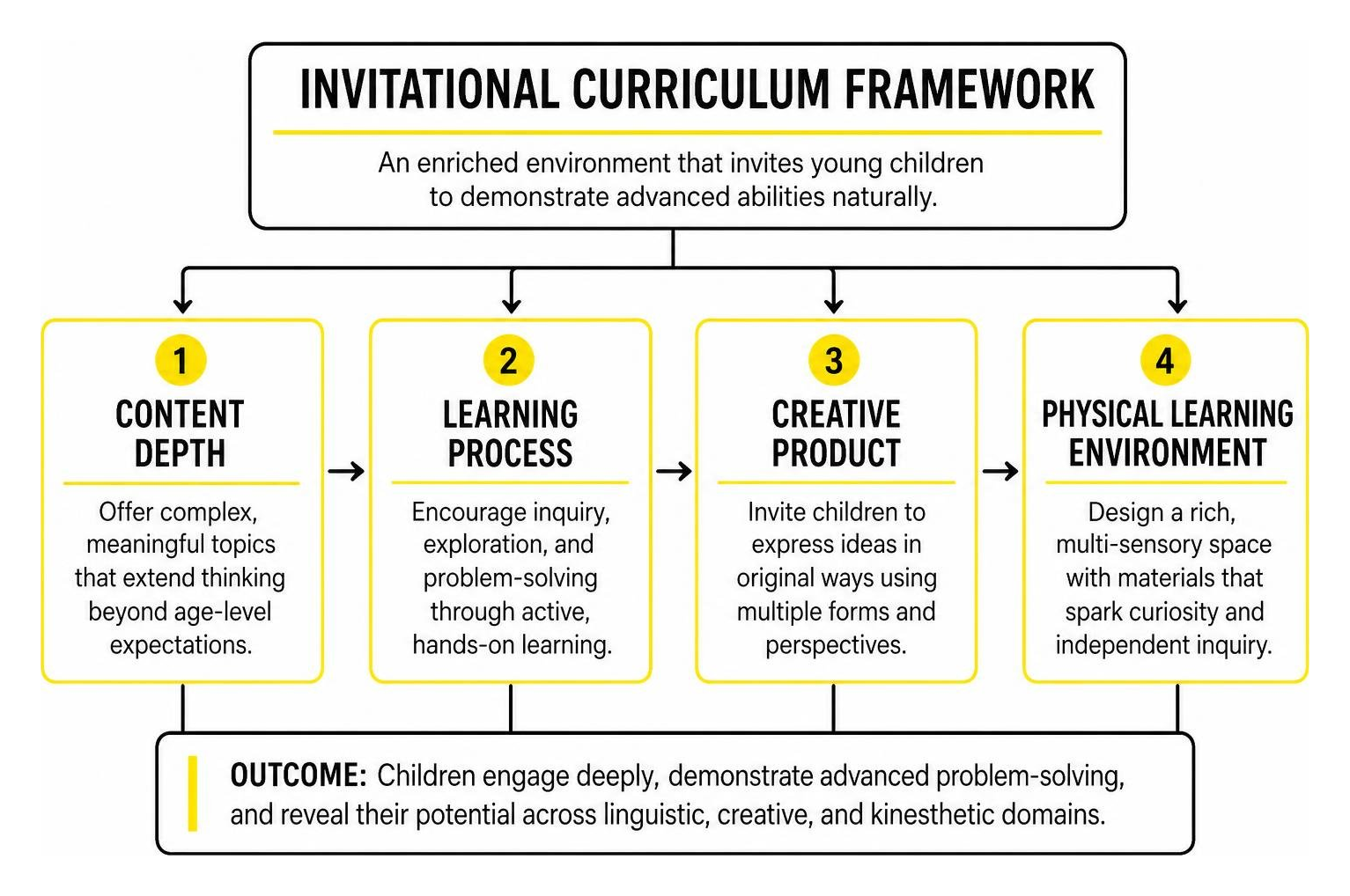
By adjusting four essential dimensions—content depth, learning process, creative product, and the physical learning environment—educators create an inviting space for inquiry. Within multi-sensory learning environments, children can manipulate physical materials, explore tactile and visual problem-solving stations, and direct their own scientific inquiries. This approach ensures that giftedness is nurtured and recognized across linguistic, creative, and kinesthetic domains.
Core Components of a Comprehensive Gifted Child Preschool Curriculum
A comprehensive curriculum for advanced early learners must offer both horizontal enrichment (exploring subjects broadly) and vertical acceleration (moving deeper into complex concepts). Established early education frameworks like the Core Knowledge Preschool Sequence and The Creative Curriculum for Preschool provide strong developmental progressions in literacy, mathematics, and science.
However, when working with gifted preschoolers, these frameworks must remain flexible. Rather than forcing a child to complete repetitive tasks on concepts they have already mastered, teachers use diagnostic teaching to scaffold activities toward higher-order analysis, synthesis, and creative exploration.
Language Learning in a Gifted Child Preschool Curriculum
Rich language learning in early education provides exceptional cognitive enrichment for gifted minds. Young brains possess remarkable neuroplasticity, making early childhood the ideal window for language acquisition.
Research demonstrates that dual-language exposure enhances executive functioning, cognitive flexibility, and working memory. When exploring the complete guide to multilingual education benefits, it becomes clear that switching between languages exercises the brain’s prefrontal cortex.
At Fantasy Island Schools for Kids, English is the language of instruction, and weekly Polish language classes on Fridays give children a taste of a second language. Whether counting during circle time, singing traditional folk songs, or conducting science experiments, our classrooms give advanced learners the vocabulary and challenge their brains crave.
Structuring Experiential Depth Across STEAM and Early Math
Rather than relying on abstract rote drills, advanced early STEM and mathematics instruction should be experiential, multi-sensory, and inquiry-driven. Gifted children benefit from rich thematic investigations, such as those detailed in the curriculum guide Six Units for Primary (K-2) Gifted/Talented Students, which covers botany, zoology, astronomy, and measurement.
| Curriculum Area | Standard Preschool Approach | Gifted Experiential Approach |
|---|---|---|
| Mathematics & Logic | Basic counting to 20, basic shape identification | Pattern rules, non-standard measurement, spatial geometry, early algebraic reasoning |
| Scientific Inquiry | Naming weather types and seasons | Hypothesizing, testing variables, life cycle biology, planetary mechanics |
| Language & Literacy | Single letter-of-the-week phonics recognition | Contextual story creation, multi-language vocabulary, phonetic decoding, oral storytelling |
| Creative Arts & Music | Standard coloring sheets, basic rhythm clapping | Weekly specialized music instruction, open-ended multi-medium art, thematic drama |
Parents can easily integrate these principles at home by using quick and easy toddler math activities, turning everyday grocery sorting, cooking measurements, and block building into rich mathematical investigations.
Comparing Curriculum Models and Educational Approaches for Early Learners
Selecting the right educational model depends on your child’s unique personality and learning style. Navigating our step by step guide to choosing the right preschool options helps families compare how different pedagogical approaches serve advanced thinkers:
- Montessori Method: Offers self-directed learning and concrete sensorial materials, allowing advanced children to move through math and language sequences at their own pace.
- Reggio Emilia Approach: Focuses on project-based, child-led emergent curriculum. It treats the environment as the “third teacher” and encourages deep exploration through arts and natural materials.
- Waldorf Education: Emphasizes holistic, arts-infused, and nature-based play, nurturing imagination and creative expression.
- Experiential Gifted Enrichment: Combines the best elements of project-based inquiry, structured thematic units, language enrichment, and specialized arts instruction to challenge every facet of the child’s development.
Adapting a Gifted Curriculum for Homeschool and Classroom Settings
Whether implementing an enriched framework at home or in an early childhood classroom, flexibility is paramount. Structured resources like the CIRCLE Pre-K Curriculum Teacher’s Manual show how teachers can introduce explicit language and math concepts while leaving room for scaffolding and individualized pacing.
When evaluating a center or choosing a daycare with curriculum, look for educators who act as learning choreographers. Rather than following rigid scripts, skilled teachers assess what each child already understands and tailor upcoming projects to provide the right degree of challenge.
Balancing Academic Acceleration with Social-Emotional Growth

A central reality of gifted early development is asynchronous development—the phenomenon where a child’s cognitive intellect outpaces their emotional or physical maturity. A 4-year-old may read at a second-grade level or calculate complex addition in their head, yet still experience standard preschool meltdowns when a block tower tumbles or when sharing toys.
For this reason, academic acceleration must never eclipse social-emotional learning. We prioritize the proven play based learning benefits because open-ended play is where children develop self-regulation, empathy, peer negotiation, and resilience.
Understanding social emotional development milestones helps parents and teachers support the whole child, ensuring advanced intellect is supported by a secure emotional foundation.
Overcoming Common Pitfalls and Assessing Ongoing Progress
Homeschooling or educating a gifted preschooler comes with unique challenges that require thoughtful strategies:
- Managing Early Perfectionism: Gifted children can become easily frustrated when their fine-motor skills cannot execute the complex ideas in their imagination. Encourage a growth mindset by celebrating effort, curiosity, and productive mistakes.
- Preventing Cognitive Fatigue: Intense curiosity requires substantial mental energy. Ensure the daily routine balances challenging investigations with active physical movement, quiet rest, and nutritious meals.
- Ensuring Qualified Teacher Scaffolding: Advanced learners need educators who understand early gifted behaviors. Checking preschool teacher qualifications ensures that staff hold Early Childhood Education credentials and training in trauma-informed care.
- Maintaining Holistic Engagement: Keep learning fresh by integrating creative enrichment activities for gifted preschoolers, from multi-sensory science labs and obstacle courses to collaborative storytelling.
Ongoing assessment should be qualitative and observational. Rather than relying on rigid tests, maintain learning portfolios, observation logs, and photo documentation to celebrate growth across intellectual, artistic, and social-emotional domains.
Frequently Asked Questions About Gifted Preschool Learning
How do I know if my 3- or 4-year-old needs an advanced curriculum?
If your child exhibits an intense drive to learn, grasps concepts after a single explanation, demonstrates an extensive vocabulary, or displays advanced pattern recognition and spatial skills, they will likely thrive in an enriched, differentiated preschool environment.
Can an advanced preschool curriculum cause academic burnout in young children?
Burnout occurs only when curricula rely on developmentally inappropriate methods, such as repetitive worksheets, rigid testing, or forced memorization. When advanced learning is structured through playful, hands-on, multi-sensory inquiry that respects the child’s stamina, it fosters joy and lifelong curiosity.
What training should teachers have when working with gifted preschoolers?
Educators should possess formal Early Childhood Education certifications, specialized training in recognizing early gifted behaviors, and grounding in trauma-informed care to support the complex social-emotional needs of advanced young learners.
Conclusion
Every gifted child deserves an early childhood experience that honors their curiosity, stretches their intellect, and protects the joy of childhood. At Fantasy Island Schools for Kids, founded in 2009 by Executive Director Beata Bielic, our mission is to provide an enriching, multi-sensory environment where young minds can explore, question, and grow.
Located at 6100 N Milwaukee Ave, Chicago, IL 60646, we proudly serve families across Chicago’s Northwest Side and surrounding communities, including Norwood Park, Edison Park, Gladstone Park, Jefferson Park, Sauganash, Edgebrook, Portage Park, Niles, Park Ridge, Skokie, Norridge, and Harwood Heights.
Our programs serve children ages 2 to 6 with flexible full-time and part-time options, operating Monday through Friday from 7:00 AM to 6:00 PM. Tuition is approximately $300–$400 per week, which includes our Gifted Enrichment Program, weekly specialized music classes, multi-sensory play, Polish and Ukrainian language support, and on-site freshly cooked meals at no additional cost. We proudly accept the Illinois Child Care Assistance Program (CCAP) and Illinois Action for Children to ensure high-quality early education remains accessible.
If you are looking for a warm, stimulating environment tailored to your child’s unique developmental journey, explore our exceptional preschool programs and schedule a tour with our team today!