

Understanding the Preschool Readiness Checklist: What Readiness Really Means
When parents hear the word “readiness,” it is easy to picture flashcards, alphabet drills, and rigid expectations. In early childhood education, genuine readiness is about holistic growth—how your child navigates their feelings, communicates their basic needs, explores their physical environment, and relates to peers.
Every child develops on their own unique timeline. A three-year-old might speak in full, complex sentences but struggle to share toys, while another child might excel at physical coordination yet need extra time to warm up to new adults. A checklist is not a pass-or-fail test; it is an observational tool designed to help you celebrate your child’s emerging strengths and gently nurture areas where they need more practice.
Evaluating your child should happen naturally during daily routines and open-ended play rather than formal desk-based assessments. For broader benchmarks, you can reference early learning readiness guidelines from the Illinois Early Learning Project to see how state frameworks support whole-child development.
| Developmental Area | Typical 3-Year-Old Milestones | Typical 4-Year-Old Milestones |
|---|---|---|
| Social & Emotional | Plays alongside peers (parallel play); begins simple sharing with adult prompting. | Engages in interactive, cooperative play; shows basic empathy and takes turns. |
| Communication | Speaks in 3–4 word sentences; follows simple 2-step directions. | Speaks clearly in 4–6 word sentences; narrates simple stories and asks “why” questions. |
| Self-Care | Attempts handwashing; assists with dressing; working on potty training. | Washes and dries hands independently; manages simple clothing fasteners; mostly bathroom independent. |
| Motor Skills | Stacks 6+ blocks; runs with balance; scribbles with whole-hand grasp. | Cuts along straight lines with safety scissors; hops on one foot; uses a 3-finger pencil grip. |
| Cognitive Concepts | Identifies primary colors; matches basic shapes; engages in simple pretend play. | Counts objects up to 10; sorts by multiple attributes (size/color); creates complex imaginative scenarios. |
Essential Developmental Domains to Assess Before Day One
A comprehensive assessment looks at the whole child across several interconnected domains. Rather than focusing solely on early academic concepts, early childhood educators look closely at how a child regulates their body, navigates social dynamics, and manages personal independence throughout a typical preschool day.
Social-Emotional Skills on the Preschool Readiness Checklist
Social and emotional maturity forms the true foundation for classroom learning. Long-term academic success is deeply tied to early social-emotional competence because children learn best when they feel safe, secure, and connected to those around them.
When evaluating this domain, look for these key milestones:
- Separation tolerance: Can your child separate from you with the help of a trusted caregiver or teacher, settling into classroom activities after a brief transition period? Implementing effective strategies for easing separation anxiety at home can make these morning drop-offs much smoother.
- Peer interaction and turn-taking: Does your child show curiosity about other children, engage in parallel or cooperative play, and wait a short time (1–2 minutes) for a shared toy?
- Emotional expression and regulation: Can your child use words or gestures to express frustration, joy, or anger rather than resorting solely to physical outbursts?
- Cooperation with adults: Does your child listen to guidance from familiar adults and show a willingness to follow simple group routines?
Communication and Language Milestones
Preschool classrooms are lively, communicative environments where children express their needs, listen to engaging stories, and build friendships.
Key expressive and receptive language milestones include:
- Expressing basic needs: Speaking clearly enough for familiar and unfamiliar adults to understand basic requests (“I need water,” “Help please,” or “I have to use the bathroom”).
- Following multi-step directions: Understanding and completing simple two-step instructions, such as “Please pick up your crayons and put them in the bin.”
- Sentence structure: Using short sentences of 3 to 5 words to describe daily events, express thoughts, or ask questions.
- Conversational turn-taking: Responding when spoken to and waiting briefly for their turn to speak during a dialogue.
- Story listening: Sitting and listening to a short picture book (5–10 minutes) and pointing to characters or objects when prompted.
Self-Care and Daily Independence Routines
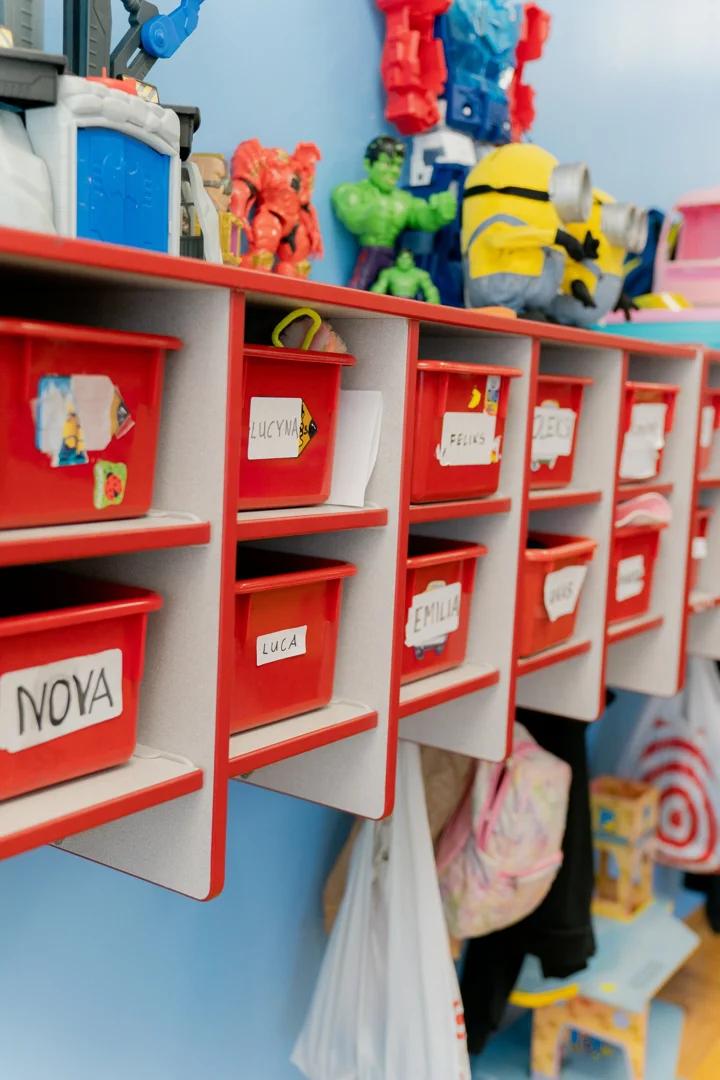
Preschool fosters a child’s sense of autonomy. Developing basic self-help skills gives children the confidence to navigate the classroom day without feeling overwhelmed by everyday routines.
Assess whether your child can practice or manage the following:
- Bathroom independence: Recognizing the physical urge to use the restroom, pulling pants up and down with minimal assistance, and attempting basic wiping.
- Hygiene habits: Washing and drying hands with soap and water after using the restroom and before eating meals.
- Dressing skills: Putting on and taking off their jacket, shoes (Velcro is preferred!), and boots with minimal support.
- Managing personal belongings: Opening their backpack, unpacking a lunchbox or snack container, and participating in classroom cleanup routines.
Fine and Gross Motor Physical Development
Motor coordination allows children to explore the classroom, participate in playground games, and prepare their hands for early writing and drawing activities.
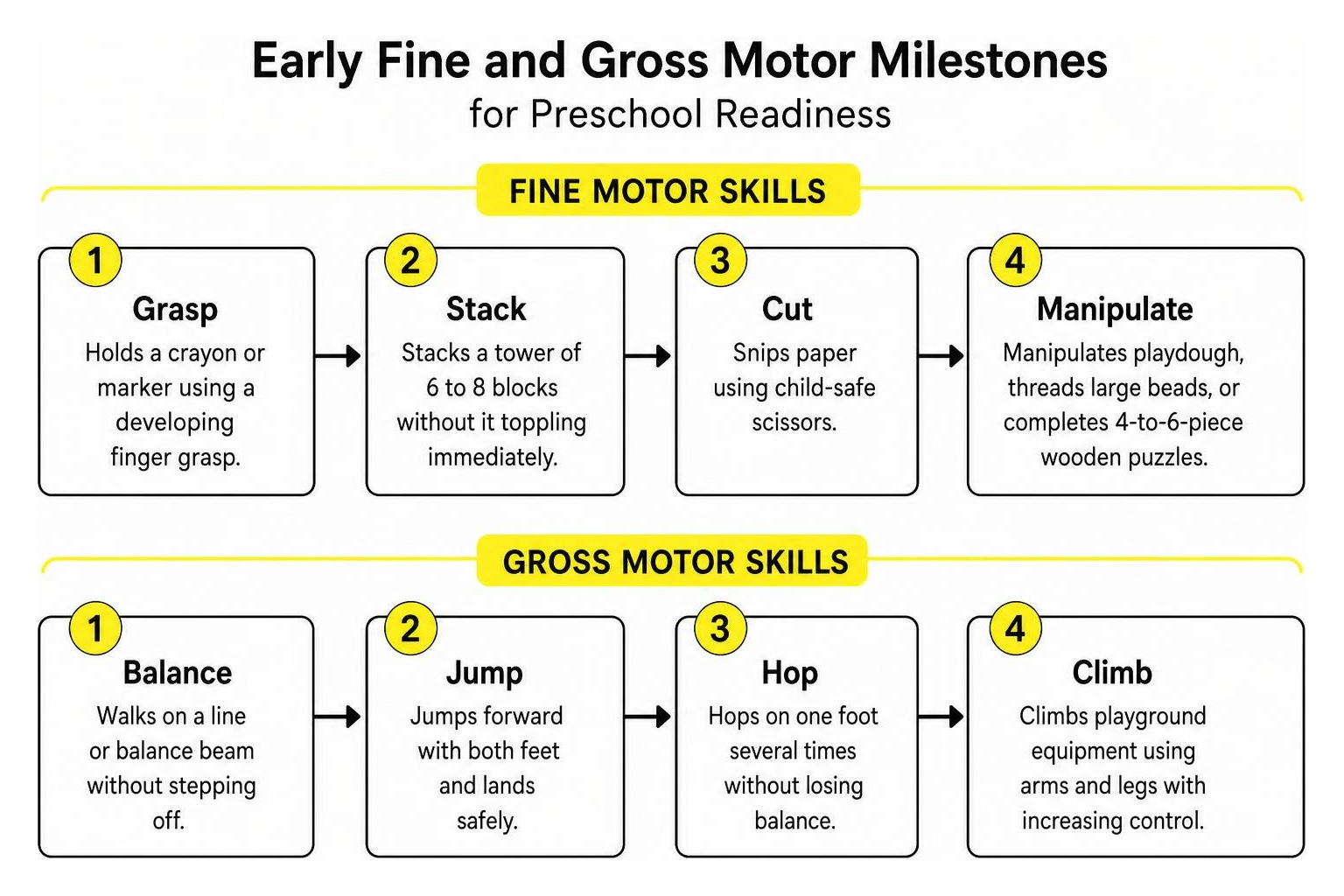
- Fine Motor Skills:
- Holding a crayon or marker using a developing finger grasp rather than a tight fist.
- Stacking a tower of 6 to 8 blocks without it toppling immediately.
- Snipping paper using child-safe scissors.
- Manipulating playdough, threading large beads, or completing 4-to-6-piece wooden puzzles.
- Gross Motor Skills:
- Walking up and down stairs using alternating feet with handrail support.
- Running, jumping with both feet leaving the ground, and balancing briefly on one foot.
- Throwing, catching, or kicking a large ball.
- Navigating outdoor playground equipment like low climbing structures and slides.
Cognitive and Early Learning Goals on the Preschool Readiness Checklist
Early cognitive development is driven by natural curiosity, exploration, and play. You do not need to drill complex academics at home; look for these foundational thinking skills instead, which align closely with the state indicator checklist for family readiness:
- Curiosity and problem-solving: Asking frequent “what,” “where,” and “why” questions to explore how things work.
- Basic concept identification: Recognizing primary colors (red, blue, yellow, green) and identifying basic shapes (circle, square, triangle).
- Early numeracy: Counting aloud in sequence from 1 to 5 (or 10) and understanding simple quantity comparisons like “more” versus “less.”
- Print awareness: Holding a book right-side up, turning pages from front to back, and recognizing that print carries meaning.
- Imaginative pretend play: Engaging in symbolic play scenarios, such as feeding a baby doll, pretending to cook, or building a garage for toy cars.
How to Build Preschool Readiness at Home Through Daily Play
Preparing your child for preschool does not require expensive workbooks or structured drills. The most impactful preparation happens through predictable family routines and open-ended play.
- Establish consistent daily rhythms: Align meal times, afternoon quiet/nap times, and wake-up schedules with typical preschool hours so your child’s body clock adapts smoothly.
- Read together every day: Ask open-ended questions while reading picture books (“Where do you think the puppy is hiding?”) to build expressive vocabulary and listening stamina.
- Encourage practical self-help at home: Give your child extra time to put on their own shoes, zip up their jacket, or wash their hands rather than doing it for them.
- Create sensory and fine motor stations: Provide playdough, child-safe scissors, water play bins, and large beads to strengthen little finger muscles for writing.
- Practice social turn-taking: Play simple games like rolling a ball back and forth, building a block tower together, or taking turns picking bedtime stories.
- Enroll in foundational group care: For families seeking structured early socialization, supportive early daycare programs provide a gentle, nurturing environment where young toddlers learn peer cooperation and classroom rhythms naturally.
What to Do When Your Child Has Not Mastered Every Skill
If your child has not mastered every item on this checklist, take a deep breath. Development is not linear, and having a few emerging skills is completely normal. Children arrive at preschool with a wide range of abilities, and early childhood educators are trained to meet each child where they are and help them grow from there.
If your child struggles with one or two specific areas:
- Focus on low-pressure play: Practice the lagging skill gently through games rather than direct correction. For example, use tweezers to pick up cotton balls if hand strength is developing slowly.
- Consult your pediatrician: If you notice persistent developmental delays, severe speech clarity issues, extreme sensory sensitivities, or ongoing difficulty following simple one-step commands, mention these observations during well-child visits. Early screenings through speech-language pathologists or pediatric occupational therapists can offer targeted support.
- Consider your child’s developmental timeline: Some families choose to give their child extra time to mature socially or physically before beginning formal schooling. This decision is a personal one, and your child’s teacher or pediatrician can help you weigh the benefits for your unique situation.
Frequently Asked Questions About Preschool Readiness
What age should my child start working through a preschool readiness checklist?
Most parents begin informally observing readiness milestones between ages 2 and 3. By age three, children typically transition into structured preschool settings. Use readiness checklists as an ongoing observational guide throughout the toddler years rather than a sudden checklist right before enrollment.
Does my child need to be fully potty trained before attending preschool?
Potty training policies vary depending on the program and age group. While many 3-to-4-year-old preschool classrooms require children to be mostly independent in the restroom, educators understand that occasional accidents happen. Look for programs with clear, supportive toileting policies that partner with parents during this developmental transition.
How can I tell if my child needs extra developmental support before preschool?
If your child exhibits persistent communication barriers (such as not using simple words by age 2.5), struggles significantly with balance and motor planning, or shows extreme distress with sensory textures and routine changes, reach out to your pediatrician. Early intervention screenings provide valuable strategies that set children up for long-term classroom joy.
Conclusion
Preschool is an exciting milestone filled with discovery, friendship, and hands-on exploration. By focusing on your child’s social-emotional resilience, functional independence, and natural curiosity, you give them the tools they need to step into the classroom with joy and self-assurance.
At Fantasy Island Schools for Kids, our English-language program with Polish and Ukrainian language support provides a rich, multi-sensory environment where children ages 2 to 6 thrive. Founded in 2009 by Beata Bielic, our state-licensed center features an experiential Gifted Enrichment Program, small class sizes, ECE-certified teachers, certified Brain Gym movement sessions, weekly music instruction, and freshly prepared on-site meals at no extra charge. We proudly partner with families across Chicago’s Northwest Side and surrounding suburbs—including Norwood Park, Edison Park, Gladstone Park, Jefferson Park, Sauganash, Edgebrook, Portage Park, Niles, Park Ridge, Skokie, Norridge, Harwood Heights, and Des Plaines—to provide an enriching early education foundation.
Ready to see our classrooms in action? Schedule a tour of our experiential preschool program today to learn how our dedicated educators can support your child’s early learning journey.