

Finding an Affordable Preschool Chicago Families Can Trust
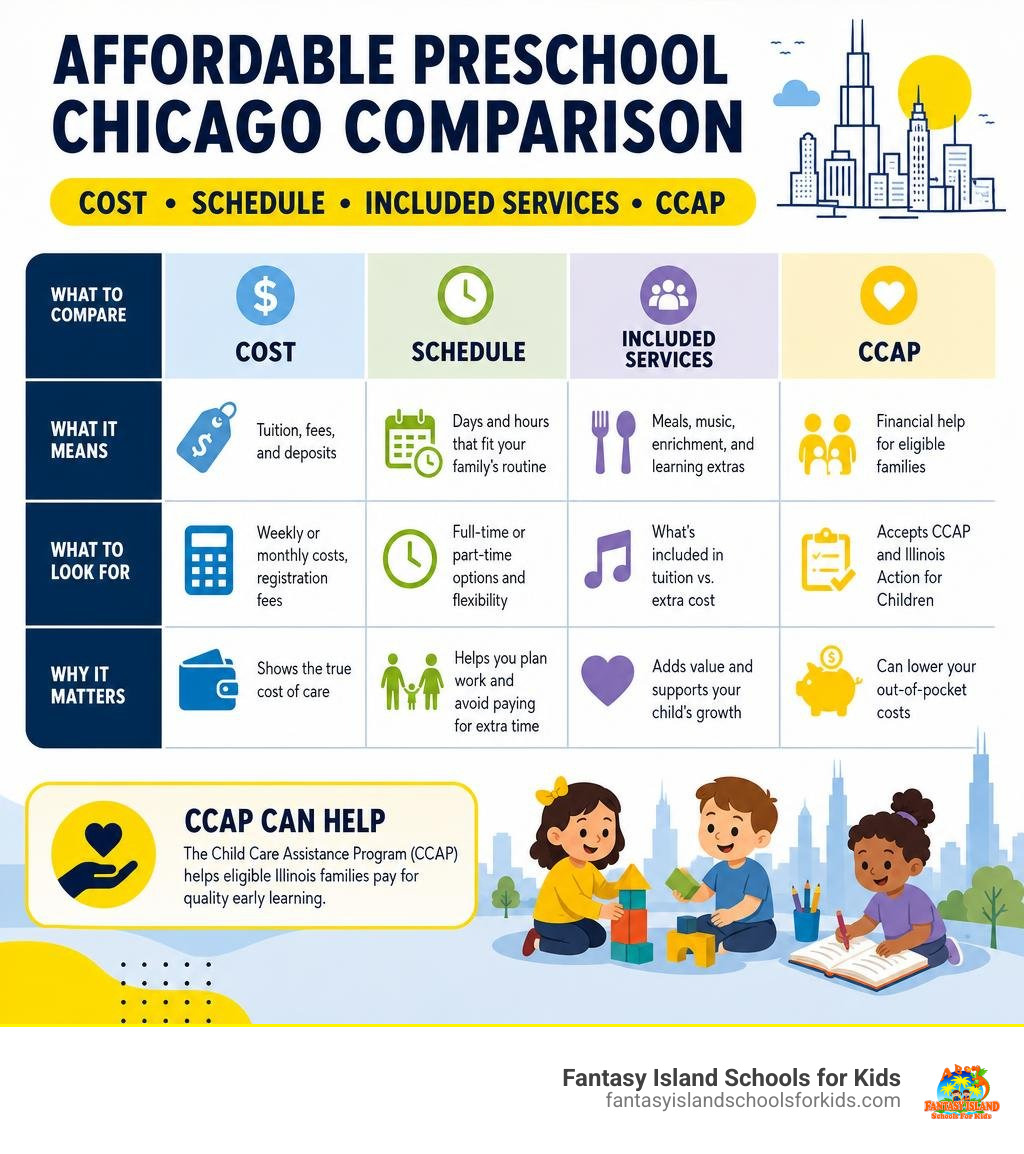
Affordable preschool Chicago families can find may include licensed child care centers, home-based programs, public early-learning options, and schools that accept Illinois child care assistance. The best fit is not always the lowest weekly price. Look at the full cost, hours, meals, learning opportunities, licensing, and whether financial aid can reduce what you pay.
| What to compare | Why it matters for your budget |
|---|---|
| Weekly or monthly tuition | Shows the base cost and billing schedule |
| Registration and deposits | Can create a larger up-front expense |
| Full-time or part-time hours | Helps you avoid paying for care you do not need |
| Included services | Meals, music, and enrichment may be included or extra |
| CCAP acceptance | Eligible families may receive help with child care costs |
| Licensing and safety standards | Helps you compare provider oversight alongside price |
For families on Chicago’s Northwest Side and nearby suburbs, a school with clear pricing and flexible scheduling can make quality early learning more manageable. At Fantasy Island Schools for Kids, children ages 2-6 can attend full-time or part-time Monday through Friday, 7 AM to 6 PM, with tuition generally around $300-$400 per week and meals, music, and gifted programming included. The school accepts CCAP and Illinois Action for Children assistance.
I am Beata Bielic, founder of Fantasy Island Schools for Kids in 2009 and an early-childhood educator with more than 17 years of experience helping families assess an affordable preschool Chicago option without losing sight of safety, care, and meaningful learning. From our location at 6100 N Milwaukee Ave, Chicago, IL 60646 (Phone: 773-206-4627), we serve families throughout the Northwest Side and nearby communities, including Norwood Park, Edison Park, Park Ridge, Niles, Skokie, and Norridge.
Comparing Child Care Settings for an Affordable Preschool Chicago Experience
Selecting the right early learning setting involves balancing daily convenience, early educational quality, and monthly budget requirements. Families exploring options across Chicago’s Northwest Side and surrounding communities like Harwood Heights, Edgebrook, and Portage Park often compare several structural models. For a deeper look at neighborhood dynamics, parents can read our guide on Navigating Full-Day Preschool Options Across Chicago Neighborhoods.
To make an informed decision, it helps to understand how different early childhood environments operate and how their fee structures compare.
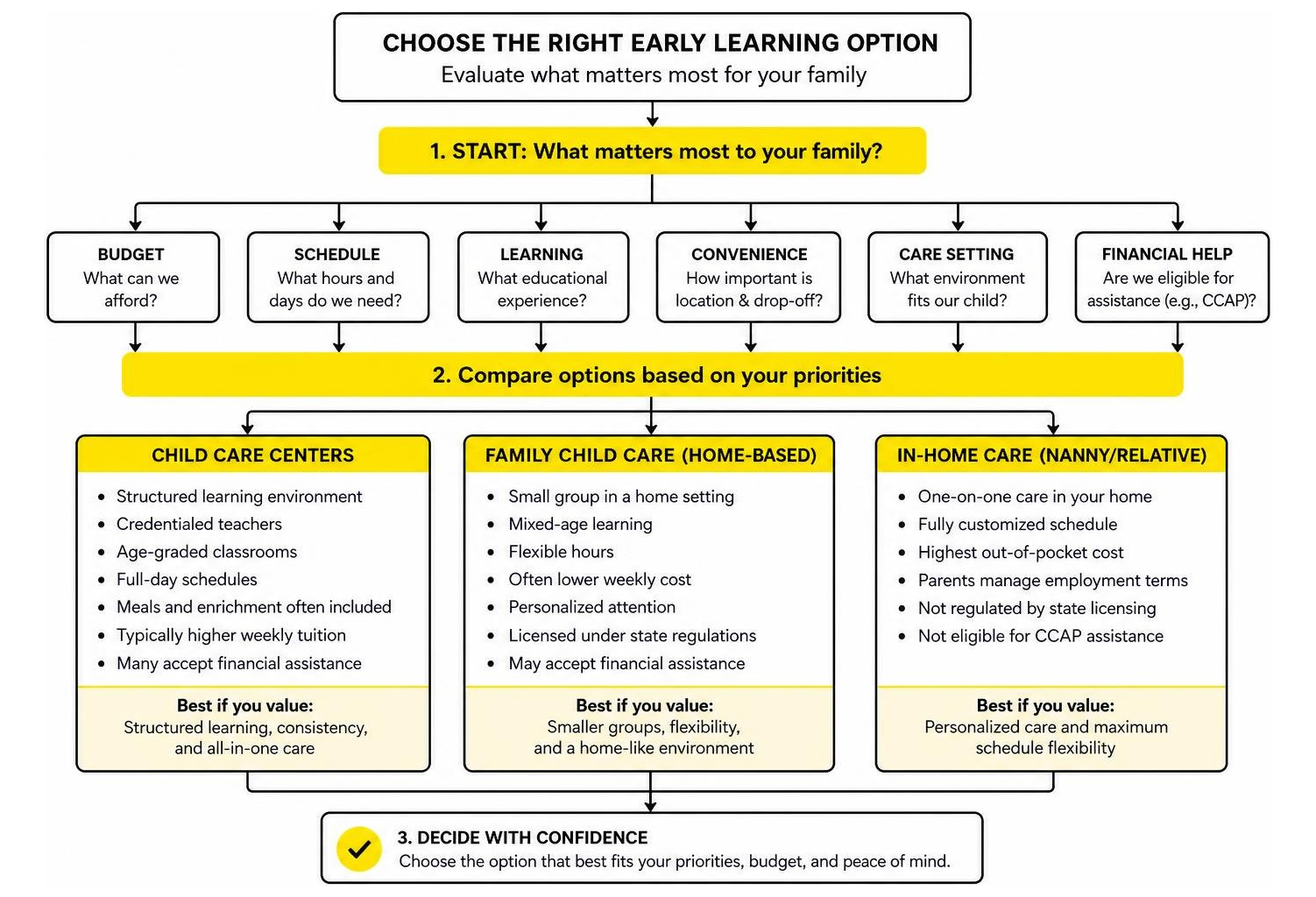
| Child Care Setting | Operational Overview | Cost Factors & Value | Regulatory Oversight |
|---|---|---|---|
| Child Care Centers | Group early education setting with age-graded classrooms, dedicated teaching staff, and structured curricula. | Tuition covers facilities, materials, and specialized enrichment. Many accept subsidies like CCAP. | Subject to state licensing standards or specific exemption criteria. |
| Family Child Care | Home-based care providing early learning in a residential setting, often with mixed age groups. | Often offers lower operational overhead and flexible hours for working parents. | Licensed family homes follow state ratio and home safety rules. |
| In-Home Care | Nanny, relative, or au pair providing individual care inside the family home. | Parents assume employer responsibilities; generally highest out-of-pocket cost per child. | Not regulated by state licensing agencies; overseen directly by parents. |
Child Care Centers, Family Care, and In-Home Options
When evaluating an affordable preschool Chicago families can rely on, understanding how setting impacts daily care is essential:
- Child Care Centers: Centers offer structured peer socialization, early academic curricula, and predictable schedules. While tuition reflects professional staffing and dedicated facility space, all-inclusive pricing (covering meals, music, and language instruction) often delivers strong educational value.
- Family Child Care: Operating out of a provider’s private home, these programs offer smaller group sizes and home-like comfort. They can be cost-effective, though hours and helper availability may vary.
- In-Home Options: Nannies and relative caregivers deliver individual attention inside your residence. However, parents take on direct payroll duties, and these arrangements lack regulatory oversight from state licensing authorities.
Licensed vs. License-Exempt Early Childhood Providers
Understanding licensing status gives parents clarity on health, safety, and staff qualifications:
- Licensed Providers: Inspected and monitored by the Illinois Department of Children and Family Services (DCFS). They must meet mandatory background checks, maximum child-to-staff ratios, emergency safety procedures, and regular facility audits.
- License-Exempt Providers: Include certain school-based programs, religious institution facilities, or informal family networks that fall outside standard DCFS jurisdiction.
Regardless of whether a program is licensed or license-exempt, child safety and wellbeing remain the primary considerations when selecting early education.
Financial Aid and the Illinois Child Care Assistance Program (CCAP)
State financial assistance plays a crucial role in bringing quality early childhood education within reach for working parents.
How to Qualify for CCAP and Illinois Action for Children
The Child Care Assistance Program (CCAP) provides state-funded subsidies designed to offset monthly child care expenses for qualified working families, parents enrolled in approved education programs, or families meeting state income thresholds.
Organized through administrative agencies such as Illinois Action for Children, CCAP allows eligible parents to select approved child care providers while paying a modest state-calculated co-payment based on family size and household income. To explore neighborhood assistance resources in adjacent communities, parents can reference state and local family support agencies.
Steps to Apply for Subsidies for an Affordable Preschool Chicago
Navigating the application process for child care assistance involves clear, sequential steps:
- Check Preliminary Eligibility Criteria: Review family size, monthly household earnings, and employment or educational activity requirements.
- Gather Required Documentation: Collect recent pay stubs, proof of employment or school enrollment, tax forms, and official identification.
- Select an Approved Provider: Choose a child care provider that accepts CCAP funding and accepts state subsidy documentation.
- Complete the State Application: Submit all completed forms and supporting documentation to Illinois Action for Children for formal review.
- Maintain Communication: Follow up promptly if state caseworkers request additional income verification or provider confirmation forms.
Because program guidelines and co-payment schedules are updated periodically by the state, we recommend contacting Illinois Action for Children or reaching out to our administrative team directly to discuss your family’s situation.
Preschool Tuition Costs, Billing Cycles, and Curriculum Value
Tuition structures across Chicago vary based on facility location, hours of care, and included enrichment options.
Evaluating Tuition Rates and Payment Installments for an Affordable Preschool Chicago
Preschool pricing across the city spans a wide spectrum. For context, specialized private Pre-K programs in some Chicago neighborhoods can range from $1,200 up to $2,400 or more per month, alongside separate registration fees and initial deposits.
By contrast, neighborhood programs on the Northwest Side offer comprehensive full-day schedules with predictable, budget-friendly rates. At Fantasy Island Schools for Kids, tuition generally runs between $300 and $400 per week. That tuition covers extended hours (7 AM to 6 PM), freshly cooked daily meals, weekly music instruction, and integrated gifted learning activities without separate add-on fees.
How Enrichment and Curricula Impact Educational Value
A program’s educational framework directly shapes school readiness. While some early learning centers follow pure Reggio Emilia or child-led project philosophies, others combine structured academics with hands-on multi-sensory exploration.
At Fantasy Island Schools for Kids, we integrate a Gifted Enrichment Program in English-language classrooms with Polish and Ukrainian language support. Parents frequently tell us that exposure to multiple languages during early childhood helps build cognitive flexibility, problem-solving skills, and executive function. Coupled with multi-sensory play environments, weekly music instruction, and trauma-informed social-emotional care, our curriculum is designed to help children develop confidence and strong academic foundations before entering elementary school.
Frequently Asked Questions About Chicago Preschools
What is the average cost of preschool in Chicago?
Preschool pricing varies across neighborhoods and center types. Private full-day programs can cost anywhere from $1,200 to over $2,400 per month. Neighborhood centers on Chicago’s Northwest Side offer quality full-day options around $300 to $400 per week, which often include meals and enrichment.
What is the difference between licensed and license-exempt care?
Licensed providers are regularly inspected by Illinois DCFS to verify teacher background checks, physical facility safety standards, and strict adult-to-child ratios. License-exempt programs, such as certain public school or religious offerings, operate under specific statutory exemptions but are not directly regulated under standard DCFS child care facility licenses.
How do I apply for CCAP child care subsidies in Illinois?
Parents can apply through Illinois Action for Children by submitting income statements, proof of employment or educational activities, and provider verification forms. For detailed eligibility assessment and application assistance, parents should contact Illinois Action for Children or direct questions to our administrative staff.
Conclusion
Finding an affordable preschool Chicago families can trust means looking at overall value, caring teachers, safe classrooms, and flexible tuition options.
Fantasy Island Schools for Kids was founded in 2009 by Beata Bielic and is located at 6100 N Milwaukee Ave, Chicago, IL 60646. Serving children ages 2-6 across Chicago’s Northwest Side and nearby suburbs, including Norwood Park, Edison Park, Gladstone Park, Jefferson Park, Sauganash, Edgebrook, Portage Park, Niles, Park Ridge, Skokie, Norridge, and Harwood Heights, we offer full-time and part-time enrollment from 7 AM to 6 PM, Monday through Friday.
With tuition running approximately $300-$400 per week, our all-inclusive approach covers on-site freshly cooked meals, weekly music lessons, multi-sensory play, Polish and Ukrainian language support, and gifted learning concepts. We accept CCAP and Illinois Action for Children assistance to support working families. Many of our graduates successfully transition into competitive elementary programs, and our curriculum is designed to help every child build a lifelong love of learning.
To learn more about our classroom opening options, schedule a tour, or ask questions about financial assistance, visit Fantasy Island Schools for Kids today.