

Is Kindergarten Full Day in Illinois? The Short Answer
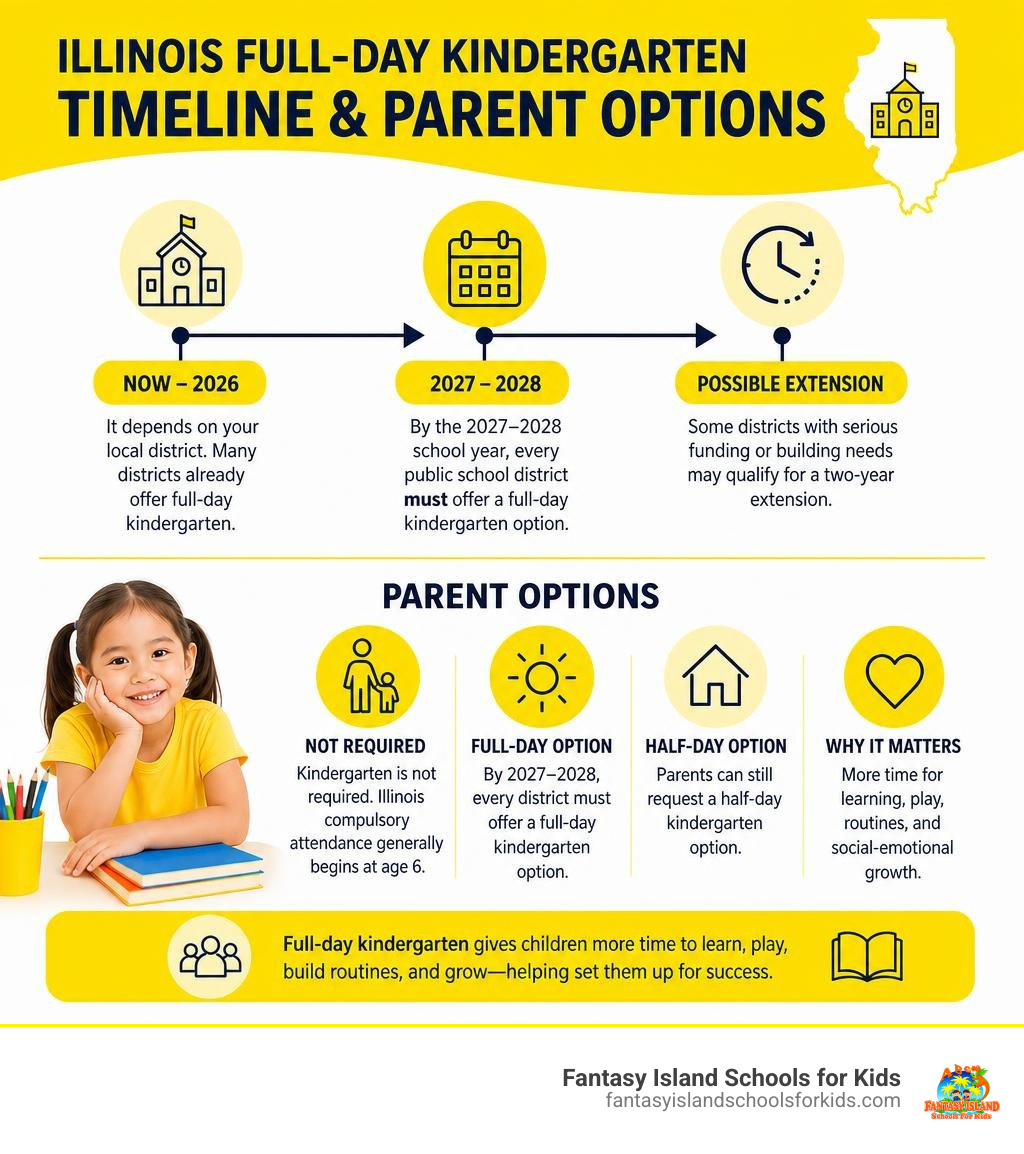
Is kindergarten full day in Illinois? Not in every public school district yet. Many Illinois districts already offer it, but state law requires every public school district to establish a full-day kindergarten option beginning in the 2027-2028 school year.
| What parents need to know | Quick answer |
|---|---|
| Is full-day kindergarten available now? | It depends on your local district. Most responding districts already offered it in 2024-25. |
| When must districts offer it? | By the 2027-2028 school year. |
| Can a district delay? | Some districts with serious funding or building needs may qualify for a two-year extension. |
| Is kindergarten required for children? | No. Illinois compulsory attendance generally begins at age 6. |
| Can parents ask for half-day kindergarten? | Yes. Illinois law preserves a half-day option for families who request one. |
This change matters because a full school day can give children more time for early reading, math, play, routines, and social-emotional learning. It can also make daily schedules easier for many working families, though districts still face real hurdles such as classroom space, staffing, transportation, and funding.
I am Beata Bielic, founder of Fantasy Island Schools for Kids, a Chicago early-childhood school founded in 2009, and I have spent more than 17 years helping families understand the early learning choices behind questions like is kindergarten full day in Illinois. As we look at what the law means, it helps to start with the statewide timeline and what your local district must provide.
Current Status: Is Kindergarten Full Day in Illinois Right Now?
When parents ask us is kindergarten full day in Illinois, the most accurate answer for today is that availability depends on where you live. For years, Illinois required school districts to establish kindergarten programs, but state law permitted those programs to operate on either a half-day or full-day schedule.
Over the past decade, however, the vast majority of Illinois communities independently transitioned to full-day schedules. As of 2023, out of the 852 school districts operating across Illinois, only 150 districts lacked a full-day kindergarten option. Survey data gathered by the state board during the 2024-2025 academic year further highlighted this momentum: among 575 responding school districts, 555 were already offering full-day kindergarten to local families, while only 20 were operating exclusively on half-day formats.
The legislative landscape changed dramatically when Governor JB Pritzker signed House Bill 2396 into law. This pivotal legislation created a statutory mandate requiring every public elementary and unit school board across Illinois to establish a full-day program. For detailed state legal guidance on how these rules apply, families can consult the official Illinois State Board of Education Kindergarten FAQ.
How Districts Currently Handle Is Kindergarten Full Day in Illinois Options
Until the mandatory statewide deadline arrives, individual school boards retain local governance over their daily schedules. Under current Illinois statutory guidelines, districts manage these options using distinct time models:
- Half-Day Programs: Traditionally operate for 2 to 2.5 hours per day, typically split into morning and afternoon cohorts. Under Illinois School Code (105 ILCS 5/10-19.05), two clock hours are required to count as a half-day of student attendance.
- Full-Day Programs: Provide a comprehensive schedule running between 4 and 6 clock hours daily. Under state law, a minimum of four clock hours constitutes a full day of attendance for kindergarten pupils.
Because school boards hold local decision-making authority, neighboring communities on Chicago’s Northwest Side or in nearby suburbs may currently offer completely different schedules. A family residing in Edison Park or Gladstone Park might have access to a full-day public option, while a family in a nearby suburb might find their local public school still operates on a 2.5-hour morning shift.
Mandatory Statewide Timeline for the 2027-2028 School Year
The passage of Public Act 102-0894 established a firm legal requirement: by the 2027-2028 school year, every public school district in Illinois must offer a full-day kindergarten program.
This legislation ensures universal access so that regardless of zip code, every child entering public school at age 5 will have the opportunity to participate in a full-day curriculum. The law specifically mandates that these expanded full-day programs must be developmentally appropriate and grounded in play-based learning frameworks rather than passive desk work.
Implementation Deadlines, Extension Waivers, and District Challenges
While the statutory goal of full-day kindergarten is widely praised by educators and parents, making the physical and operational transition is a massive undertaking for public school systems. For districts that have historically operated half-day programs, doubling the instructional time overnight requires twice as many physical classrooms, double the licensed teaching staff, expanded cafeteria services, and adjusted busing routes.
Two-Year Extension Waivers for Underfunded Districts
To prevent economically strained or space-constrained communities from failing, lawmakers established a formal extension process under Public Act 103-0410. School districts facing severe resource limitations can apply for a two-year extension waiver, pushing their required implementation deadline back to the 2029-2030 school year.
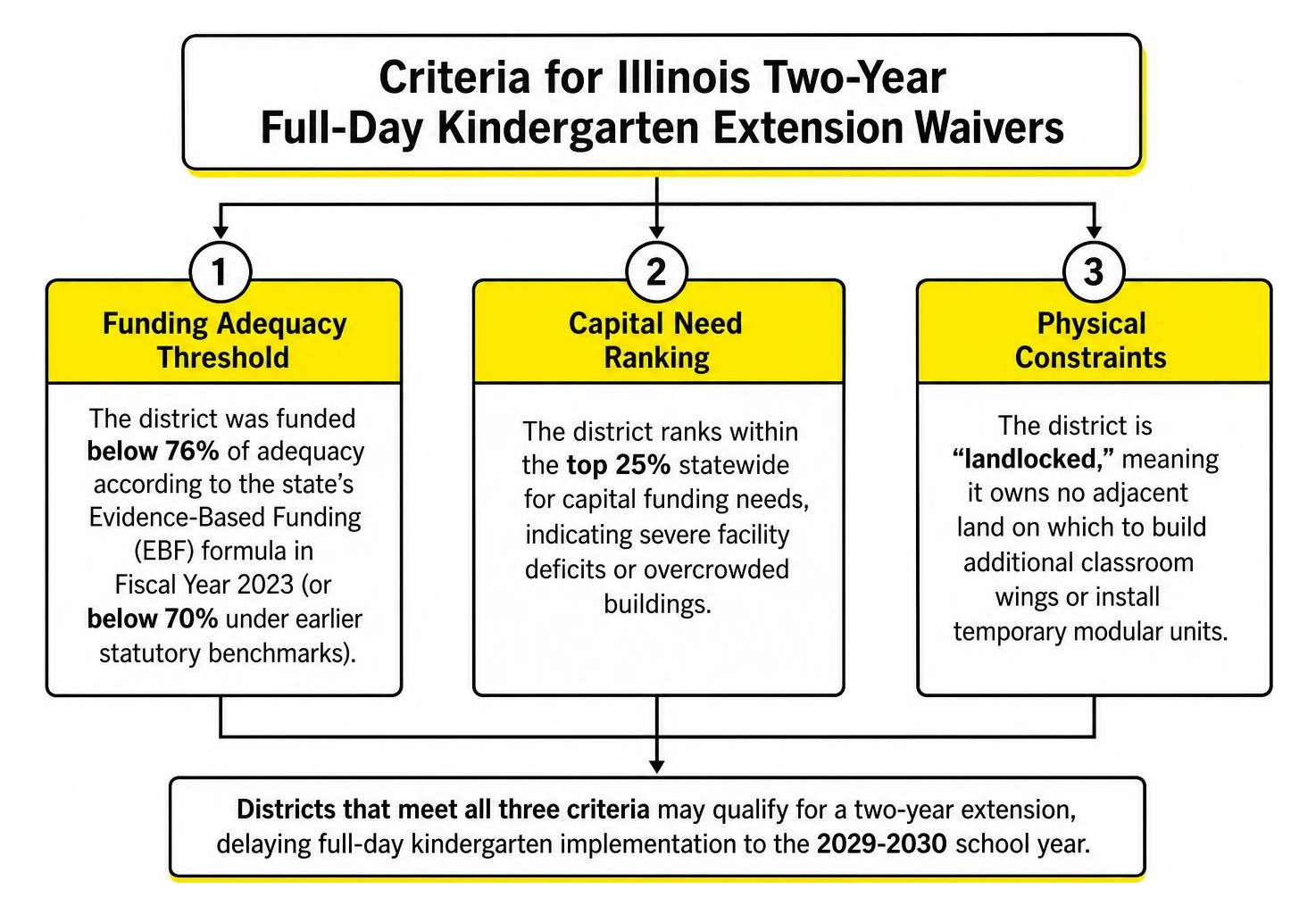
To qualify for this two-year grace period, a school district must satisfy specific financial or capital eligibility criteria evaluated by the Illinois State Board of Education (ISBE):
- Funding Adequacy Threshold: The district was funded below 76% of adequacy according to the state’s Evidence-Based Funding (EBF) formula in Fiscal Year 2023 (or below 70% under earlier statutory benchmarks).
- Capital Need Ranking: The district ranks within the top 25% statewide for capital funding needs, indicating severe facility deficits or overcrowded buildings.
- Physical Constraints: The district is “landlocked,” meaning it owns no adjacent land on which to build additional classroom wings or install temporary modular units.
Parents can read the complete statutory waiver criteria in Public Act 103-0410 Waiver Details. Survey findings from spring 2024 revealed that among 20 responding districts without full-day kindergarten, 5 estimated that physical and financial barriers would prevent them from meeting the primary 2027-2028 deadline without a waiver.
Role and Findings of the Full-Day Kindergarten Task Force
To ensure a smooth transition statewide, state leaders created the Full-Day Kindergarten Task Force. Composed of educators, superintendents, legislative appointees, and early childhood advocates, the Task Force conducted a comprehensive statewide audit to identify structural obstacles and recommend funding mechanisms.
In its official memorandum submitted to state leaders, available to read via the ISBE Task Force Memorandum, the Task Force highlighted several critical barriers:
- Classroom Space and Construction Costs: Many older suburban elementary schools lack unused rooms to double their kindergarten footprint.
- Teacher Shortages and Licensure: Securing qualified educators holding valid Illinois Early Childhood Education endorsements remains a challenge during statewide staffing shortages.
- Transportation and Operational Logistics: Bus routes must be completely restructured when midday kindergarten routes are eliminated and replaced by morning and afternoon routes shared with older elementary grades.
- Fiscal Reserves Safeguards: The Task Force recommended that the state protect local district finances by offering Early Childhood Construction Grants and reimbursing at least 50% of capital expenses for districts that draw down more than 15% of their local financial reserves to build new facilities.
Educational Benefits, Parent Rights, and Preparation
The policy push behind full-day kindergarten stems from compelling research regarding early brain development and school readiness. State observational data gathered through the Kindergarten Individual Development Survey (KIDS) revealed that during recent school years, only 30% of entering Illinois kindergarteners demonstrated overall readiness across all three key developmental domains (Social-Emotional Development, Language & Literacy, and Mathematics). Specifically, 58% met benchmarks in social-emotional skills, 48% in language and literacy, and 36% in math.
Expanding classroom hours provides educators with the instructional time required to bridge these learning gaps before children enter first grade.
Academic and Social Growth Under Illinois Early Learning Standards
A landmark study by the National Education Association demonstrated that full-day kindergarten significantly boosts academic achievement while strengthening essential social and emotional competencies. When children have 4 to 6 hours in a structured school setting, teachers can cover the complete set of learning benchmarks set forth in the Illinois Kindergarten Standards.
The core educational benefits of full-day kindergarten include:
- Deeper Mastery of Core Subjects: Children show higher long-term gains in early reading comprehension, phonics, number sense, and mathematical problem-solving compared to peers in 2.5-hour programs.
- Expanded Play-Based Learning: Full-day schedules eliminate the rush of short half-day windows, allowing teachers to integrate rich block play, sensory exploration, and dramatic play centers that foster natural inquiry.
- Social-Emotional Stamina: Extended time helps young learners practice conflict resolution, self-regulation, empathy, group collaboration, and independence in managing personal belongings.
- Early Intervention: Teachers have more individual time to identify learning differences or speech delays early, connecting families with support services well before first grade.
At Fantasy Island Schools for Kids, we see these developmental milestones daily. Our accelerated early childhood curriculum and Gifted Enrichment Program are specifically structured to help young children build total confidence in literacy, logic, social growth, and self-help skills. Parents often tell us that our specialized preparation gives their children a distinct advantage when entering elementary school settings. For families interested in detailed readiness strategies, our guide on Full-Time Kindergarten Jefferson Park Readiness explores how play-based academic enrichment prepares children for long-term success.
Parent Rights and Schedule Options Under State Law
A crucial detail that many parents overlook when asking is kindergarten full day in Illinois is that state law protects parental choice. Under Illinois School Code (105 ILCS 5/10-22.18), if a public school district offers a full-day kindergarten program, it is legally required to provide a half-day option for any family that requests it.
If you feel your 5-year-old child is not emotionally or physically ready for a 6-hour daily schedule—perhaps due to stamina concerns, nap transitions, or medical reasons—you retain the legal right to request a shortened half-day schedule from your public school principal. School boards must accommodate these requests without penalty. For a deeper look at building strong educational foundations while keeping parent choices flexible, explore our resource on Kindergarten Jefferson Park Strong Foundation.
What Parents Should Do If Full-Day Options Are Not Available
If you reside in a school district that currently offers only half-day kindergarten and has not yet established a full-day model, you do not have to feel powerless. Parents have clear options for advocacy and alternative enrollment strategies.
Navigating Options When Is Kindergarten Full Day in Illinois Is Not Yet Offered Locally
First, check your local school district’s strategic plan and school board minutes to see if a full-day transition is already scheduled ahead of the 2027 deadline. If your local board has delayed action, Illinois law gives resident parents a direct mechanism for grassroots advocacy:
Under 105 ILCS 5/10-22.18, if 50 or more parents or guardians of school-age children who reside within one mile of a public elementary school submit a formal signed petition requesting a kindergarten program, the local school board is legally obligated to consider establishing it, provided at least 15 students will maintain average daily attendance.
In addition to public advocacy, many families choose high-quality private or independent early childhood centers to secure comprehensive full-day coverage. If you are comparing enrollment timing and neighbourhood programs, our article Kindergarten Enrollment Sauganash Guide provides step-by-step enrollment insights for families across Chicago’s Northwest Side.
Early Learning Resources and Preparation Strategies for Families
Whether your child will attend a public or private kindergarten program, home preparation plays an essential role in easing the transition. Parents can access state and regional early education tools, such as the Chicago Early Learning portal, ISBE Early Childhood resources, and the Illinois Early Learning Project.
To help your child build full-day stamina before their first day, consider these practical routines:
- Practice Independent Self-Help Skills: Help your child practice opening lunchboxes, unzipping backpacks, opening sandwich bags, using water bottles, and putting on coats independently.
- Adjust Sleep Schedules Early: Gradually shift bedtime 2 to 3 weeks before school starts so your child wakes up refreshed for early morning schedules.
- Phase Out Afternoon Naps: If your 4- or 5-year-old still takes a midday nap, gradually replace naptime with quiet independent book reading or drawing activities.
- Foster Multilingual and Cultural Exploration: Exposing young children to second languages—such as English, Polish, or Spanish—enhances cognitive flexibility, executive functioning, and working memory, giving them a mental boost for full-day learning environments.
Frequently Asked Questions
Is kindergarten attendance mandatory for 5-year-olds in Illinois?
No. In Illinois, kindergarten attendance is not legally mandatory. Under Illinois School Code (105 ILCS 5/26-1), compulsory school attendance does not begin until a child turns 6 years old on or before September 1 of the school year.
While public school districts are legally required to offer kindergarten programs, parents are not legally forced to enroll their 5-year-olds in kindergarten or complete kindergarten prior to enrolling them in first grade. However, the vast majority of Illinois families (over 84% nationally and over 120,000 children statewide annually) choose to enroll their eligible 5-year-olds to establish critical academic foundations.
Will parents still have the option to choose half-day kindergarten?
Yes. Even after the 2027-2028 statewide full-day mandate takes full effect, Illinois law explicitly preserves parental opt-out flexibility. Public school districts that operate full-day kindergarten programs are mandated by state statute to maintain a half-day accommodation for parents who formally request a reduced schedule for their child.
How can parents check if their local district offers full-day programs?
Parents can easily verify their local status by:
- Visiting their public school district’s administrative website and checking the kindergarten enrollment tab.
- Calling the local elementary school principal or district registrar directly.
- Reviewing local school board meeting agendas for updates regarding Public Act 102-0894 implementation plans, construction bonds, or ISBE two-year waiver submissions.
Conclusion
Understanding the transition surrounding is kindergarten full day in Illinois helps families make confident decisions about their children’s early education. While state law mandates universal full-day options across all public districts by the 2027-2028 school year, navigating current schedules, extension waivers, and readiness expectations requires thoughtful planning.
At Fantasy Island Schools for Kids, we believe every child deserves a joyful, rich, and supportive start to their learning journey. Founded in 2009 by Beata Bielic, Fantasy Island Schools for Kids is located at 6100 N Milwaukee Ave, Chicago, IL 60646. We proudly serve families across Chicago’s Northwest Side and surrounding communities, including Norwood Park, Edison Park, Gladstone Park, Jefferson Park, Sauganash, Edgebrook, Portage Park, Niles, Park Ridge, Skokie, Norridge, and Harwood Heights.
Our school serves children ages 2 through 6 with flexible full-time and part-time options, operating Monday through Friday from 7:00 AM to 6:00 PM. With affordable tuition ranging between $300 and $400 per week, our all-inclusive programming features freshly cooked daily meals prepared on-site at no extra cost, weekly music instruction with a dedicated music teacher, a large multi-sensory play space, and our renowned Gifted Enrichment Program. We celebrate cultural diversity: most of our teachers speak Polish, Polish language classes run every Friday, and Ukrainian-speaking teachers support Ukrainian-speaking children. To ensure high-quality early education remains accessible for all families, we accept CCAP (Illinois Child Care Assistance Program) and Illinois Action for Children. Many of our graduates comfortably transition into top public gifted programs, magnet schools, and elite private elementary programs.
Whether you are preparing your child for upcoming public school enrollment or searching for a nurturing, highly enriched private early learning environment, our experienced team is here to support your family. Visit Fantasy Island Schools for Kids to schedule a personalized tour!
