

Essential Preschool Teacher Qualifications: Degrees, CDA, and Training
Understanding early childhood credentials helps you evaluate whether a classroom environment will support your child’s developmental milestones. Educators entering early childhood classrooms follow several distinct educational tracks, ranging from specialized professional certifications to comprehensive university degrees.
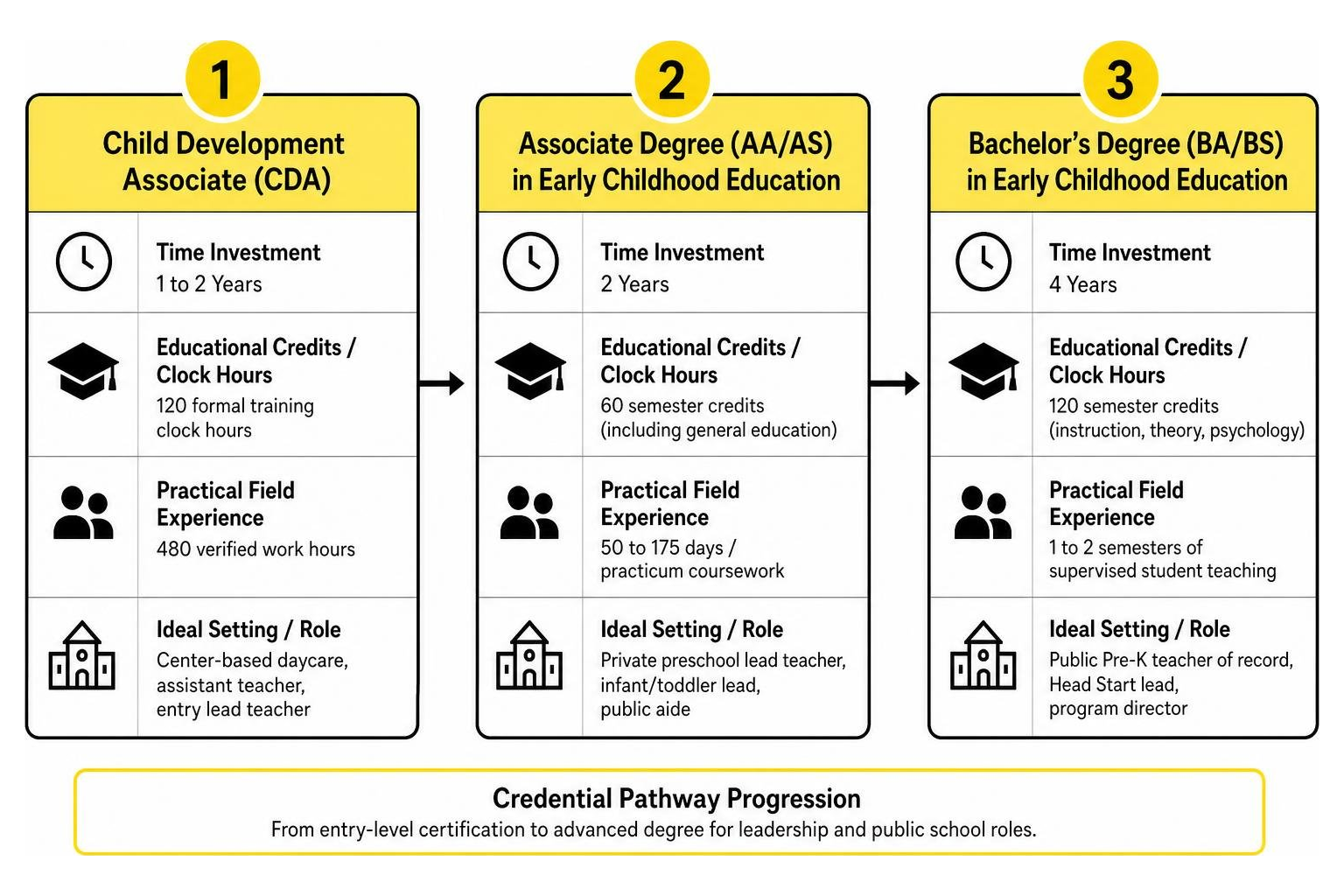
The baseline credential recognized nationwide is the Child Development Associate (CDA). Administered by the Council for Professional Recognition, the CDA requires 120 clock hours of formal early childhood education training alongside 480 clock hours of practical experience working directly with young children within a designated setting. Candidates must assemble a detailed professional portfolio and undergo formal observation by an approved specialist.
For more advanced leadership and public school roles, educators typically pursue collegiate degrees in Early Childhood Education (ECE) or Child Development:
- Associate Degree in Early Childhood Education (60 semester credits / 2 years): Focuses heavily on core early development, positive behavior guidance, introductory curriculum design, and family communication. Programs typically require 6 to 12 semester units dedicated to child growth and a supervised practicum course.
- Bachelor’s Degree in Early Childhood Education (120 semester credits / 4 years): Provides in-depth clinical training spanning developmental psychology, assessment methodology, literacy and numeracy foundations, trauma-informed practices, and inclusive education for children with diverse learning needs. This pathway is standard for state-funded public Pre-K and Head Start programs, where federal mandates require at least 50% of lead staff to hold four-year degrees.
State licensing departments evaluate these pathways through structured frameworks, as detailed in the national Preschool Credential Overview.
| Credential / Degree Pathway | Time Investment | Educational Credits / Clock Hours | Practical Field Experience | Ideal Setting / Role |
|---|---|---|---|---|
| Child Development Associate (CDA) | 1 to 2 Years | 120 formal training clock hours | 480 verified work hours | Center-based daycare, assistant teacher, entry lead teacher |
| Associate Degree (AA/AS) in ECE | 2 Years | 60 semester credits (including general education) | 50 to 175 days / practicum coursework | Private preschool lead teacher, infant/toddler lead, public aide |
| Bachelor’s Degree (BA/BS) in ECE | 4 Years | 120 semester credits (instruction, theory, psychology) | 1 to 2 semesters of supervised student teaching | Public Pre-K teacher of record, Head Start lead, program director |
When selecting an early learning center, examining staff credentials helps ensure your child receives intentional, milestone-based guidance. For a broader look at evaluating center quality, review our step-by-step guide to choosing the right preschool options.
State Credentialing and Regulatory Standards
State-by-State Breakdown of Preschool Teacher Qualifications
Early learning standards are established at the state level, creating different benchmarks across regional departments. While local requirements vary, most jurisdictions balance academic coursework, verified classroom hours, and ongoing professional development.
In Illinois, child care centers operate under licensing standards set by the Department of Children and Family Services (DCFS), alongside professional credential frameworks managed through Gateways to Opportunity. Entry into licensed early childhood classrooms requires candidates to complete formal coursework in child development and secure appropriate Gateways credentials, as outlined in the ChildCareEd Guide to Becoming an Early Educator. In public school districts, lead teachers must hold a professional educator license with an Early Childhood endorsement covering age birth through grade 2 or 3.
Other states use distinct regulatory structures:
- California: Regulated by the California Commission on Teacher Credentialing (CTC), educators earn tiered permits. A Child Development Teacher Permit requires 24 semester units of ECE, 16 general education units, and 175 days of verified classroom experience within 4 years, alongside standardized examinations like the CBEST, CSET, or RICA.
- Texas: Governed under 19 Tex. Admin. Code § 102.1003 for high-quality Pre-K programs, lead teachers must hold state educator certification plus a supplementary credential such as a CDA, an ECE degree, or 150 hours of documented professional development (with at least 50% dedicated to mentored, practical application).
Mandatory Health, Safety, and Compliance Requirements
Beyond academic degrees, every early childhood professional must clear non-negotiable health, safety, and regulatory compliance standards before stepping into a classroom.
- Pediatric CPR, First Aid, and AED Certification: Staff must complete comprehensive in-person training. Online-only certifications are rejected by state licensing bodies because real-world emergency response requires physical practice with child and infant mannequins.
- Mandated Reporter Training: Early educators are legal mandated reporters under state law (such as AB 1207 guidelines in California and equivalent DCFS protocols in Illinois). This training prepares staff to identify and report signs of child abuse, neglect, and family trauma, requiring recertification every two years.
- Immunizations and Health Clearances: Regulations (such as California SB 792 models adopted nationwide) require up-to-date immunizations against Pertussis (whooping cough) and Measles (MMR), alongside annual Influenza screenings and negative tuberculosis (TB) tests.
- Comprehensive Background Checks: Staff must pass comprehensive FBI fingerprinting, state police background checks, and sex offender registry screenings before supervising children.
- Trauma-Informed Care Training: Progressive early learning programs train educators in trauma-informed care. This enables teachers to recognize emotional dysregulation, create calm sensory environments, and support children experiencing big transitions or stress.
Employment Tracks, Classroom Roles, and Career Outlook
Substitute vs. Contracted Preschool Teacher Qualifications
Staffing in early childhood education requires tiered qualifications to maintain regulatory ratios while ensuring instructional quality. Standards established under the ACECQA Centre-Based Service Qualifications and national frameworks outline distinct roles for classroom personnel.
- Substitute & Assistant Teachers: Typically hold an Associate Teacher credential, a high school diploma with introductory ECE units, or roughly 60 semester college units (including foundational courses in child growth, English composition, and infant-toddler care). They must complete at least 50 days of logged classroom experience under the direct supervision of a lead teacher.
- Contracted Lead Teachers: Must hold a full Child Development Teacher Permit, an associate degree, or a bachelor’s degree in Early Childhood Education with at least 24 ECE units. They must document 175 days of verified classroom teaching, demonstrate curriculum planning skills, and lead parent-teacher conferences.
Structured entry pipelines, such as the Early Childhood Hybrid Apprenticeship Standards, require up to 2,400 hours of clinical on-the-job training covering 62 core teaching competencies. This includes mastering diverse teaching methodologies (370 hours), teaching foundational life skills (510 hours), and collaborating with specialists on Individualized Education Programs (IEPs).
Career Outlook, Salary Benchmarks, and Essential Skills
Early childhood education is a expanding sector. According to the BLS Occupational Outlook Handbook, employment for preschool teachers is projected to grow steadily from 2024 to 2034, generating approximately 65,500 annual job openings across the nation.
Data from the Bureau of Labor Statistics highlights key wage benchmarks:
- National Median Annual Wage: $37,120 per year ($17.85 per hour as of May 2024).
- Earnings Range: The lowest 10% earn less than $28,300, while the top 10% (typically holding bachelor’s degrees and working in public school districts) earn more than $60,070 annually.
- Industry Variances: Educational and school-based services provide higher median wages ($50,710) compared to standalone child daycare services ($36,060).
- Regional Differences: In California, preschool teachers earn an average of $53,512, compared to the national overall average of $42,993 per year.
As detailed in the O*NET Summary Report for Preschool Teachers, technical qualifications must be paired with essential soft skills:
- Problem Sensitivity & Observation: The ability to quickly recognize subtle behavioral, emotional, or physical cues indicating a child needs support.
- Classroom Management: Guiding group dynamics through positive behavioral reinforcement, predictable routines, and play-based transitions.
- Multilingual and Communication Abilities: Actively engaging multilingual learners and providing clear developmental updates to families.
How to Verify Educator Standards When Evaluating Programs
When touring early education centers, observing daily classroom interactions reveals far more than examining a paper license on a wall.
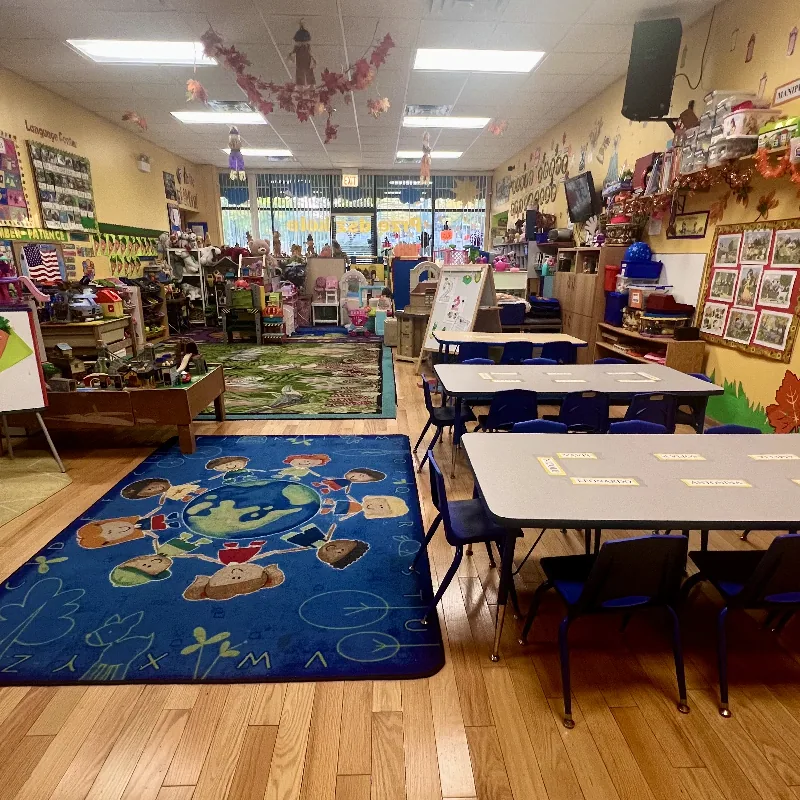
During your tour, keep these practical verification steps in mind:
- Observe Teacher-Child Interactions: Watch whether educators speak to children at eye level, ask open-ended questions during play, and respond calmly to emotional moments.
- Ask About Continuing Education: Inquire how many annual professional development hours teachers complete. High-performing centers support their staff with ongoing training in curriculum design, trauma-informed care, and safety.
- Confirm In-Person Safety Credentials: Verify that all active classroom educators maintain current, in-person pediatric First Aid and CPR certifications.
- Review Multilingual & Specialty Staffing: Ask how the school supports language acquisition and whether enrichment subjects (such as music or sensory play) are led by dedicated instructors.
Before making an enrollment decision, visit and tour private kindergartens before enrollment to evaluate the facility’s physical safety, classroom organization, and learning atmosphere. You can also read authentic parent testimonials and explore our about us page to learn more about our teaching philosophy.
Frequently Asked Questions About Early Educator Credentials
If you are exploring early learning options for your family, check our complete list of frequently asked questions or read through these common inquiries:
What is the fastest path to earn preschool teaching credentials?
The quickest entry path into early childhood education is the Child Development Associate (CDA) credential. It requires 120 clock hours of professional education, 480 hours of verified classroom experience, and an in-person assessment, typically taking between 6 and 18 months to complete.
Are online CPR and first aid certifications accepted for preschool staff?
No. State licensing departments require in-person pediatric CPR, First Aid, and AED training. Hands-on practice with specialized child and infant mannequins is essential to ensure life-saving technique during choking or breathing emergencies.
Do private preschools require state teaching licenses?
Private preschools must comply with state child care licensing standards (such as Illinois DCFS regulations), requiring lead teachers to hold relevant semester units, CDA credentials, or early childhood degrees. While private centers do not always mandate a public school teaching certificate, high-quality programs prioritize degree-holding staff with specialized early learning training.
Conclusion
A high-quality early childhood education builds the foundation for lifelong curiosity, academic confidence, and social-emotional resilience. Choosing a program with fully certified, safety-trained educators ensures your child learns in a secure environment designed to nurture their unique potential.
At Fantasy Island Schools for Kids, we combine educational excellence with a warm, supportive community. Founded in 2009 by Beata Bielic and located at 6100 N Milwaukee Ave, Chicago, IL 60646, our center serves children ages 2 to 6 across Chicago’s Northwest Side and surrounding suburbs—including Norwood Park, Edison Park, Gladstone Park, Jefferson Park, Sauganash, Edgebrook, Portage Park, Niles, Park Ridge, Skokie, Norridge, and Harwood Heights.
Our programs operate Monday through Friday from 7 AM to 6 PM, offering full-time and part-time enrollment options. Weekly tuition of $300 to $400 covers our Gifted Enrichment Program, weekly music instruction with a dedicated teacher, and freshly cooked on-site meals every day. To ensure quality care remains accessible, we proudly accept CCAP (Illinois Child Care Assistance Program) and Illinois Action for Children. All of our educators hold Early Childhood Education credentials, maintain in-person First Aid/CPR certification, and are trained in trauma-informed care and multilingual instruction (including English and Polish).
We invite you to explore our preschool programs in Chicago and schedule a visit to our preschool classrooms to meet our dedicated teaching team today.