

How Experiential Learning Helps Preschoolers Learn by Doing
An experiential learning preschool helps children learn through active, real-world experiences instead of mainly listening, repeating, or completing worksheets. Your child might build a ramp, care for a classroom plant, sort objects, prepare a snack, act out a community role, or talk with classmates about what happened afterward.
The strongest programs pair child-led discovery with teacher guidance:
- Children explore with safe, hands-on materials.
- Teachers ask questions, add useful vocabulary, and model new skills.
- Children reflect through conversation, drawing, movement, or play.
- Families reinforce learning through simple routines at home.
Research on a structured eight-week preschool program found significant gains in both life skills and social skills compared with traditional instruction. At Fantasy Island Schools for Kids in Chicago, our multilingual, multi-sensory curriculum is designed to make learning active, collaborative, and meaningful for children ages 2 to 6.
I am Beata Bielic, Executive Director of Fantasy Island Schools for Kids, where I have worked since 2009 after beginning as a teacher. With a Master’s degree in Psychology and more than 17 years in early childhood education, I help shape an experiential learning preschool environment where children can explore, reflect, communicate, and grow with confidence.
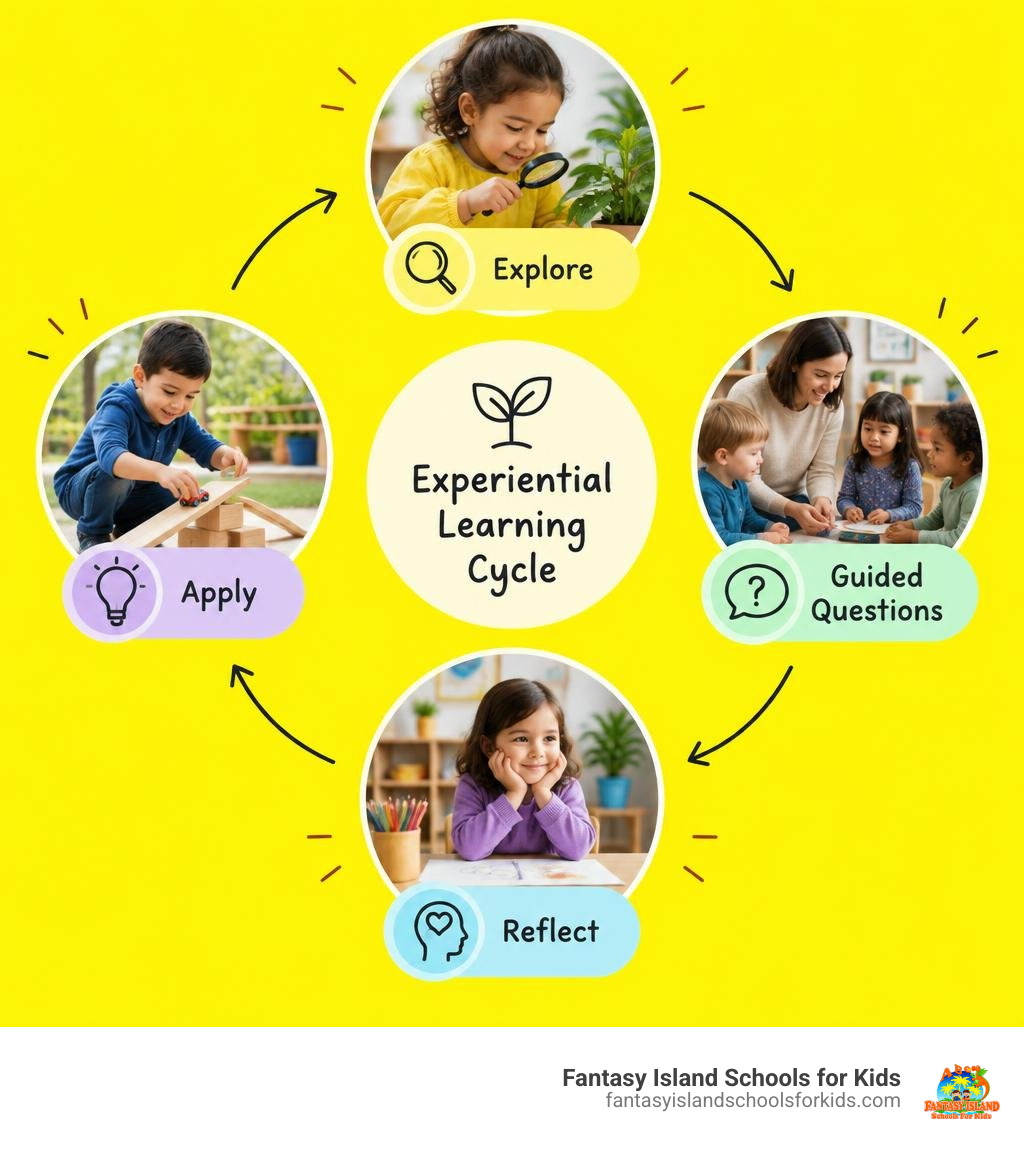
Common experiential learning preschool vocab:
What Is Experiential Learning in Early Childhood Education?
Experiential learning in early childhood is rooted in the idea that young minds build knowledge by interacting directly with their environment. Rather than sitting quietly while an instructor delivers facts, children actively touch, manipulate, test, and observe the world around them. Understanding play-based learning benefits allows us to see how spontaneous curiosity transforms into deep, lasting comprehension.
When a toddler drops wooden blocks into water, they are not just splashing; they are investigating buoyancy, density, and cause-and-effect relationships. This concrete exploration forms the bridge to abstract understanding later in life.
| Dimension | Traditional Rote Preschool | Experiential Learning Model |
|---|---|---|
| Primary Method | Repetition, flashcards, and passive listening | Direct touch, trial-and-error, and sensory discovery |
| Teacher’s Role | Central lecturer directing every step | Facilitator who scaffolds inquiry and models vocabulary |
| Child’s Role | Passive receiver of instructions | Active investigator and collaborator |
| Skill Assessment | Memorization tests and static worksheets | Real-world application, observation, and reflective dialogue |
| Curriculum Focus | Isolated subject drills | Integrated, cross-curricular thematic explorations |
Hands-On Exploration vs. Traditional Rote Instruction
Traditional early education often relies heavily on adult-directed instruction, where children are expected to duplicate templates or memorize letters in isolation. In contrast, experiential education treats young learners as capable discoverers.
By utilizing open-ended materials—such as clay, sensory sand, measuring cups, and building blocks—educators guide children toward meaningful conclusions. When children engage with a balanced daycare curriculum, teachers act as responsive facilitators, introducing precise terminology while children manipulate objects. This tactile discovery anchors new concepts firmly in a child’s cognitive framework.
How an Experiential Learning Preschool Boosts Executive Function
Executive function skills—which include working memory, mental flexibility, and self-regulation—develop rapidly during the early years. The rapid neural expansion in early childhood provides an ideal window to build these cognitive control centers.
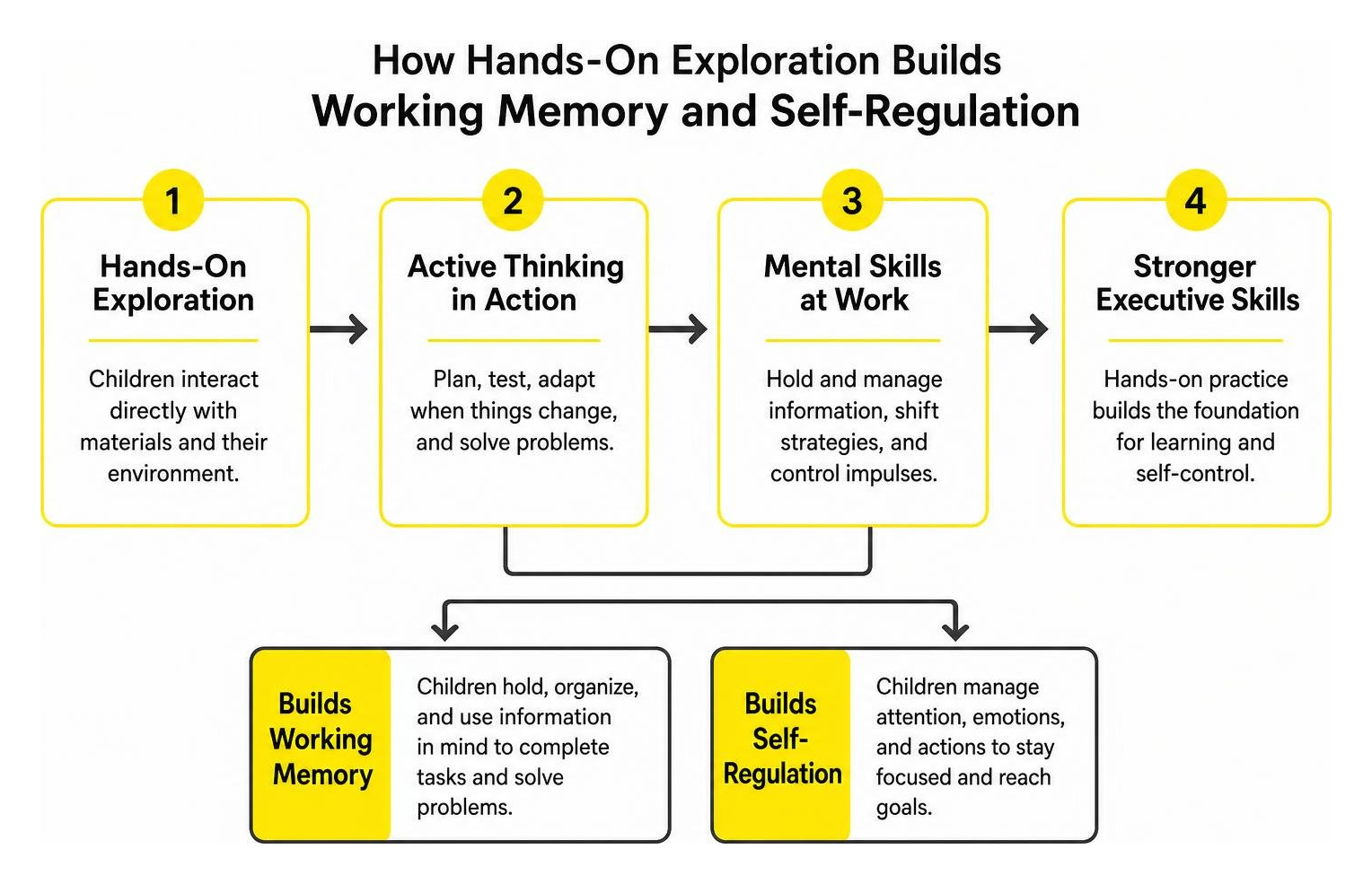
When preschoolers plan how to construct a tower, adapt when it falls, and negotiate with peers for specific pieces, they exercise cognitive flexibility and impulse control. Direct sensory problem-solving trains the brain to manage multiple streams of information simultaneously, building self-discipline far more effectively than passive compliance ever could.
Core Pillars of an Experiential Learning Preschool Framework
An effective experiential model does not mean unstructured chaos. Instead, it relies on intentional pedagogical design where freedom of exploration operates within clear, predictable boundaries.

High-quality programs incorporate established educational guidelines, such as the Core Knowledge Preschool Sequence guidelines, to ensure that hands-on experiences systematically build the foundational content knowledge needed for elementary school.
Designing the Experiential Learning Preschool Daily Routine
A balanced daily routine moves rhythmically between child-led investigation and structured group collaboration. Highly trained educators with recognized early childhood teacher qualifications organize the classroom day into intentional segments:
- Morning Arrival & Welcome Circle: Setting daily intentions, checking in on social-emotional readiness, and introducing new thematic centers.
- Open Exploration & Choice Time: Self-directed engagement in sensory stations, art studios, math manipulative zones, and building corners.
- Small-Group Inquiry: Guided, hands-on STEM experiments, literacy activities, and teacher-scaffolded projects.
- Outdoor & Multi-Sensory Movement: Gross motor challenges, nature observation, and cooperative games.
- Reflective Circle: Group discussions where children articulate what they built, solved, or discovered.
The Care, Grow, and Change Thematic Model
Many exemplary experiential programs organize their year around overarching, relatable concepts. Following the framework outlined in the Early childhood exploration curriculum guide, classrooms frequently explore three universal themes:
- Care: Children explore nurturing roles—such as caring for classroom pets, watering herbs, or engaging in dramatic pretend-play with baby dolls and doctor kits. This builds empathy and personal hygiene awareness.
- Grow: Learners plant seeds, track seedling height with rulers, measure ingredients for cooking projects, and discover how living organisms thrive.
- Change: Preschoolers investigate physical transformations through mixing primary paint colors, observing ice melt into water, or tracking seasonal changes in weather.
Key Developmental and Social Benefits of Hands-On Learning
Preschoolers who learn through concrete action demonstrate advanced social, physical, and academic competence.

In a structured early education setting, physical manipulation naturally strengthens fine and gross motor coordination, spatial reasoning, and cooperative problem-solving abilities.
Life Skills, Independence, and Emotional Regulation
A notable quasi-experimental study on early childhood life and social skills measured the effects of an eight-week experiential learning intervention on children aged 4 to 5. The researchers observed remarkable, statistically verified improvements:
- Life Skills Growth: The experimental group’s life skills scores rose from a pre-test mean of 24.75 to a post-test mean of 29.28 ($p < 0.05$).
- Social Skills Growth: Social competencies increased from a pre-test mean of 26.78 to a post-test mean of 29.10 ($p < 0.05$).
- Statistical Significance: A one-way MANOVA confirmed the superior efficacy of the experiential model compared to traditional instruction (Wilks’ Lambda = 0.760, $F = 8.377, p < 0.05$).
When children practice practical life routines—like buttoning coats, serving their own snacks, and resolving peer disputes during shared building projects—they meet critical social-emotional milestones with genuine self-assurance.
Cognitive Growth, Early STEM, and Language Acquisition
Experiential learning makes abstract mathematics and science immediately accessible. Engaging in interactive early math activities—such as counting pinecones, sorting buttons by size, or balancing scales—lays the groundwork for arithmetic fluency.
For advanced learners, creative enrichment activities for gifted children provide complex puzzles, scientific experimentation, and multi-step logic challenges. When teachers introduce rich descriptive language during hands-on experiments, children internalize vocabulary naturally within clear contexts.
Adapting Hands-On Education for Diverse and Multilingual Learners
Every child brings a unique developmental profile and cultural heritage to the classroom. Experiential learning is inherently adaptable, offering tactile and visual entry points that transcend language barriers.
Integrating comprehensive music and arts enrichment invites children to communicate ideas through rhythm, melody, and expressive movement, fostering inclusive community bonds.
Multi-Sensory Approaches for Inclusive Classrooms
Classrooms equipped as multi-sensory learning environments support neurodivergent learners, children with sensory processing sensitivities, and dual-language learners. Educators implement several proven strategies:
- Visual Picture Schedules: Helping children navigate daily routines independently without language anxiety.
- Auditory Rhythm and Percussion: Reinforcing pattern recognition, focus, and motor coordination through beat and movement.
- Bilingual Scaffolding: Unlocking the proven multilingual education benefits by pairing tactile activities with vocabulary in multiple languages (such as English and Polish).
- Trauma-Informed Sensory Zones: Providing calming corners with weighted cushions, soft lighting, and tactile soothing tools.
Bridging School Learning and Family Engagement at Home
Experiential learning extends seamlessly into home life. When families and educators collaborate, children reinforce their skills across everyday routines. Parents can easily support experiential principles by:
- Involving children in meal preparation, measuring ingredients, and setting the table.
- Taking exploratory nature walks in local parks to collect leaves, stones, and seeds.
- Assigning meaningful home responsibilities, like watering house plants or sorting laundry by color.
- Celebrating family cultural traditions through cooking, storytelling, and music.
When evaluating preschool programs in Chicago, look for centers that encourage strong parent communication and active family involvement.
Frequently Asked Questions About Hands-On Early Education
How does experiential learning prepare children for kindergarten?
Experiential learning builds the intellectual curiosity, working memory, and social resilience children need for kindergarten. Rather than merely memorizing test answers, children learn how to ask questions, persist through challenging tasks, work collaboratively in groups, and express their thinking with clarity.
Can hands-on learning work alongside structured academic milestones?
Yes. Hands-on exploration and rigorous developmental benchmarks complement each other. High-quality programs use intentional lesson planning to ensure that sensory, child-led activities directly teach core math, literacy, science, and fine motor standards sequentially.
What should parents look for in an experiential classroom setting?
Look for clean, accessible learning zones stocked with open-ended materials, child-sized furniture, designated sensory and creative spaces, and a calm, engaging atmosphere. Observe whether teachers actively guide and listen to children rather than lecturing from the front of the room.
Conclusion: Setting the Foundation for Lifelong Curiosity
Experiential learning transforms early childhood education from a passive routine into an engaging adventure. By touching, experimenting, questioning, and reflecting, children build the cognitive grit, social empathy, and intellectual confidence needed for future academic success.
At Fantasy Island Schools for Kids, we have proudly served local families since 2009. Founded and directed by Beata Bielic, our licensed center is located at 6100 N Milwaukee Ave, Chicago, IL 60646. We provide full-time and part-time programs for children ages 2 to 6, operating Monday through Friday from 7:00 AM to 6:00 PM.
Our comprehensive curriculum brings together key educational advantages:
- Multilingual Instruction: Immersive dual-language experiences in English and Polish.
- Gifted Enrichment Program: Advanced cognitive, STEM, and logic challenges that prepare graduates for gifted kindergarten programs.
- Weekly Music Classes: Led by a qualified music teacher to enhance rhythm, coordination, and pattern recognition.
- Freshly Cooked Meals: Nutritious, home-style meals prepared daily on-site at no extra cost.
- Multi-Sensory Play Spaces: Designed to stimulate curiosity, fine motor development, and gross motor strength.
- Certified, Caring Educators: Certified in Early Childhood Education, First Aid/CPR, and trained in trauma-informed care.
Our tuition ranges from approximately $300 to $400 per week, which fully includes our educational programming, freshly cooked meals, weekly music classes, and the Gifted Enrichment Program. We proudly accept CCAP (Illinois Child Care Assistance Program) and Illinois Action for Children to ensure high-quality early education remains accessible. We welcome families across Chicago’s Northwest Side and surrounding communities, including Norwood Park, Edison Park, Gladstone Park, Jefferson Park, Sauganash, Edgebrook, Portage Park, Niles, Park Ridge, Skokie, Norridge, and Harwood Heights.
If you are looking for an exceptional, hands-on start for your child, explore our dedicated kindergarten program in Chicago or contact us to schedule a personal tour.
