

What Is a Multi-Sensory Learning Environment?
A multi-sensory learning environment helps children learn by using more than one sense at a time. Instead of only listening or looking, your child might see a picture, say a word, touch a letter, move their body, and explore real objects connected to the lesson.
For young children, the goal is simple: make ideas concrete, active, and meaningful. A well-planned environment may include:
- Visual supports, such as pictures, colors, and simple charts
- Sound, songs, conversation, and rhymes
- Hands-on materials, including clay, blocks, sand, and textured letters
- Purposeful movement, such as acting out a story or counting while hopping
- Calm, predictable spaces that help children notice and manage their bodies
This is not about labeling a child as a “visual learner” or a “hands-on learner.” Learning-styles labels are not supported by strong evidence. Multisensory teaching gives all children several connected ways to explore the same idea, while teachers watch carefully for signs of interest, comfort, or overload.
A thoughtful sensory-rich classroom can support attention, early language, motor skills, memory, and joyful participation. It also does not require expensive equipment: everyday materials and responsive teaching often make the biggest difference.
I am Beata Bielic, Executive Director of Fantasy Island Schools for Kids, founded in 2009 in Chicago, and I have more than 17 years of early-childhood education experience. With a Master’s degree in Psychology and years spent supporting experiential teaching, I have seen how a balanced multi-sensory learning environment can help children ages 2-6 explore, communicate, and build confidence.

Quick multi-sensory learning environment definitions:
Understanding the Multi-Sensory Learning Environment: Definition and Science
At its neurological core, a multi-sensory approach transforms how young minds absorb and store new concepts. When children engage multiple sensory channels—often referred to as VAKT modalities (Visual, Auditory, Kinesthetic, and Tactile)—their brains process information simultaneously through distinct neural pathways. According to cognitive learning theories like Dual Coding, the brain stores verbal and non-verbal information in separate, interconnected mental codes. When a child hears the Polish or English word for “apple,” sees a crisp red fruit, feels its smooth skin, and takes a crunchy bite, these sensory inputs converge in the prefrontal cortex.
This sensory scaffolding supports working memory by recruiting subsidiary systems, such as the phonological loop (speech-based memory) and the visuospatial sketchpad (visual imagery), at the same time. Rather than relying on a single channel that can quickly become fatigued, multi-sensory integration distributes cognitive load and builds dense, interconnected synaptic pathways. As educators understand what is multisensory learning in education, they can better map activities to early growth, tracking how real-world experiences match the definitive guide to toddler cognitive development milestones.
The Eight Sensory Systems in a Multi-Sensory Learning Environment
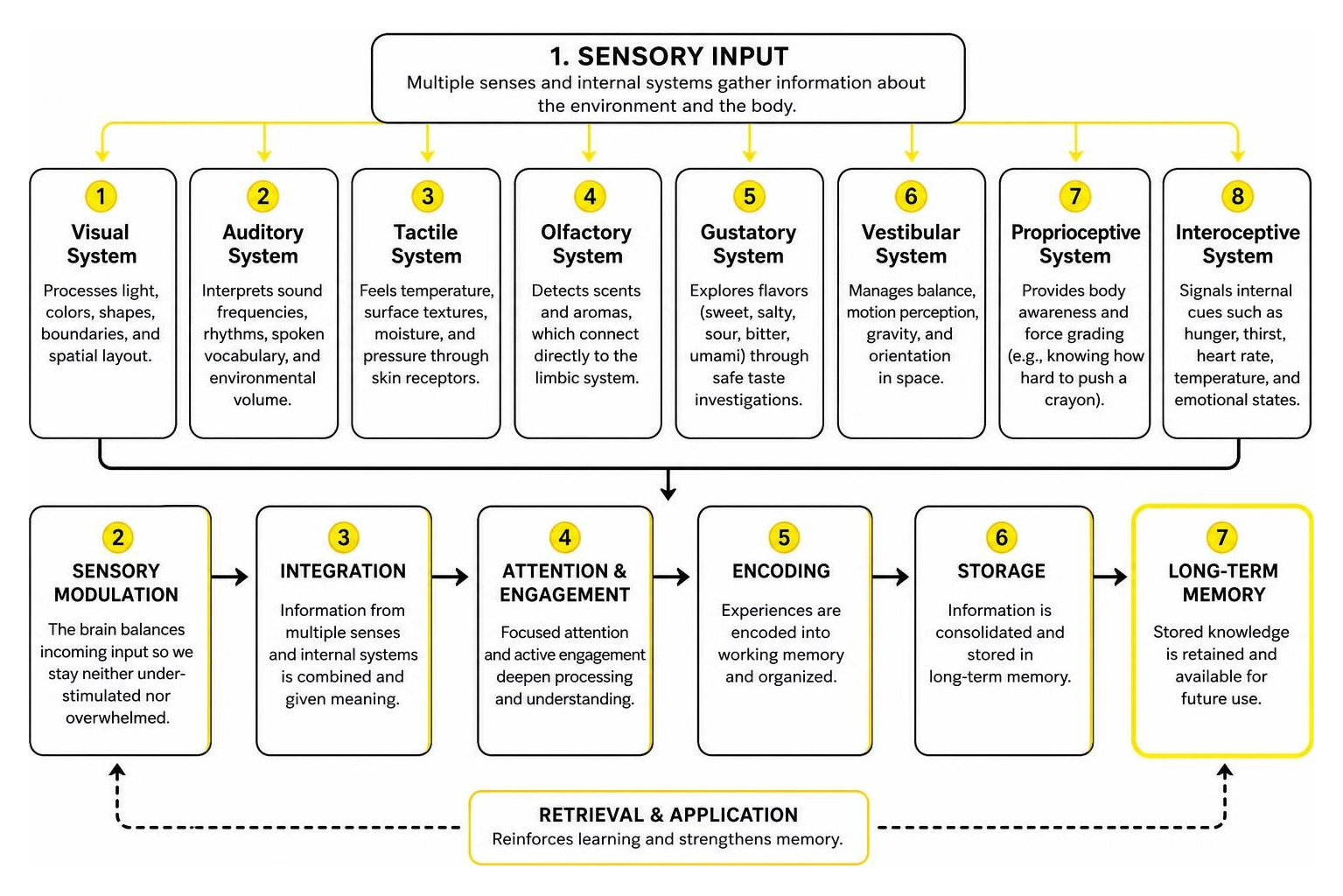
While most people can name the traditional five senses, occupational therapy and sensory integration research identify eight distinct sensory systems that work in concert:
- Visual System: Processing light, colors, shapes, boundaries, and spatial layout.
- Auditory System: Interpreting sound frequencies, rhythms, spoken vocabulary, and environmental volume.
- Tactile System: Feeling temperature, surface textures, moisture, and pressure through skin receptors.
- Olfactory System: Detecting scents and aromas, which connect directly to the limbic system (the emotional and memory center of the brain).
- Gustatory System: Exploring flavors (sweet, salty, sour, bitter, umami) through safe taste investigations.
- Vestibular System: Located in the inner ear, this manages balance, motion perception, gravity, and orientation in space.
- Proprioceptive System: Receptors in joints and muscles that provide body awareness and force grading (e.g., knowing how hard to push a crayon without snapping it).
- Interoceptive System: Internal bodily cues that signal hunger, thirst, heart rate, temperature, and emotional states.
When teachers design spaces that address both external senses and internal systems (vestibular, proprioceptive, and interoceptive), children develop better sensory modulation—the brain’s capacity to balance incoming sensory input so they stay neither understimulated nor overwhelmed.
Multisensory Instruction vs. The Myth of Learning Styles
For decades, popular culture promoted the idea that children learn best when restricted to a single “learning style” (such as being strictly a visual, auditory, or kinesthetic learner). However, contemporary cognitive science has thoroughly debunked this neuromyth. A 2025 meta-analysis concluded that educators should focus on flexible learning strategies emphasizing critical thinking, self-regulation, and deep engagement rather than perpetuating rigid learning styles.
| Feature | Debunked “Learning Styles” Theory | Multi-Sensory Integration Framework |
|---|---|---|
| Core Concept | Individuals have one fixed, preferred modality for processing all information. | The human brain naturally learns best by combining multiple senses concurrently. |
| Pedagogical Goal | Match single-medium lessons to individual student labels (e.g., visual only). | Provide multimodal access points (VAKT) for all learners during the same lesson. |
| Scientific Evidence | Lacks empirical backing in controlled cognitive trials. | Strongly supported by neuroimaging and sensory integration research. |
| Inclusivity Model | Isolates learners into rigid, self-limiting categories. | Utilizes Universal Design for Learning (UDL) principles to give everyone access. |
| Cognitive Effect | Risks limiting exposure to diverse problem-solving channels. | Strengthens neural plasticity, working memory, and cross-modal retrieval. |
Core Cognitive and Developmental Benefits for Young Learners
Engaging multiple senses builds robust neural architecture. When children explore concepts physically and conversationally, information encoding is far deeper than during passive listening. In early childhood, these multisensory experiences lay the groundwork for executive functioning: children learn to plan motor actions, maintain sustained attention, and regulate their emotional responses.
When a classroom balances sensory stimulation with structured calm, it supports self-regulation. Children discover how deep pressure (proprioception) or soothing visual rhythms can restore emotional balance, a foundational skill detailed in our guide to all about social-emotional development in toddlers: key milestones.
Supporting Neurodivergent Learners: Dyslexia, ADHD, and Sensory Processing
Multisensory structured language approaches, such as those rooted in Orton-Gillingham methods, have long been used to support children with dyslexia and language delays. While a 2022 meta-analysis emphasizes that instruction must remain explicit and systematic to be most effective, simultaneous visual, auditory, and kinesthetic tracing provides clear cognitive anchors.
For children with ADHD, purposeful movement channels excess physical energy into focused learning. Integrating balance cushions or rhythmic clapping helps maintain arousal levels within the optimal window for learning. Similarly, for children with dyspraxia or sensory motor delays, educators can use co-regulation strategies—calm adult modeling and gentle backward chaining—to help students master multi-step physical and academic tasks without triggering anxiety.
Enhancing Language Acquisition and Early Literacy
Language development flourishes when words are paired with concrete physical sensations. For young children learning English, including those who speak Polish or Ukrainian at home, multi-sensory strategies help connect new vocabulary with tactile experiences.
Tracing textured sandpaper letters while vocalizing phonemes develops muscle memory alongside auditory discrimination. Pairing new words with expressive song, physical gesture, and cultural exploration helps accelerate language acquisition.
How to Design an Effective Multi-Sensory Learning Space
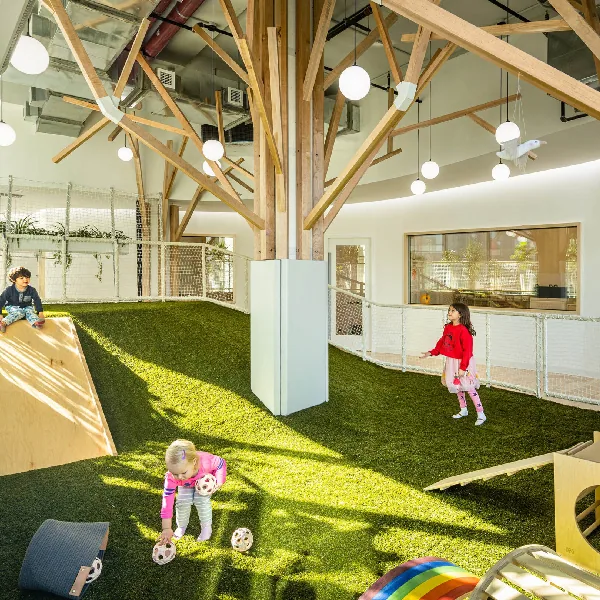
Designing a supportive classroom begins with the principle of reverse inclusion: engineering the physical space to accommodate sensitive sensory profiles creates an environment that works better for all children. Rather than covering every wall with loud, chaotic decorations, modern spatial design favors room neutrality—soft white or neutral walls that act as a calm canvas for intentional lighting, video projections, or focused student artwork.
According to empirical research on interactive multimodal environments, physical spaces that allow untethered, full-body exploration significantly enhance sustained attention and peer-to-peer social collaboration. Classrooms benefit from intentional zoning: active movement islands equipped with soft flooring, quiet reading nooks with dimmable warm lighting, and organized discovery stations with clear visual labels.
Low-Cost, High-Impact Sensory Tools and Classroom Stations
You do not need an extensive corporate budget to build an engaging sensory classroom. Everyday materials offer rich tactile and kinesthetic exploration:
- Textured Sensory Bins: Dry rice, pasta, pinto beans, split peas, or water beads paired with scoops and hidden plastic letters.
- Tactile Tracing Trays: Shallow cookie sheets filled with salt, fine sand, or shaving cream for finger-writing shapes and numbers.
- Kinesthetic Floor Markers: Colored painter’s tape lines for balance walks, hopping games, and letter-formation movement paths.
- Proprioceptive Heavy Work: Soft medicine balls, resistance bands wrapped around chair legs, and small weighted lap cushions.
- Natural Texture Collections: Pinecones, smooth river stones, tree bark, and sea shells used for tactile math counters and sorting games.
Integrating Technology and Snoezelen-Inspired Elements
Originating in the Netherlands in the 1970s, the Snoezelen philosophy focuses on controlled multi-sensory stimulation to encourage relaxation and exploratory engagement. Modern classrooms often adapt these ideas by introducing interactive projection systems, gentle bubble tubes, fiber-optic light strands, and vibroacoustic floor mats that allow children to feel the gentle vibrations of classical music. When combined with dry scent diffusers releasing calming lavender or invigorating citrus, these responsive elements create immersive thematic learning units—from an ocean habitat to a seasonal autumn forest.
Implementing Multisensory Strategies Across Curriculum and Age Groups
Applying multi-sensory strategies across the curriculum connects experiential discovery with classical pedagogical frameworks like Bloom’s Taxonomy and David Ausubel’s Learning Assimilation Theory. By using graphic pre-organizers and physical models, teachers bridge a child’s existing knowledge with abstract concepts. For instance, in our creative enrichment activities for gifted preschoolers, young learners explore math by physically grouping real wooden blocks, singing counting songs in Polish and English, and drawing mathematical patterns on large chalkboards.
Adapting a Multi-Sensory Learning Environment for Hybrid and Virtual Settings
When learning happens at home, maintaining a sensory-rich approach prevents screen fatigue. Educators and parents can collaborate using practical strategies:
- At-Home Sensory Kits: Distributing small take-home kits with modeling clay, textured fabric swatches, and rhythm sticks.
- Off-Screen Movement Breaks: Integrating “Simon Says” balance games and whole-body alphabet stretches between online segments.
- Real-World Scavenger Hunts: Asking children to find something cold, rough, or fragrant in their own kitchen to match the day’s science lesson.
- Digital and Physical Pairing: Using online interactive stories alongside physical puppets or hand-held props.
Step-by-Step Multisensory Lesson Planning Model
Teachers can follow a structured seven-step model to ensure complete sensory integration in daily lessons:
- Activate Prior Knowledge: Review familiar ideas using open-ended questions and familiar physical props.
- Focus Attention: Introduce a novel sensory cue—such as ringing a soft chime, dimming the lights, or whispering—to gather focus.
- Build Sensory Connections: Present core content using simultaneous visual imagery, verbal explanation, and hands-on objects.
- Organize Information: Use color-coded charts, graphic organizers, or floor maps to visually clarify relationships.
- Expand Imagery & Exploration: Invite children to act out concepts, role-play scenarios, or sculpt models with clay.
- Structure Problem-Solving: Provide tactile challenges, such as building balance towers or sorting objects by texture and weight.
- Practice Retrieval: Reinforce long-term retention through movement-based games, rhythmic songs, and collaborative recall.
Frequently Asked Questions About Multi-Sensory Classrooms
At what age is multisensory instruction most effective?
Multisensory instruction benefits children across all developmental stages, beginning in infancy and toddlerhood when sensory-motor exploration is the primary engine of cognitive growth. While complex integration of cross-modal inputs matures further in middle childhood (around age 8), early childhood environments build the foundational neural connections needed for later abstract thinking.
How do teachers prevent sensory overload in active classrooms?
Preventing overload requires intentional sensory modulation and continuous teacher observation. Educators should establish dedicated quiet zones or “calming corners” with soft cushions and noise-dampening headphones, use dimmable natural lighting instead of harsh fluorescent bulbs, provide clear visual transition schedules, and alternate high-energy kinesthetic games with grounding, quiet activities.
Does research support multisensory techniques in higher education?
Yes. Beyond early childhood and primary education, research models such as the Multisensory Integration Approach Model (MIAM) demonstrate substantial benefits in higher education, including undergraduate nursing instruction. In complex medical training—such as learning cardiovascular anatomy and acute coronary management—simulating blood flow with physical floor mapping, tactile vessel models, and dynamic audio-visual simulations significantly improves procedural recall and diagnostic comprehension.
Conclusion: Investing in Whole-Child Sensory Education
Creating an intentional, sensory-rich educational environment nurtures the whole child. By honoring the eight sensory systems, discarding debunked learning style myths, and weaving visual, auditory, and kinesthetic exploration into every lesson, we help young minds build lasting confidence and cognitive flexibility.
At Fantasy Island Schools for Kids, founded in 2009 by Beata Bielic, our curriculum is designed to help children ages 2-6 thrive through joyful, hands-on discovery. Located at 6100 N Milwaukee Ave, Chicago, IL 60646, we proudly serve families across Chicago’s Northwest Side and surrounding suburbs—including Norwood Park, Edison Park, Gladstone Park, Jefferson Park, Sauganash, Edgebrook, Portage Park, Niles, Park Ridge, Skokie, Norridge, and Harwood Heights.
Our programs feature certified Early Childhood Education staff trained in First Aid, CPR, and trauma-informed care, a large multi-sensory play space, weekly music classes, on-site freshly cooked meals at no extra charge, and a proven Gifted Enrichment Program with Polish and Ukrainian language support. We offer both full-time and part-time enrollment with tuition typically ranging from $300 to $400 per week, and we proudly accept CCAP (Illinois Child Care Assistance Program) and Illinois Action for Children. If you are interested in our comprehensive preschool programs, we invite you to schedule a private tour to explore our classrooms firsthand.