

How to Track Early Childhood Milestones
Early childhood milestones are skills many children develop as they grow, such as smiling, speaking, solving simple problems, and moving with more control. To track your child’s progress, check an age-based milestone list and note what you see in four areas: movement, language, thinking, and social-emotional skills. Bring your notes to well-child visits. If a skill worries you, or your child loses a skill they once had, talk with their pediatrician rather than waiting for the next checklist.
The milestones below cover birth through age five. They are guides, not a test your child must pass on a certain day. You will also find simple ways to support growth through play and daily routines. For children ages 2 to 3, our daycare program builds these skills through structured play and daily routines.
I’m Beata Bielic, Executive Director of Fantasy Island Schools for Kids, with more than 17 years of early childhood education experience and a master’s degree in psychology. In my work with young children, I use early childhood milestones to help families notice progress and know when to ask questions.
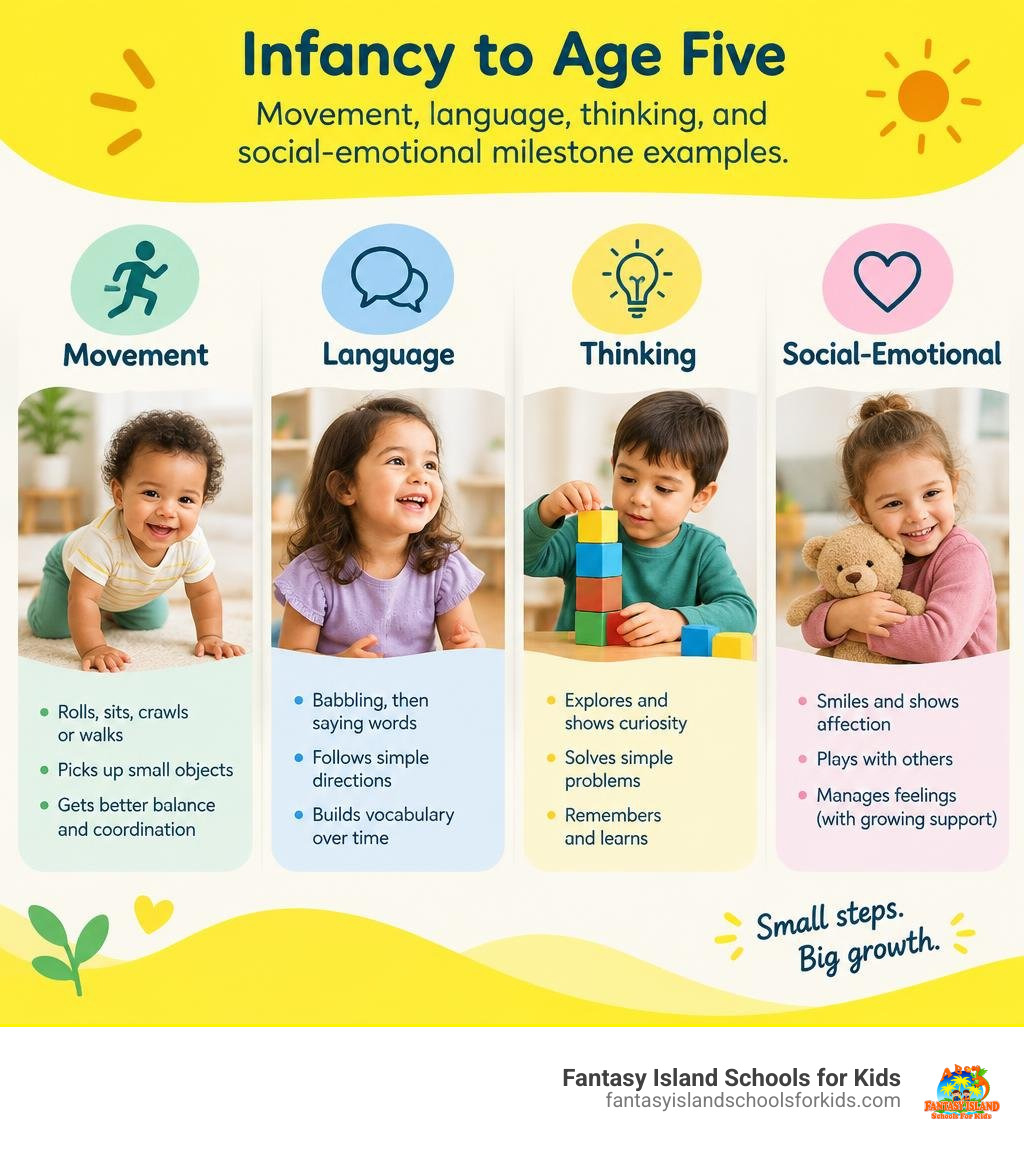
The Four Core Domains of Child Development
Childhood growth unfolds across interconnected developmental domains. When a child learns a new skill, multiple systems in the brain and body work together. A helpful resource from Boston Children’s Hospital child development overview explains that development is dynamic, where physical progress often fuels cognitive and emotional breakthroughs.
- Physical and Motor Coordination: Motor development divides into two main categories: gross motor skills and fine motor skills. Gross motor involves large muscle groups used for sitting, crawling, running, and jumping. Fine motor involves smaller muscle movements in the hands, wrists, and fingers, such as grasping a rattle, picking up finger foods, or using safety scissors.
- Social-Emotional Development: This domain encompasses how children form attachments, express emotions, manage impulses, and interact with peers. Learning empathy, self-regulation, and turn-taking forms the foundation of toddler psychosocial development milestones.
- Cognitive Processing: Cognitive milestones reflect how a child thinks, explores, reasons, and solves problems. It includes discovering cause and effect, understanding object permanence, sorting objects, and symbolic pretend play.
- Language and Communication: Communication consists of receptive language (understanding words, gestures, and directions) and expressive language (producing sounds, words, signs, and sentences). It also includes adaptive daily living skills, such as drinking from an open cup or dressing independently.
| Domain | Key Focus Areas | Everyday Examples |
|---|---|---|
| Physical (Motor) | Gross motor, fine motor, balance, hand-eye coordination | Kicking a ball, stacking blocks, holding a crayon |
| Social-Emotional | Attachment, self-regulation, empathy, cooperative play | Comforting a sad peer, sharing toys, taking turns |
| Cognitive | Memory, problem-solving, spatial awareness, reasoning | Completing puzzles, matching shapes, imaginative play |
| Language & Adaptive | Receptive/expressive speech, gestures, self-care routines | Pointing to pictures, using sentences, washing hands |
Tracking Key Early Childhood Milestones from Birth to Age 5

Tracking your child’s progress allows you to celebrate achievements and identify areas where they may benefit from extra support. The Centers for Disease Control and Prevention (CDC) breaks down early development into 12 distinct milestone checkpoints: 2 months, 4 months, 6 months, 9 months, 1 year, 15 months, 18 months, 2 years, 30 months, 3 years, 4 years, and 5 years. Standardized guidance, such as this Developmental Milestones guide, offers families an observational framework during well-child pediatric checkups.
Key Milestones: Infancy (Birth to 12 Months)
The first year of life is marked by rapid neurodevelopmental changes:
- 2 to 4 Months: Babies develop head control while lying on their bellies and begin flashing a spontaneous social smile. They track moving objects visually, coo in response to familiar voices, and discover their own hands.
- 6 Months: Most infants roll over in both directions, reach for toys using both hands, pass items from hand to hand, and begin sitting with light support. They also enjoy mirror play and make repetitive babbling sounds (e.g., “ba-ba”, “da-da”).
- 9 Months: Babies sit unsupported, pull up to a standing position, and crawl across the floor. They master the pincer grasp (holding small items between the thumb and forefinger) and understand object permanence, enjoying games like peek-a-boo.
- 12 Months: By one year, most babies say about three words (such as “mama,” “dada,” or “baba”), point to indicate desire, imitate simple gestures like waving “bye-bye,” and take their first steps with or without support.
Key Milestones: Toddlerhood (1 to 3 Years)
Between ages one and three, children transform into energetic explorers, which we explore further in our daycare program for toddlers ages 2 to 3.
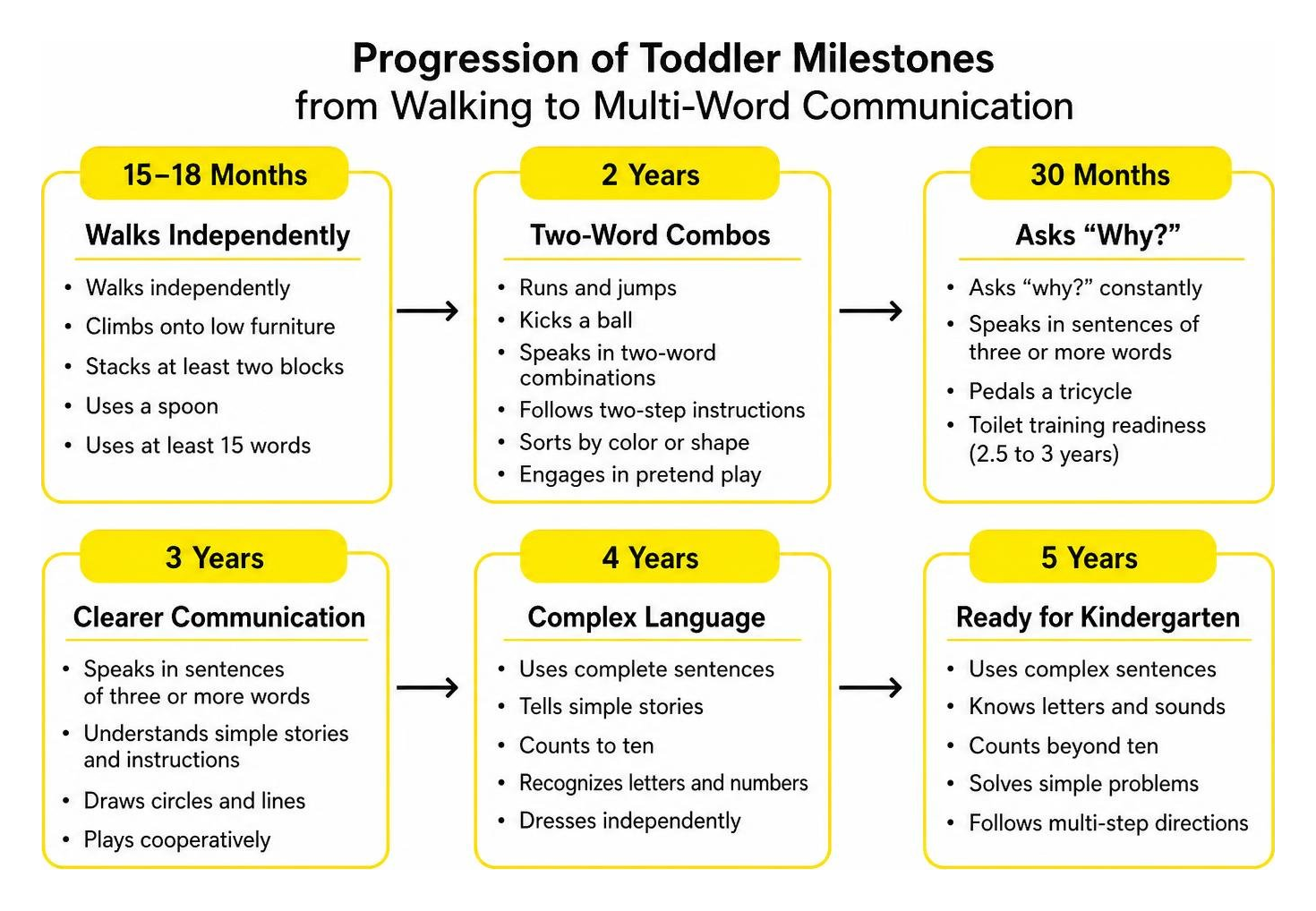
- 15 to 18 Months: Toddlers walk independently, climb onto low furniture, stack at least two blocks, and use a spoon. Expressive language expands, and children typically use at least 15 distinct words by 18 months.
- 2 Years: Toddlers run, jump with both feet off the floor, kick a ball, and speak in two-word combinations (such as “more milk” or “big dog”). They follow simple two-step instructions, sort objects by basic color or shape, and engage in basic pretend play, like feeding a stuffed animal.
- 30 Months to 3 Years: Children ask “why?” constantly, speak in sentences of three or more words, and pedal a tricycle. Most children reach peak readiness for toilet training between two and a half and three years. You can read more about these cognitive shifts in our guide to toddler cognitive milestones.
Key Milestones: Preschool and Kindergarten (3 to 5 Years)
During preschool and kindergarten years, motor precision and social skills deepen significantly:
- 3 to 4 Years: Children dress and undress with minimal help, catch a bounced ball, cut along lines with safety scissors, and draw simple circles and crosses. They recall events from yesterday, speak clearly enough for unfamiliar adults to understand, and transition from parallel play to cooperative group play.
- 4 to 5 Years: Children can draw a person with at least three distinct body parts, write some letters of their name, hop on one foot, and ride a bicycle with training wheels. They understand rules, tell multi-sentence stories, and show independence during daily hygiene routines. Mastering these self-regulation and early literacy skills prepares children for a smooth kindergarten transition.
Developmental Monitoring vs. Developmental Screening
It is helpful to distinguish between ongoing developmental monitoring and formal developmental screening.
- Developmental Monitoring: This is the continuous, informal process where parents, caregivers, and early childhood teachers observe a child’s everyday growth. Tools like the CDC Milestone Tracker app allow families to log emerging behaviors at home.
- Developmental Screening: This is a structured, formal evaluation using validated, standardized questionnaires, such as the Ages & Stages Questionnaires (ASQ-3) or the Parents’ Evaluation of Developmental Status (PEDS).
The American Academy of Pediatrics (AAP) recommends formal developmental screening for all children at 9, 18, and 30 months, with dedicated autism screenings at 18 and 24 months, or whenever a parent or educator expresses a concern. Screening does not provide a formal medical diagnosis; rather, it highlights whether a child would benefit from a comprehensive developmental evaluation by a specialist.
When to Act Early: Recognizing Delays and Taking Action
While slight variations in developmental timing are completely normal, consistent delays across milestones warrant timely attention. Understanding when to worry about developmental delays allows families to access support early, when neuroplasticity is at its highest.
Key red flags include:
- Not responding to sounds or familiar voices by 4 to 6 months
- Not sitting independently by 9 months
- Inability to walk or speak at least 15 words by 18 months
- Not using two-word meaningful sentences by age 2
- Difficulty maintaining eye contact or limited interest in interactive social play
- Loss of any previously acquired language, motor, or social skill at any age
If your child exhibits any of these signs, contact your pediatrician to request a formal evaluation. For children under 36 months, families can also self-refer to their state’s Early Childhood Intervention (ECI) program (in Illinois, known as Child and Family Connections under the Department of Human Services). These programs provide multidisciplinary developmental therapies regardless of family income.
Why Early Childhood Milestones Matter for Long-Term Growth
During the first five years, the brain forms over one million new neural connections every second, according to Harvard University’s Center on the Developing Child. Child development experts often note that learning is non-linear; children may experience temporary “touchpoints,” or brief behavioral regressions (such as changes in sleep or temporary clinginess), right before making a major cognitive or motor leap. Tracking milestones helps caregivers distinguish between normal developmental touchpoints and systemic delays, ensuring children build a strong neurodevelopmental base for future school success.
How Early Education Programs Support Early Childhood Milestones
High-quality early learning environments provide intentional opportunities to nurture all developmental domains. A structured classroom balances social-emotional guidance, multi-sensory materials, and cognitive exploration. Daily routines that incorporate gross-motor challenges, music classes, and responsive teacher interactions provide consistent scaffolding tailored to each child’s individual pace.
At Fantasy Island Schools for Kids, we serve children ages 2 to 6 with an experiential curriculum designed to support these foundational milestones. Our classrooms feature small class sizes, weekly music instruction, and certified Brain Gym activities twice weekly to boost motor coordination and cognitive integration.
Frequently Asked Questions About Early Childhood Milestones
What is the difference between a developmental milestone and a developmental screening?
A developmental milestone is an observable skill (like pointing, walking, or speaking in sentences) that most children achieve by a certain age. A developmental screening is a formal, standardized questionnaire (like the ASQ-3) administered by a healthcare or education professional to determine if a child needs a comprehensive diagnostic assessment.
What should I do if my child misses a milestone?
If your child has not met several milestones within an age bracket, log specific observations and schedule an appointment with your pediatrician. You do not need a physician’s referral to contact your local Early Intervention program if your child is under age three. Early support leads to significantly better long-term developmental outcomes.
What are the AAP screen time recommendations for young children?
The American Academy of Pediatrics recommends avoiding digital screen media (other than video chatting with loved ones) for children younger than 18 months. For children ages 2 to 5 years, the AAP advises limiting screen use to no more than one hour per day of high-quality programming, ideally co-viewed with a caregiver to help explain concepts.
Conclusion
Every child grows at their own unique pace, but monitoring milestones provides a clear roadmap to ensure they receive the right encouragement and support at every stage. Celebrating small achievements—from their first steps to their first complex sentences—builds confidence for lifelong learning.
If you are looking for an enriched, nurturing environment for your child, schedule a tour at Fantasy Island Schools for Kids to see how our experiential curriculum supports early growth.