

What Is Social Emotional Development in Toddlers and Why Does It Matter?
At its core, social emotional development toddlers navigate involves two intertwined domains: social growth (how a child relates to adults and peers) and emotional growth (how a child identifies, expresses, and manages feelings). During the toddler years, children undergo rapid brain architecture shifts. The first three years of life represent the most pivotal, vulnerable period for brain development, where early experiences physically shape neural pathways.
During this phase, the right brain limbic system—the seat of raw emotion and fear response—matures faster than the prefrontal cortex, which governs executive function, decision-making, and impulse control. This neurobiological reality explains why a two-year-old cannot simply “think through” intense frustration when a block tower falls. They rely heavily on adults to serve as an external brain, lending calm and support through co-regulation.
Research highlighted by the StatPearls Developmental Stages of Social Emotional Development underscores that roughly 20% to 25% of children seen in primary care clinics experience clinically significant social-emotional challenges. Early attention to emotional health is vital because social-emotional characteristics—such as self-regulation, persistence, and interpersonal skills—play a massive role in long-term success at school, in friendships, and in life, often predicting future well-being more reliably than early IQ metrics alone.
Key Milestones of Social Emotional Development Toddlers Experience
Every child grows at their own pace, but toddlerhood features recognizable milestones as children transition from individual exploration toward social play.

Between 12 and 36 months, toddlers shift from parallel play (playing side-by-side without direct interaction) to interactive, cooperative play. Understanding these stages helps parents and caregivers set realistic expectations and offer appropriate support.
| Age Range | Key Social-Emotional Milestones | Caregiver Support Strategy |
|---|---|---|
| 12–18 Months | Uses proto-declarative pointing to share interest; uses caregivers as a safe base; imitates simple adult actions. | Provide steady physical presence; label simple emotions (“happy”, “sad”); play interactive turn-taking games. |
| 18–24 Months | Begins parallel play alongside peers; uses words like “mine” and “no” to assert independence; shows emerging empathy. | Scaffold problem-solving; praise efforts and persistence; maintain predictable daily routines. |
| 24–30 Months | Moves from parallel play into short interactive play bursts; experiences complex emotions (shame, pride, jealousy). | Offer clear binary choices to head off tantrums; introduce explicit feeling vocabulary; use pretend play. |
| 30–36 Months | Engages in sustained pretend play; calms down within 10 minutes after separation; verbalizes needs during conflicts. | Guide peer conflict mediation; set firm, consistent limits with reasons; encourage home culture and language. |
Core Stages of Social Emotional Development Toddlers Reach (12 to 24 Months)
In the first half of toddlerhood, children rely on caregivers as a primary “safe home base.” An 18-month-old will venture across the room to explore a new toy, only to look back and make eye contact with a parent for reassurance before continuing.
During this window, toddlers show significant growth through proto-declarative pointing—pointing at a dog in the park not because they want it, but to share excitement with you. They also begin imitating emotional expressions and simple domestic tasks, such as feeding a teddy bear with a plastic spoon. Turn-taking games like rolling a ball back and forth lay early foundations for sharing and conversation, as detailed in Zero to Three’s 12 to 24 Months Guide.
Advanced Stages of Social Emotional Development Toddlers Reach (24 to 36 Months)
As children pass two years of age, their inner world expands dramatically. Between 24 and 36 months, toddlers enter what developmental experts call an “interactive play explosion.” They begin playing with peers rather than just alongside them, negotiating roles in imaginative games like running a pretend restaurant or building a shared train track.
With increased self-awareness comes complex self-conscious emotions such as embarrassment, pride, shame, and jealousy. As noted in Zero to Three’s 24 to 36 Months Development Framework, older toddlers are actively learning to name these internal feelings. While their desire for autonomy is strong (“I do it!”), their impulse control is still maturing, making warm adult guidance during peer disputes essential.
Practical Strategies and Activities to Promote Social-Emotional Growth
Supporting social emotional development toddlers need at home does not require expensive tools—it thrives on intentional daily micro-interactions.
Emotion Coaching and Co-Regulation
When big feelings surge, toddlers cannot regulate alone. Practice emotion coaching by validating their state before jumping to solutions:
- Name it to tame it: Say, “You are feeling so frustrated because that puzzle piece won’t fit.”
- Offer physical comfort: A gentle touch, lower tone, or deep breath together helps calm their limbic system.
- Set limits with warmth: “It is okay to feel angry, but it is not okay to throw blocks.”
Process Praise vs. Outcome Praise
Praising effort over results builds emotional resilience and grit. Instead of saying “Good job building that tower!”, try “You worked so hard trying different blocks on the carpet until you found ones that stayed balanced!” Celebrating persistence teaches toddlers that making mistakes is simply part of learning.
Structured Play Activities for Emotional Literacy
- Feelings Charades & Mirror Play: Make funny or exaggerated faces in front of a mirror (excited, surprised, worried) and ask your toddler to guess or copy the emotion.
- Non-Sharing Cooperative Games: To minimize peer friction, offer activities where toddlers work near each other without fighting over single items—such as large floor coloring sheets, sensory water tables with separate buckets, or play-dough sculpting.
- Creating a “Friend Book”: Gather photos of family members, classmates, or playdate friends. Assemble a small book and talk about what each person likes to do, fostering social awareness and perspective-taking.
- Breathing Bubbles: Teach deep breathing by asking your toddler to blow slow, gentle bubbles. This physical exercise can be used later to help them settle during frustrating moments.
For structured approaches to these foundational skills, many parents refer to early learning models like the CASEL Framework for Toddlers (Ages 2-6), which translates core competencies like self-awareness and relationship skills into simple home routines.
Addressing Challenges, Cultural Backgrounds, and Developmental Red Flags
Navigating Tantrums and Developing Impulse Control
Temper tantrums are a natural result of a toddler’s strong desires outstripping their verbal and physical capabilities. Expecting consistent impulse control before ages 6 or 7 is physiologically unrealistic. Parents can reduce melt-downs by offering structured binary choices (e.g., “Do you want to put on your blue shoes or your red shoes first?”), providing predictable visual daily schedules, and giving advance warnings prior to routine transitions.
Integrating Home Culture and Native Language
A child’s social-emotional health is deeply rooted in their family culture and home language. Research highlighted in the California Department of Education PTKLF Framework emphasizes that preserving native home languages strengthens a toddler’s sense of belonging and identity.
At Fantasy Island Schools for Kids, located at 6100 N Milwaukee Ave in Chicago, we celebrate this rich cultural diversity daily. English is the language of instruction, and our Polish- and Ukrainian-speaking teachers can comfort and guide children in the language they know from home. Serving families across Chicago’s Northwest Side—including Norwood Park, Gladstone Park, and nearby suburbs like Niles and Park Ridge—our early learning programs offer a warm, inclusive setting where children feel understood in their home language while developing essential social-emotional skills.
Recognizing Developmental Red Flags
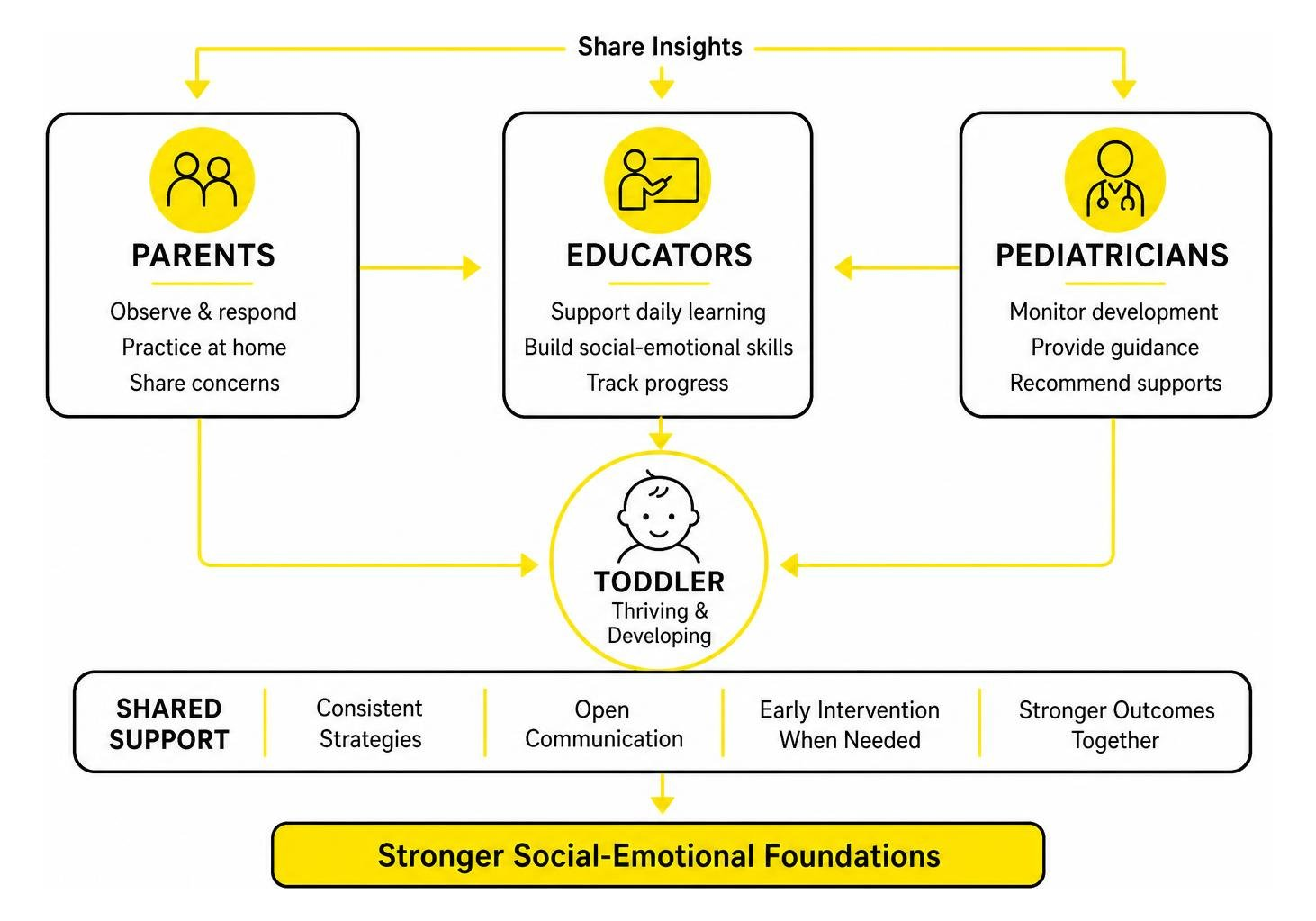
While developmental variation is normal, persistent patterns may indicate a need for professional guidance. Parents should consult their pediatrician or reach out for early intervention screenings if a toddler:
- Shows persistent lack of eye contact or does not respond to their name by 18 months.
- Demonstrates no interest in interacting with caregivers or peers.
- Experiences severe regression in social skills or language abilities.
- Cannot be soothed or calm down after 20–30 minutes despite consistent adult support.
- Does not engage in joint attention or proto-declarative pointing by 18 to 24 months.
In Chicago, families can access free multidisciplinary evaluations through the Illinois Early Intervention program or consult with early childhood specialists to ensure every child receives timely support.
Frequently Asked Questions About Toddler Social-Emotional Development
How can parents help toddlers manage temper tantrums without escalating conflict?
Maintain a calm voice and low body language to avoid matching the toddler’s high intensity. Validate their emotion (“I see you are angry”), ensure physical safety, and avoid lengthy lectures while they are upset. Once they have calmed down through co-regulation or deep breathing, help them name what happened and offer simple choices for moving forward.
What is the difference between parallel play and interactive play in toddlers?
Parallel play occurs when toddlers play side-by-side with similar toys (e.g., two children playing with cars next to each other) without actively coordinating their play. Interactive play, which emerges around 24 to 36 months, involves shared goals, role-playing, turn-taking, and active verbal communication during play.
When should parents seek professional evaluation for a toddler’s social-emotional progress?
Seek professional guidance if your child exhibits extreme, long-term distress during daily routines, complete lack of interest in social engagement, absence of eye contact, loss of previously acquired speech or social milestones, or inability to self-soothe even with warm caregiver assistance.
Nurturing Lifelong Emotional Resilience
Fostering strong social emotional development toddlers need requires patience, consistency, and a warm, responsive environment. By validating big feelings, encouraging effort over outcomes, and modeling calm problem-solving, you give your child the tools to build healthy relationships and navigate life’s challenges with confidence.
At Fantasy Island Schools for Kids, founded in 2009 by Beata Bielic, we incorporate these principles into every aspect of our care. Located at 6100 N Milwaukee Ave, Chicago, IL 60646, our certified early childhood team provides full-time and part-time programs (Mon–Fri, 7 AM – 6 PM) for children ages 2 to 6. Our curriculum includes a Gifted Enrichment Program, rich multi-sensory indoor play spaces, weekly music classes, and freshly cooked daily meals at no extra cost, with tuition around $300–$400/week. We accept CCAP (Illinois Child Care Assistance Program) and Illinois Action for Children to ensure quality care remains accessible.
Whether you reside in Jefferson Park, Edgebrook, Niles, or neighboring Northwest Chicago communities, our team is dedicated to supporting your child’s emotional growth and school readiness. Contact us today to schedule a tour and see our vibrant early childhood community in action!