

Find a CCAP Daycare Chicago Families Can Trust
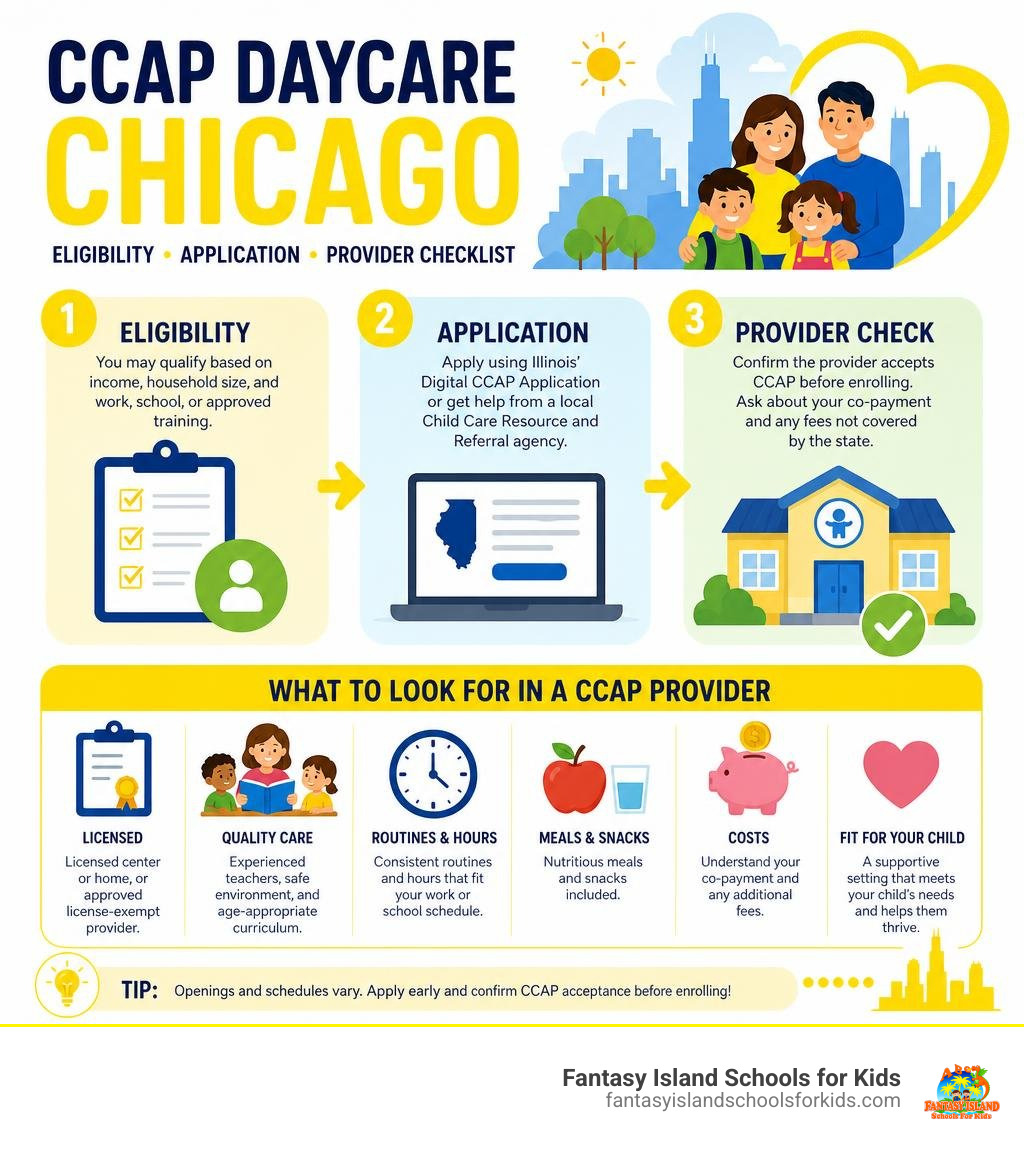
CCAP Daycare Chicago options include licensed child care centers, licensed homes, and some approved license-exempt providers that accept Illinois Child Care Assistance Program payments. CCAP can lower the cost of care for eligible families while parents work, attend school, or take part in approved training.
For a quick starting point:
- Check whether your income, household size, and work or school schedule may qualify.
- Use Illinois’ Digital CCAP Application or ask a local Child Care Resource and Referral agency for help.
- Confirm that the provider accepts CCAP before enrolling, and ask about your co-payment and any fees not covered by the state.
- Compare more than price. Look at licensing, classroom routines, teacher experience, meals, hours, and whether the setting fits your child’s needs.
Chicago parents have more choices than they may realize, but openings, schedules, and provider participation can vary. This guide will help you understand the program and compare CCAP-accepting care with clear questions to ask along the way.
At Fantasy Island Schools for Kids, founded in 2009 by Beata Bielic at 6100 N Milwaukee Ave in Chicago, we serve children ages 2-6 with full-time and part-time care, Monday through Friday from 7 AM to 6 PM. I am Beata Bielic, and with more than 17 years in early childhood education, I help families on Chicago’s Northwest Side and nearby suburbs understand their CCAP Daycare Chicago options, including our school’s acceptance of CCAP and Illinois Action for Children assistance.
Understanding CCAP Daycare Chicago Eligibility and Administration
Navigating state child care financial assistance can feel complex, but understanding how the Child Care Assistance Program (CCAP) works makes the process manageable. CCAP is designed to help low-income working families, students, and parents participating in state-approved activities access high-quality early care and education for children up to age 13 (or up to age 19 for children with documented special needs).
Who Qualifies for CCAP Daycare Chicago Financial Assistance?
Eligibility for child care subsidies in Illinois is determined by several core criteria: your family size, gross monthly household income, county of residence (such as Cook County), and your involvement in qualifying activities.
Parents and guardians may qualify if they are engaged in:
- Employed work: Working full-time or part-time.
- Educational programs: Attending high school, trade school, GED courses, or ESL classes.
- Higher education: Pursuing an undergraduate degree at a 2-year or 4-year college or university with low or no income.
- Approved training: Participating in Temporary Assistance for Needy Families (TANF) work-related activities.
To verify your specific eligibility requirements, parents can review details through the Get Help Paying for Child Care – Illinois Department of Early Childhood resource. Because income limits and program guidelines update periodically, we always advise families not to assume they are ineligible—rather, direct specific qualification questions to your provider or contact Illinois Action for Children for guidance.
IDEC Governance and the 2026 Program Transition
Significant state-level administrative updates took effect in 2026. Effective July 1, 2026, the newly formed Illinois Department of Early Childhood (IDEC) officially became the lead state agency responsible for overseeing CCAP, early childhood licensing, Head Start, and state early education grants.
This governance transition consolidated programs formerly managed across the Illinois Department of Human Services (IDHS) and the Illinois State Board of Education (ISBE) under one umbrella. For Chicago parents, this means a more unified early learning system, streamlined licensing oversight, and modernized digital tools for managing child care subsidies.
How to Apply for Illinois Child Care Assistance Subsidies
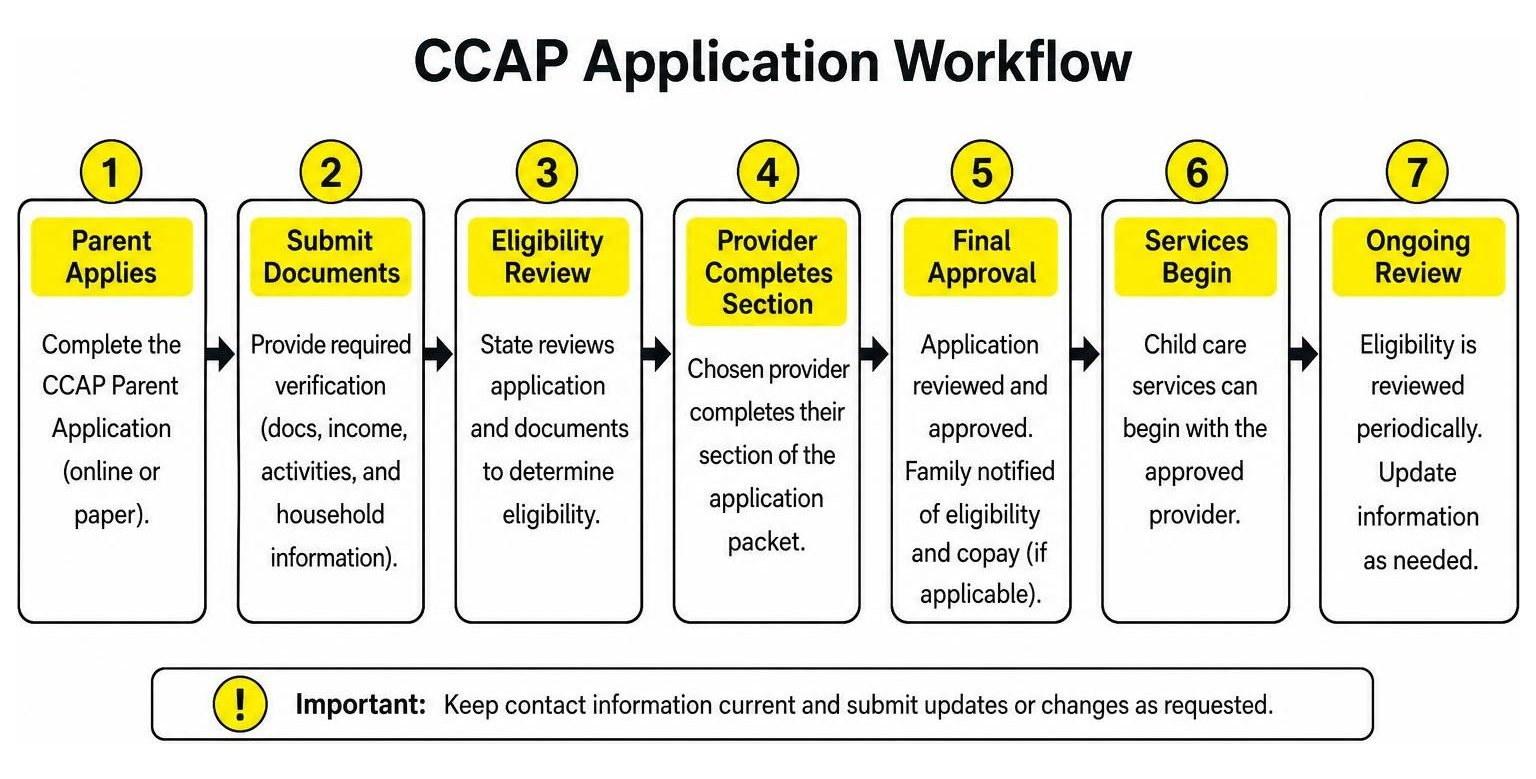
Securing assistance begins with completing a official application packet that includes sections for both the parent and your chosen early childhood learning center.
Step-by-Step Digital Application Process
Illinois offers a mobile-ready Digital CCAP Application accessible across smartphones, tablets, and computers. Parents can also submit paper applications through their local Child Care Resource and Referral (CCR&R) agency.
To ensure your application is processed without unnecessary delays:
- Complete the Parent Section: Fill out your family details, household size, employment schedule, or school transcripts.
- Submit Income Verification: Provide 30 consecutive days of recent pay stubs. If you just started a new job and do not have pay stubs yet, you can submit an official letter on employer letterhead signed by a manager detailing your start date, hourly pay rate, weekly hours, work schedule, and company tax ID (FEIN).
- Have Your Provider Complete Their Section: Your selected daycare or preschool must complete and sign their designated provider portion of the application.
- Submit for Review: Send the completed package via the digital portal or submit directly to your local CCR&R.
Timing is critical when applying. State rules dictate that CCAP applications can only be backdated a maximum of seven days from the date the application is officially received by the CCR&R office. Applying as early as possible before or right as care starts minimizes potential out-of-pocket tuition expenses prior to official state approval.
For complete administrative guidance and step-by-step renewal rules, parents can consult A Parent’s Guide to CCAP | Child Care Resource Service | Illinois. Approved CCAP cases are generally authorized for a 12-month period, after which parents must complete a redetermination process during their 11th month to maintain continuous coverage.
Finding an Approved CCAP Daycare Chicago Provider Near You
Finding the right early care environment involves matching your child’s developmental needs with a quality provider that accepts state subsidies. In the Chicago metropolitan region, families receive direct assistance from local agencies such as Illinois Action for Children, which supports nearly 200,000 children and families every year across Cook County.
Parents can search for community support and intake details through the Child Care Assistance Program (CCAP) – Illinois Department of Human Services (IDHS) serving Chicago, IL | findhelp.org /6350549503574016?postal=60601) directory or contact live referral specialists.
When evaluating potential schools, look beyond basic financial assistance. Explore neighborhood program structures and full-day schedules by reading our guide on Navigating Full-Day Preschool Options Across Chicago Neighborhoods to learn how classroom routines, enrichment activities, and licensed staff support early development.
Covered Care Types, Co-Payments, and Chicago Enrollment Trends
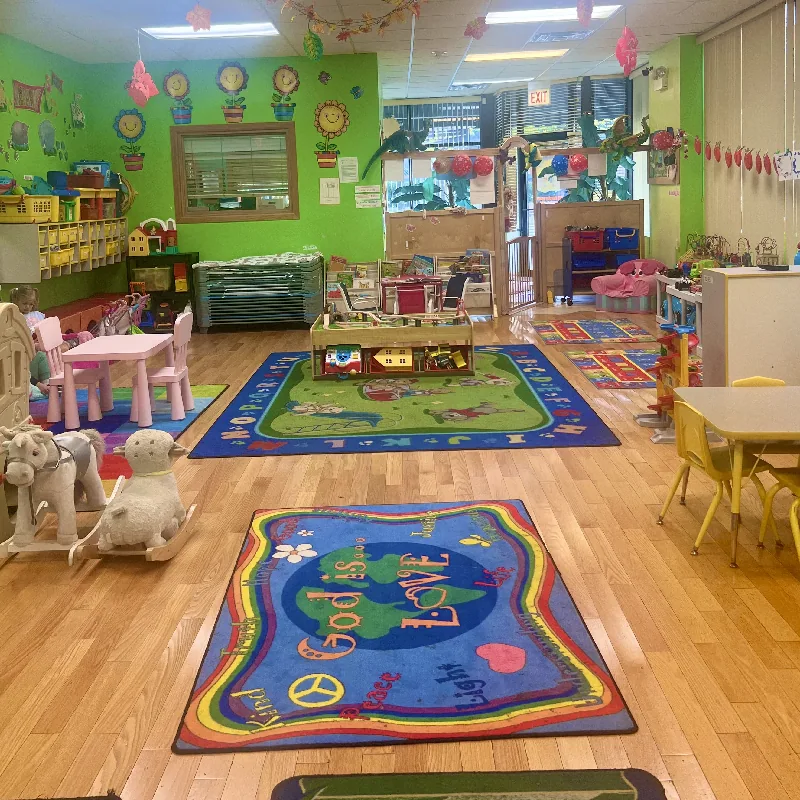
The Illinois Child Care Assistance Program reimburses authorized care across a range of setting types to ensure working parents can find care that fits their family structure.
Types of Care Covered and Provider Resources
CCAP covers several categories of early care and education providers:
- Licensed Child Care Centers: Facility-based programs operating under strict state safety, staffing, and educational standards.
- Licensed Family Child Care Homes: Home-based programs providing care in a residential setting.
- License-Exempt Care: Certain relative care arrangements or exempt school-age center programs.
To maintain eligibility to receive state payments, non-relative providers must meet health and safety requirements, complete First Aid/CPR certifications, receive trauma-informed care training, and clear state and FBI background checks (including CANTS screening).
Once approved, payments are issued directly from the Illinois Office of the Comptroller to the child care provider, minus the parent’s calculated monthly co-payment.
Understanding Co-Payments, Provider Fees, and Take-Up Rates
Every family approved for CCAP is assigned a monthly state co-payment based on family size and gross monthly income. This co-payment is paid directly to your child care provider. If a family utilizes two separate providers (for instance, a full-time weekday preschool and a weekend provider), the single monthly co-payment is assigned strictly to the provider receiving the larger portion of state reimbursement.
| Care Schedule Type | State Care Hour Threshold | Co-Payment Allocation Rule |
|---|---|---|
| Full-Day Care | 5 to 12 hours per day | Full daily rate paid; standard monthly co-payment assigned to primary provider. |
| Part-Day Care | Less than 5 hours per day | Part-day rate applied; co-payment split only if primary provider care is under maximum state threshold. |
| Dual Provider Usage | Split weekly schedule | Entire family co-payment assigned solely to the provider receiving higher total state reimbursement. |
It is important to note that child care providers are permitted under program rules to charge families differential fees if the provider’s standard tuition rate exceeds the state reimbursement rate, or for optional registration, materials, or activity fees. Always review tuition policies with your provider prior to enrollment.
Statewide research reveals that CCAP take-up rates vary by age group and geographic location. Overall CCAP take-up rates in 2023 were 42% for infants and toddlers (ages 0-2), 48% for preschool-age children (ages 3-5), and 22% for school-age children (ages 6-12). Urban counties like Cook County consistently demonstrate the highest participation rates across Illinois, particularly within racially diverse and vibrant metropolitan zip codes.
Frequently Asked Questions about CCAP Daycare in Chicago

How fast can a CCAP application be backdated in Illinois?
Under Illinois state policy, a CCAP application can only be backdated a maximum of seven (7) days prior to the date the application packet is officially stamped and received by your local Child Care Resource and Referral (CCR&R) agency. Any child care services rendered prior to that 7-day window cannot be covered by state subsidy funds, making early submission critical.
What changes must parents report to maintain CCAP eligibility?
Parents enrolled in CCAP have legal rights and responsibilities to maintain accurate records. You must report changes in family size, gross monthly income, household address, or work/school hours to your CCR&R agency within 10 business days. If you plan to change your child care provider, you must notify the agency at least 30 days before the transition occurs.
Can child care providers charge fees beyond the state co-payment?
Yes. While state guidelines establish the required monthly co-payment, providers are allowed to charge additional tuition differences if their standard public rate exceeds the combination of the state reimbursement rate plus your assigned co-payment. Providers may also charge separate enrollment fees or late pickup charges if specified in their written parent agreement.
Conclusion: Securing Quality Early Learning on Chicago’s Northwest Side
Finding a quality CCAP Daycare Chicago provider means looking for a safe, nurturing environment where your child can thrive academically, socially, and emotionally. At Fantasy Island Schools for Kids, founded in 2009 by Beata Bielic and located at 6100 N Milwaukee Ave, Chicago, IL 60646, we believe every family deserves exceptional early education.
We serve children ages 2-6 with full-time and part-time options, operating Monday through Friday from 7 AM to 6 PM. Our service area spans Chicago’s Northwest Side and surrounding suburbs, welcoming families from Norwood Park, Edison Park, Gladstone Park, Jefferson Park, Sauganash, Edgebrook, Portage Park, Niles, Park Ridge, Skokie, Norridge, and Harwood Heights.
Our standard weekly tuition ranges around $300-$400/week, which includes freshly cooked daily meals, specialized weekly music instruction, and our Gifted Enrichment Program at no extra charge. To ensure our quality care remains accessible to working parents, we proudly accept CCAP (Illinois Child Care Assistance Program) and Illinois Action for Children financial assistance.
Our certified early childhood educators are First Aid/CPR certified, trained in trauma-informed care, and dedicated to school readiness. Our English-language program, with Polish and Ukrainian support, helps every child feel at home, and parents frequently tell us how confident they feel watching their children progress into top-tier gifted kindergarten programs.
If you are evaluating daycare costs, navigating subsidy application steps, or looking for a vibrant multi-sensory environment for your child, we invite you to reach out to our team today.
To learn more about our classroom openings and enrollment options, visit Fantasy Island Schools for Kids.