

A Working Parents Childcare Guide for Making Confident Choices
A Working Parents Childcare Guide starts with one clear goal: find safe, dependable care that fits your work hours, your budget, and your child’s needs.
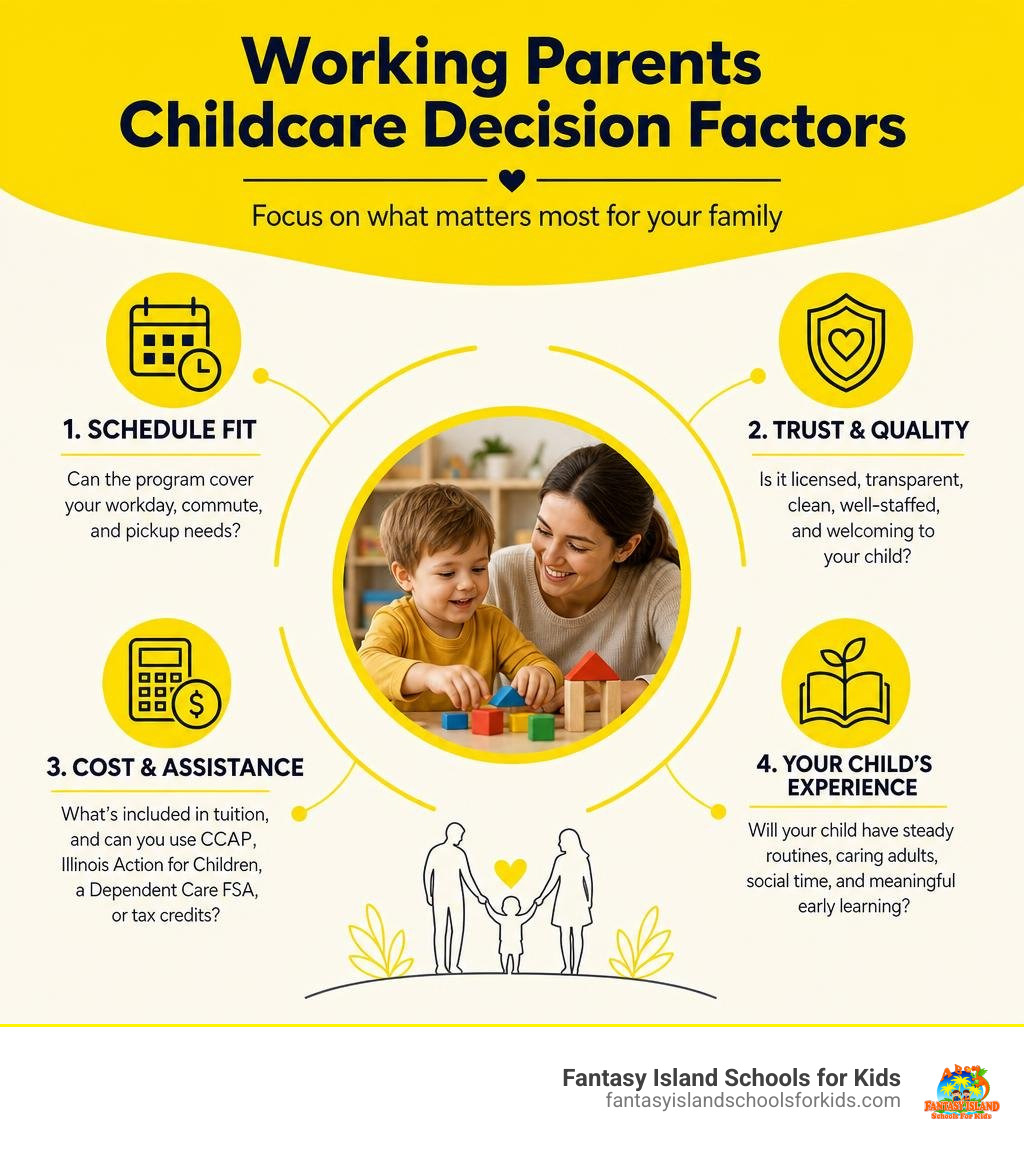
For many families, the best choice is a licensed program with reliable weekday hours, trained teachers, clear safety practices, age-appropriate learning, and a backup plan for sick days or closures. As you compare options, focus on these four factors:
- Schedule fit: Can the program cover your workday, commute, and pickup needs?
- Trust and quality: Is it licensed, transparent, clean, well-staffed, and welcoming to your child?
- Cost and assistance: What is included in tuition, and can you use CCAP, Illinois Action for Children, a Dependent Care FSA, or tax credits?
- Your child’s experience: Will your child have steady routines, caring adults, social time, and meaningful early learning?
Childcare is not a minor household task. It affects your income, daily stress, career choices, and your child’s routine. Nationally, families often spend far more than the federal affordability benchmark of 7% of household income on care. That makes it especially important to compare the full picture, not just weekly tuition.
At Fantasy Island Schools for Kids, founded in 2009 by Beata Bielic, families can find full-time and part-time care for children ages 2-6, Monday through Friday from 7 AM to 6 PM. Located at 6100 N Milwaukee Ave, Chicago, IL 60646, we serve Chicago’s Northwest Side and nearby suburbs with tuition generally around $300-$400 per week, including meals, music, and gifted programming; CCAP and Illinois Action for Children are accepted.
I am Beata Bielic, Executive Director of Fantasy Island Schools for Kids, and I have worked in early childhood education since joining the school as a teacher in 2009. Through this Working Parents Childcare Guide, I will help you weigh the practical questions parents face when choosing care and building a routine that works for the whole family.
Working Parents Childcare Guide: Comparing Options, Costs, and Flexibility
When structuring your family’s care arrangements, understanding how different childcare models balance cost, scheduling flexibility, and developmental benefits is essential. Across the United States in 2026, childcare costs vary drastically depending on the setting, caregiver qualifications, and whether program tuition includes baseline necessities like meals and enrichment programs.
For parents managing full-time job responsibilities, reliability and consistent coverage hours are often the decisive factors. Below is a comparative overview of common center-based care options available to working families:
| Childcare Model | Average Estimated Cost (2026 Rates) | Schedule Flexibility | Reliability & Coverage | Social & Educational Focus |
|---|---|---|---|---|
| Licensed Center Daycare & Preschool | $300–$600/week (Toddlers) $250–$500/week (Preschool/Pre-K) |
Set daily hours (e.g., 7 AM–6 PM); high consistency | High (open during staff vacations; strict calendar) | High structured learning, group socialization, multi-sensory play |
| Family Child Care (Home Daycare) | $200–$400/week | Moderate; negotiable with single owner | Moderate (subject to provider illness/vacation) | Small group socialization, cozy home environment |
Licensed Center-Based Daycare and Preschool Programs
Licensed early childhood education centers provide working parents with high operational reliability. Unlike individual in-home caregivers, professional centers maintain full staff coverage, ensuring care remains available even when primary classroom teachers take time off or are ill.
For parents comparing options across Chicago, licensed facilities operate under state mandates governing staff-to-child ratios, sanitation, security, and teacher qualifications. Structured group environments offer children daily exposure to foundational socialization, peer interaction, and educational routines. When evaluating local early learning programs, take time to explore navigating full day preschool options across chicago neighborhoods to see how classroom structures align with your family’s daily commute.
At Fantasy Island Schools for Kids, we combine this structural reliability with specialized enrichment. Our certified early childhood educators are CPR/First Aid certified and trained in trauma-informed care. Our program features a dedicated Gifted Enrichment Program, weekly music instruction led by a qualified music teacher, a large multi-sensory play space, freshly cooked daily meals served at no extra charge, and a multilingual learning environment with fluent Polish and English educators.
Full-Time vs. Part-Time Center Care Schedules
Many working families do not require identical coverage hours every day of the week. Hybrid work models, compressed workweeks, and rotating work shifts have created a demand for flexible enrollment structures.

- Full-time center enrollment (5 days/week): Ideal for parents working traditional 40-hour workweeks or commuting daily. Full-time enrollment provides young children with seamless daily routines, steady peer relationships, and maximum coverage (such as our 7 AM to 6 PM schedule).
- Part-time center enrollment (2-3 days/week or half-days): Excellent for parents working remote hybrid schedules or part-time shifts. Part-time attendance introduces young children to structured classroom routines, social play, and pre-academic concepts while keeping weekly tuition aligned with reduced coverage needs.
Combining Center Enrollment with Family Support
For families with non-traditional work hours—such as healthcare professionals, emergency responders, or evening shift workers—standard center hours may not cover every working hour. In these instances, parents often ask trusted relatives to help bridge the gap before or after center hours.
Grandparent or relative support can complement a licensed program by covering early morning drop-offs or late afternoon hours. Combining center enrollment with family support provides children with peer interaction and educational structure while giving family helpers predictable, manageable schedules. To evaluate how these options impact your long-term household budget, consult Back to Work? Here’s What Childcare Will Actually Cost You (2026) | Daycare Cost Guide.
Navigating Costs, Subsidies, and Workplace Rights

Childcare costs are a primary expense for working families. Taking advantage of tax-advantaged accounts, state assistance programs, and workplace leave protections helps families keep high-quality early education affordable.
Financial Assistance, Tax Credits, and Dependent Care FSAs
Working parents have several financial tools available to help offset annual childcare costs:
- Dependent Care Flexible Spending Accounts (FSAs): Employer-sponsored Dependent Care FSAs allow eligible working parents to set aside up to $5,000 pre-tax per household annually ($2,500 if married filing separately) for qualified care expenses, including licensed daycare, preschool, and day camps. Paying for care with pre-tax dollars reduces your overall taxable income, saving many families 20% to 30% or more depending on their tax bracket.
- Child and Dependent Care Tax Credit: For expenses not reimbursed through an FSA, parents can claim federal tax credits for eligible care expenses (up to $3,000 for one qualifying child or $6,000 for two or more children).
- State Child Care Subsidies (Illinois CCAP): State assistance programs help eligible lower- and moderate-income working families cover childcare costs. In Illinois, the Child Care Assistance Program (CCAP), administered through organizations like Illinois Action for Children, reimburses licensed providers directly, requiring families to pay only a modest monthly co-pay.
If you are exploring state financial aid, review Affordable Daycare Options: How to Find Childcare You Can Afford | ChildCarePath for nationwide budgeting principles.
At Fantasy Island Schools for Kids, we accept CCAP and Illinois Action for Children subsidies to ensure local families have access to high-quality early education. Parents curious about applying state assistance toward our tuition (which ranges from $300–$400 per week, including meals, music, and gifted programming) are encouraged to contact our office or Illinois Action for Children directly for income guidelines and application procedures.
Legal Rights, Family Leave, and Employer Benefits
Understanding your legal rights as a working parent helps you advocate for necessary workplace accommodations:
- Family and Medical Leave Act (FMLA): Federal law grants eligible employees up to 12 weeks of unpaid, job-protected leave per year for the birth, adoption, or foster placement of a child, as well as to care for a family member with a serious health condition.
- Providing Urgent Maternal Protections (PUMP) for Nursing Mothers Act: The federal PUMP Act expands rights for nursing mothers, requiring employers to provide reasonable break time and a private, secure space (that is not a bathroom) to express breast milk for up to one year following a child’s birth.
- Employer-Sponsored Backup Care & Benefits: An increasing number of employers offer backup care stipends, flexible working schedules, or subscriptions to caregiver networks. Check with your HR department to see if your company provides childcare subsidies or emergency backup care coverage.
Planning the Transition Back to Work and Managing Daily Logistics
Transitioning back to work after parental leave involves both logistical planning and emotional adjustment. Establishing a proactive timeline prevents last-minute panic and creates a smooth shift for your child.
Timing Your Return-to-Work and Waitlist Strategy
Due to strict teacher-to-child ratios in licensed early childhood facilities, toddler and preschool classrooms frequently carry waitlists ranging from 6 to 12 months. Parents preparing for a return to work should begin contacting centers early to secure enrollment.
To ease the physical and emotional transition, we recommend implementing a 4-day gradual trial schedule during the week prior to your official first day back at work:
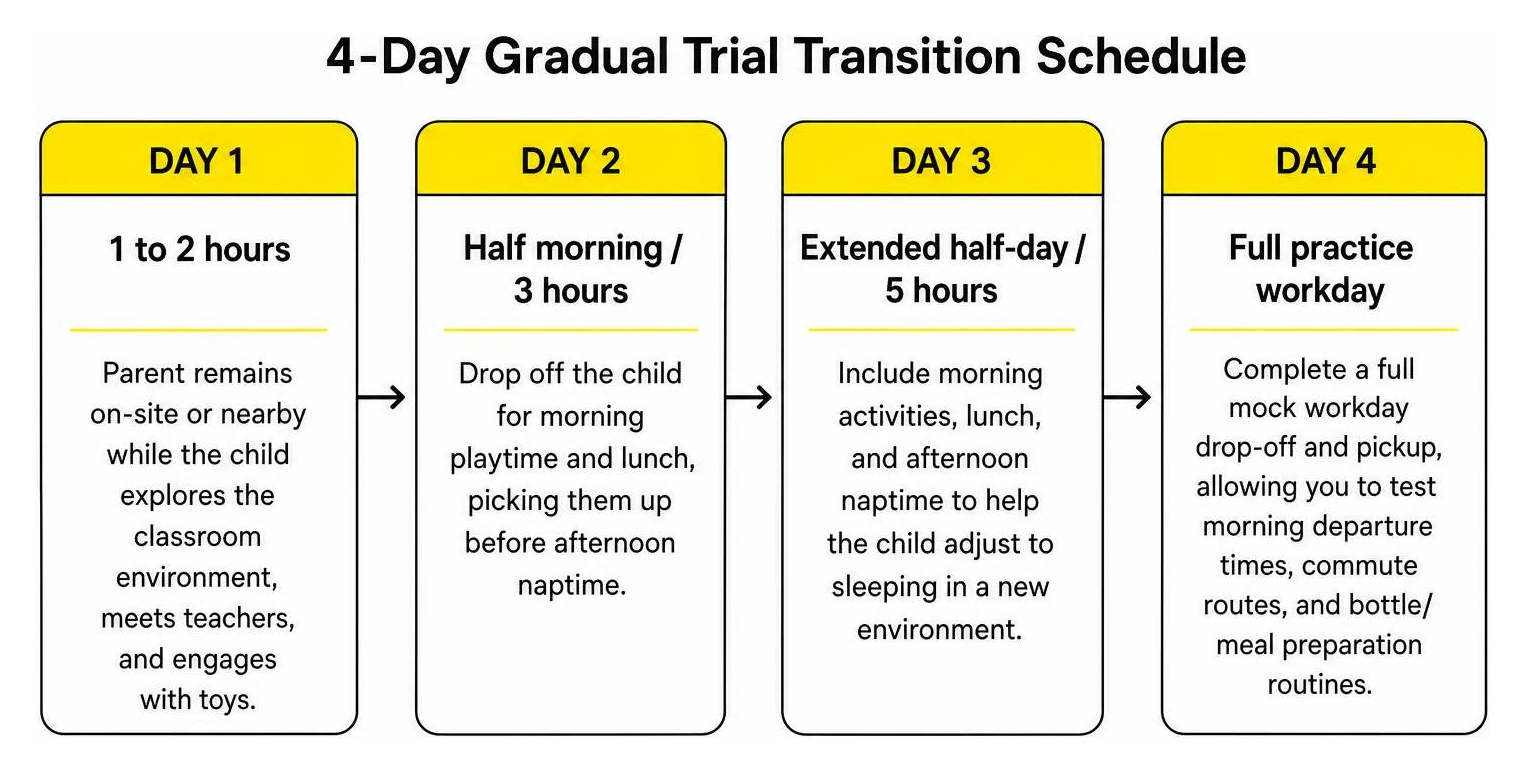
- Trial Day 1 (1 to 2 hours): Parent remains on-site or nearby while the child explores the classroom environment, meets teachers, and engages with toys.
- Trial Day 2 (Half morning / 3 hours): Drop off the child for morning playtime and lunch, picking them up before afternoon naptime.
- Trial Day 3 (Extended half-day / 5 hours): Include morning activities, lunch, and afternoon naptime to help the child adjust to sleeping in a new environment.
- Trial Day 4 (Full practice workday): Complete a full mock workday drop-off and pickup, allowing you to test morning departure times, commute routes, and meal preparation routines.
For more detailed planning strategies on returning to the workforce, read Returning to Work Childcare Guide 2026: Planning Your Transition | DaycarePath.
Essential Working Parents Childcare Guide to Daily Routines
Establishing structured daily habits keeps household logistics running smoothly and minimizes morning rush stress:
- Night-before preparation: Pack daycare backpacks, label extra clothing sets, prep water bottles or meals, and lay out outfits the evening before.
- Build a 20-minute morning buffer: Set departure times 20 minutes earlier than technically necessary to absorb unexpected diaper changes, toddler shoe delays, or traffic slow-downs without causing work tardiness.
- Divide drop-off and pickup duties: Co-parents can share responsibility by having one parent handle early morning drop-offs while the other shifts work hours slightly earlier to manage 5 PM or 6 PM pickups.
- Synchronize digital family calendars: Maintain a single shared digital calendar tracking center holiday closures, teacher institute days, pediatrician appointments, and key work deadlines.
For practical daily logistics advice, explore Working Parent Tips for Managing Childcare 2026 | ChildCarePath.
Communicating with Managers and Negotiating Flexibility
Clear, transparent communication with your employer helps set reasonable expectations while maintaining your professional status:
- Focus on deliverables, not hours logged: When requesting hybrid work arrangement shifts or flexible start times, emphasize how your proposed schedule ensures key job duties and project deadlines remain fully met.
- Set clear availability windows: Inform your manager and team of your daily hard stop times (e.g., “I will be offline between 5:00 PM and 7:00 PM for pickup and dinner routines, but will check urgent emails by 7:30 PM”).
- Use clear, professional scripts for child needs: Avoid over-apologizing when child commitments arise. Use direct communication: “I am taking leave today to care for my unwell child. I have reassigned today’s client update to Sarah, and I will check urgent messages periodically.”
Emergency Plans, Sick Days, and Emotional Well-Being
Even the most meticulously structured childcare plans face unexpected disruptions when illness strikes or centers close for holidays. Building a resilient contingency plan protects both your job performance and your sanity.
Working Parents Childcare Guide for Sick Days and Backup Plans
Licensed daycares follow public health guidelines requiring children running fevers or exhibiting contagious symptoms (such as vomiting or diarrhea) to stay home until symptom-free for 24 hours. Because childhood illnesses happen frequently in early childhood, working parents need a multi-tiered backup plan:
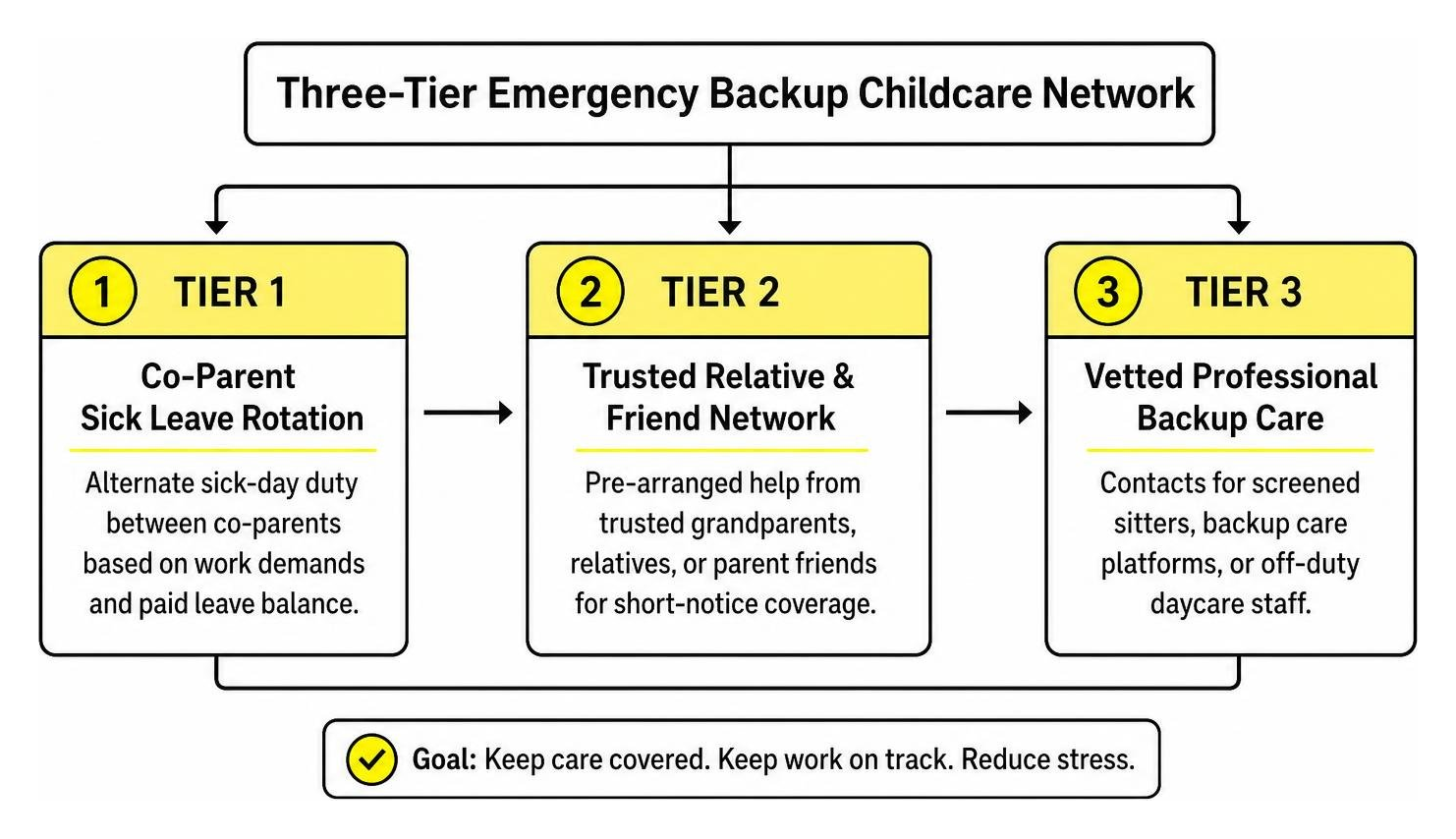
- Tier 1 (Co-Parent Sick Leave Rotation): Alternate sick-day duty between co-parents based on daily work meeting intensity and accrued paid leave.
- Tier 2 (Trusted Relative & Friend Network): Establish pre-arranged agreements with trusted grandparents, nearby relatives, or local parent friends who can step in for short-notice daytime coverage.
- Tier 3 (Vetted Professional Backup Care / Off-Duty Staff): Maintain contacts with screened on-demand sitters, emergency backup care platforms, or off-duty daycare staff who offer independent babysitting during emergency closures.
Overcoming Working Parent Guilt and Emotional Challenges
Leaving your child in someone else’s care can trigger strong emotional responses, including feelings of anxiety or guilt. It is important to remember that these feelings are completely normal and shared by working parents everywhere.
- Reframe your perspective: Recognize that placing your child in a nurturing early learning environment is a positive step for their development. Studies consistently demonstrate that high-quality early childhood education fosters peer social skills, emotional resilience, and academic readiness.
- Focus on quality of connection: Children thrive on consistent, loving interactions. Spending dedicated, focused time with your child during evening reading or weekend play builds strong emotional security, regardless of your work schedule.
- Prevent maternal and parental burnout: Working mothers experience disproportionately high rates of workplace burnout due to the mental load of managing home logistics alongside career demands. Sharing domestic duties equally, leaning on community support networks, and protecting personal rest are essential practices for long-term well-being.
Frequently Asked Questions About Working Parents Childcare
How early should working parents start searching for childcare?
Working parents should start researching licensed daycare facilities, scheduling tours, and joining waitlists 6 to 12 months before their anticipated return-to-work date. High-quality toddler and preschool programs operate with strict legal staff-to-child ratios, resulting in limited open spots throughout the year.
What should working parents do when regular childcare falls through unexpectedly?
When regular care falls through, activate your pre-planned three-tier backup system. Notify your supervisor early in the morning using concise, professional phrasing to arrange work-from-home tasks, adjust meeting schedules, or take a accrued paid sick day. Co-parents should check their daily commitments to split coverage into morning and afternoon shifts.
Is a Dependent Care FSA better than the Child and Dependent Care Tax Credit?
For most working families in higher tax brackets, a Dependent Care FSA offers greater net financial savings because contributions reduce federal, state, and payroll (FICA) taxes upfront up to the $5,000 household maximum. However, lower-income families or those without employer FSA options may benefit more from claiming the Child and Dependent Care Tax Credit directly on their tax returns. Consult a tax professional to determine the ideal combination for your household.
Finding the Right Childcare Solution for Your Family
Finding dependable childcare that balances work requirements, family budgets, and educational quality is one of the most important investments you will make as a working parent. By evaluating center licensing, maximizing tax credits and state subsidies, establishing daily routines, and building a reliable backup care network, you can navigate your career with confidence knowing your child is thriving in a safe, nurturing environment.
At Fantasy Island Schools for Kids, we have supported working families across Chicago’s Northwest Side since our founding in 2009 by Beata Bielic. Located at 6100 N Milwaukee Ave, Chicago, IL 60646, our school provides complete care and early education for children ages 2 to 6, operating Monday through Friday from 7 AM to 6 PM with both full-time and part-time enrollment options.
We serve families across local Chicago communities and surrounding suburbs, including Norwood Park, Edison Park, Gladstone Park, Jefferson Park, Sauganash, Edgebrook, Portage Park, Niles, Park Ridge, Skokie, Norridge, and Harwood Heights. Our program features:
- A dedicated Gifted Enrichment Program designed to build critical thinking and school readiness.
- A multilingual learning environment staffed by fluent Polish and English educators, including Polish-language kindergarten instruction.
- A large, well-equipped multi-sensory play space encouraging physical health and creative exploration.
- Weekly music instruction taught by a qualified music teacher.
- On-site freshly cooked meals served daily at no additional cost to parents.
- Full accreditation standards with all staff holding Early Childhood Education certifications, CPR/First Aid credentials, and training in trauma-informed care.
With weekly tuition generally ranging from $300 to $400, including all meals, music classes, and gifted programming, we strive to keep exceptional early education accessible. We proudly accept CCAP (Illinois Child Care Assistance Program) and Illinois Action for Children subsidies to assist working families. Contact us today to schedule a private tour and explore how our program can support your child’s growth while giving you peace of mind throughout your workday.