

Essential Early Math Milestones for Toddlers
The best toddler math activities are simple, play-based experiences integrated into everyday routines. Parents and caregivers can nurture early numeracy through hands-on counting games (such as one-to-one snack counting or pasta sorting), sensory shape and pattern play (like jumping onto painter’s tape floor shapes), and comparative measurement explorations during kitchen help and daily chores.
Before children learn formal addition or write numerals with pencil and paper, their brains build intuitive mental frameworks. Research shows that early mathematical concepts that first-grade mathematics curriculum builds on include understanding size, shape, and patterns, the ability to count verbally, recognizing numerals, identifying more and less of a quantity, and mastering one-to-one correspondence.
Toddlers do not need flashcards to understand these ideas. Instead, they absorb mathematical relationships through sensory discovery, physical movement, and language.
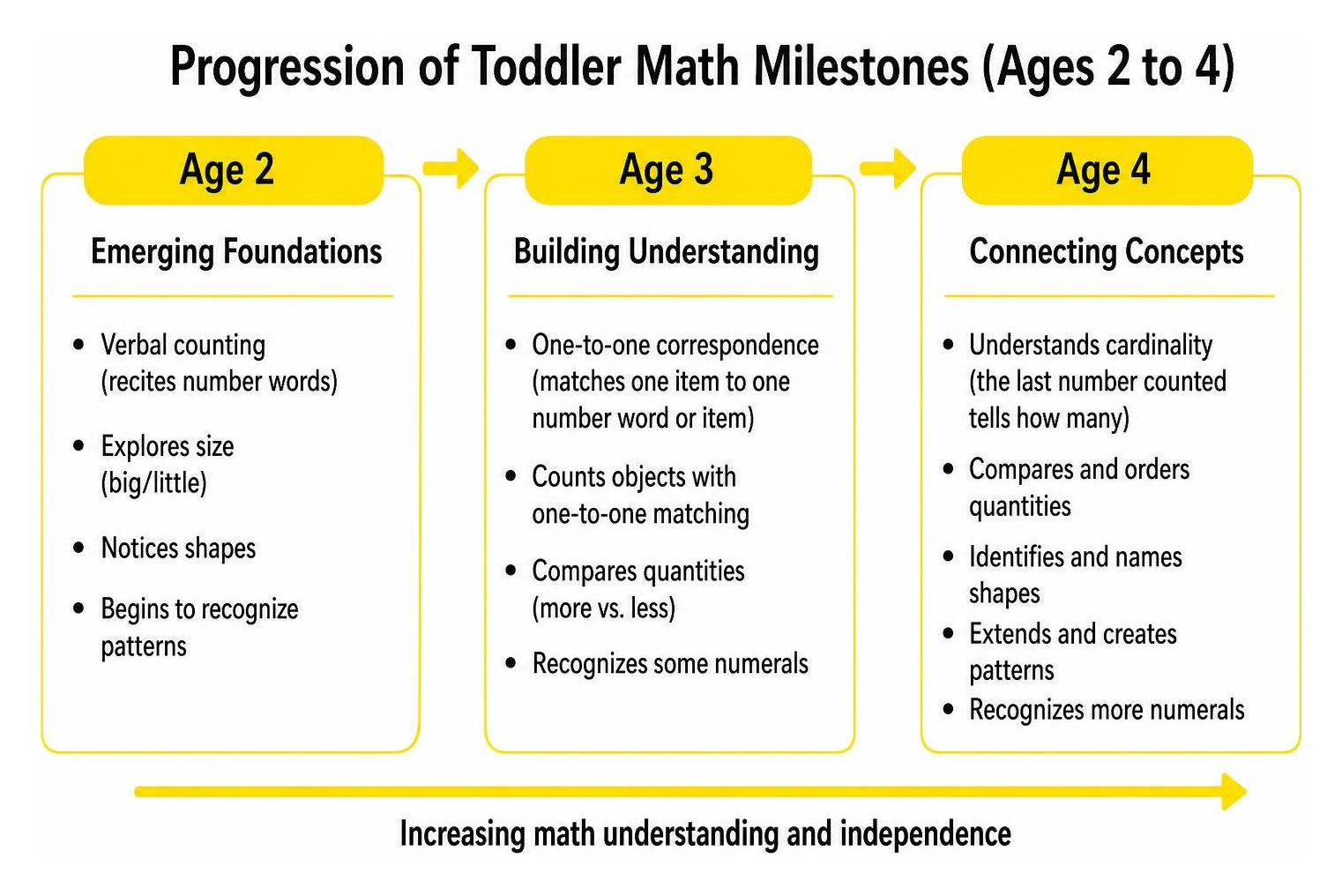
When evaluating early developmental milestones, early numeracy develops across several interconnected skills:
- Verbal Counting vs. Rational Counting: A two-year-old might recite “one, two, three, four, five” like a nursery rhyme. Rational counting occurs when a child touches one object while saying “one,” touches the second while saying “two,” and understands that the number belongs to the item.
- One-to-One Correspondence: Matching one physical item to one number word, or pairing items one-for-one (like giving one cup to each stuffed animal at a pretend tea party).
- Cardinality: Recognizing that the final number counted in a set represents the total quantity of items present, rather than just labeling the last object.
- Perceptual Subitizing: The cognitive ability to instantaneously recognize the quantity of a small group of items (typically 1 to 3 objects for toddlers, and up to 5 for older preschoolers) at a single glance without counting them individually.
- Comparative Thinking & Size Relationships: Using descriptive language to classify items by physical attributes (taller, shorter, heavy, light, bigger, smaller).
- Shape & Pattern Recognition: Identifying geometric attributes in real-world spaces (noticing that a plate is a circle or a window is a rectangle) and duplicating simple repeating sequences.
| Age | Counting & Number Sense | Geometry & Spatial Awareness | Measurement & Patterns |
|---|---|---|---|
| Age 2 | Recites number words up to 3–5; explores “more” vs. “all done”; begins pointing to items during counting play. | Explores basic shapes (circle, square); stacks blocks vertically; fits simple puzzle pieces into matching slots. | Compares big vs. small; notices basic daily routines; groups items by a single obvious feature (like bright colors). |
| Age 3 | Counts 3–5 items using one-to-one matching; subitizes 1–3 items; understands that the last number counted means “total.” | Identifies circles, squares, and triangles in the environment; uses spatial words like in, on, under, up, and down. | Notices and copies simple AB patterns (red-blue-red-blue); arranges 3 items by size from smallest to largest. |
| Age 4 | Counts 10+ items accurately; subitizes sets up to 4 or 5; connects written numerals (0–9) to physical quantities. | Combines 2D shapes to create pictures; understands symmetry; builds complex structures with balance and intent. | Extends and creates original patterns; compares weight, length, and volume using non-standard units (e.g., blocks or yarn). |
10 Fun and Play-Based Toddler Math Activities
You do not need expensive kits or specialized workbooks to teach mathematical thinking. Common household items, natural treasures, and everyday play routines offer rich materials for hands-on discovery.
Hands-on Counting and Number Sense Toddler Math Activities
1. Snack Time One-to-One Counting & Five-Frame Cartons
Turn morning or afternoon snack time into an interactive math invitation. Cut a clean cardboard egg carton in half lengthwise so you have a strip with five compartments (a “five-frame”). Give your toddler five snack pieces, such as sliced bananas, blueberries, or whole-grain crackers.
Invite your child to place one snack into each compartment while counting aloud: “One, two, three, four, five.” If they eat two blueberries, look together at the empty spaces: “We had five, you ate two, and now three are left!” This visual grid helps children develop subitizing skills and understand number bonds intuitively.
2. DIY Sensory Counting Stones & Sand Numeral Tracing
Collect smooth, flat river stones during a walk through your neighborhood. Using a marker, write numbers 1 through 5 on one side, and draw matching dot arrays on the reverse side. Provide a shallow wooden tray or pie dish filled with a thin layer of fine colored sand, cornmeal, or salt.
Your child can pick a stone, count the dots, and practice tracing the corresponding number shape in the sensory sand using their index finger or a soft paintbrush. This tactile mark-making supports fine motor control and visual numeral recognition without pencil-and-paper pressure. For families looking for more ways to spark curiosity, exploring creative enrichment activities for gifted preschoolers can inspire hands-on STEM challenges at home.
3. Threading Pasta Drop & Animal Feeding Boxes
Fine motor strength and early numeracy support each other naturally. Transform an empty shoebox into a friendly “counting monster” or animal by cutting a small mouth opening on top. Label small cups or cards with numbers 1 through 5. Your toddler can pick a card, count out that exact number of large dried penne pasta tubes or wooden blocks, and “feed” them into the slot one by one.
You can also create a threading pasta craft using colored pasta and yarn to build hand-eye coordination while counting out matching sets.
Spatial Awareness, Shapes, and Pattern Toddler Math Activities
4. Painter’s Tape Floor Shapes & Gross-Motor Obstacle Paths
Toddlers learn with their whole bodies. Use low-tack blue painter’s tape to create large geometric shapes (a square, triangle, circle, and rectangle) directly on your living room rug or bare floor.
Call out energetic movement challenges:
- “Can you jump like a frog into the triangle?”
- “Can you tip-toe around the outside edge of the big square?”
- “Can you find three soft toys and place them inside the circle?”
This kinesthetic game builds spatial awareness, reinforces shape vocabulary (corners, sides, straight lines, curves), and burns energy during indoor playtime.
5. Nature Walk Attribute Sorting Trays
Head outside to collect natural treasures: smooth pebbles, fallen leaves, acorns, pine cones, and twigs. When you return inside, provide an empty muffin tin or divided serving tray.
Invite your child to sort their collection by attributes:
- Sort by item type (all pine cones in one cup, all acorns in another).
- Sort by color (brown crispy leaves vs. green leaves).
- Sort by texture (rough bark vs. smooth stones).
Sorting helps toddlers classify information, recognize sets, and look closely at physical properties.
6. AB Pattern Block Trains & Action Rhythm Sequences
Patterning is the foundation of algebraic reasoning. Start simple with alternating AB patterns using colorful toy building bricks (e.g., yellow brick, blue brick, yellow brick, blue brick). Build a horizontal “train” and ask your toddler: “What color comes next?”
You can also take patterns off the table and make them physical:
- Clap, stomp, clap, stomp, clap, stomp.
- Hop, freeze, hop, freeze.
Connecting visual patterns to musical rhythm and body movement helps children internalize predictive sequences.
7. DIY Corkboard Geoboards & Geometric Problem-Solving
Introduce spatial geometry and shape composition using a thick cork placemat, rounded push pins, and colorful elastic hair bands or rubber bands. (Always supervise closely when using push pins).
Press several pins firmly into the cork mat and show your child how to stretch an elastic band between pins to form a triangle, a diamond, or a square. Manipulating shapes on a geoboard builds finger strength and introduces early geometry concepts like corners, sides, symmetry, and spatial transformation.
Everyday Routines and Measurement Exploration
8. Culinary Volume & Kitchen Measuring Play
The kitchen is a natural laboratory for early measurement. While preparing family meals, invite your toddler to participate using child-safe measuring cups, wooden spoons, and plastic bowls.
Let them scoop dry oats, pour water into containers of different shapes, or level off flour with their fingers. Use comparative language as they explore:
- “This big blue bowl is completely full, but the red bowl is empty.”
- “Is this bag of potatoes heavy or light compared to this apple?”
- “Let’s pour this water into a tall, skinny cup. Did the amount change?”
Exploring volume, capacity, and weight in real contexts helps abstract concepts make practical sense.
9. Non-Standard Ribbon & Block Measuring Hunts
Before toddlers learn to read inches or centimeters on a ruler, they explore measurement through non-standard units. Cut a piece of bright yarn or ribbon to match your child’s height or arm span.
Walk through your home together on a “measuring hunt” to find items that are:
- Taller than the ribbon (like the refrigerator or bookshelf).
- Shorter than the ribbon (like their favorite picture book or a shoe).
- About the exact same length (like their small playroom table).
You can also line up standard toy wooden blocks alongside their favorite teddy bear to see how many “blocks tall” the bear is.
10. Laundry Pair Matching & Grocery Cart Tallying
Household chores offer daily opportunities for math conversations:
- Sock Matching: Dump a basket of clean socks on the rug. Ask your child to find matching pairs by color, size, or pattern, then roll them together while counting by twos.
- Table Setting: Ask your toddler to set the table: “We have four people eating dinner. Can you put one napkin and one fork at each seat?”
- Grocery Store Helpers: While shopping, give your child small counting jobs: “Can you place four green apples into our bag? Let’s count them together: one, two, three, four.”
Adapting Math Play for Diverse Learners and Special Needs
Every child approaches mathematics through their own developmental timeline and sensory preferences. When working with neurodivergent children, dual-language learners, or toddlers with motor delays, small adjustments make math play engaging and accessible:
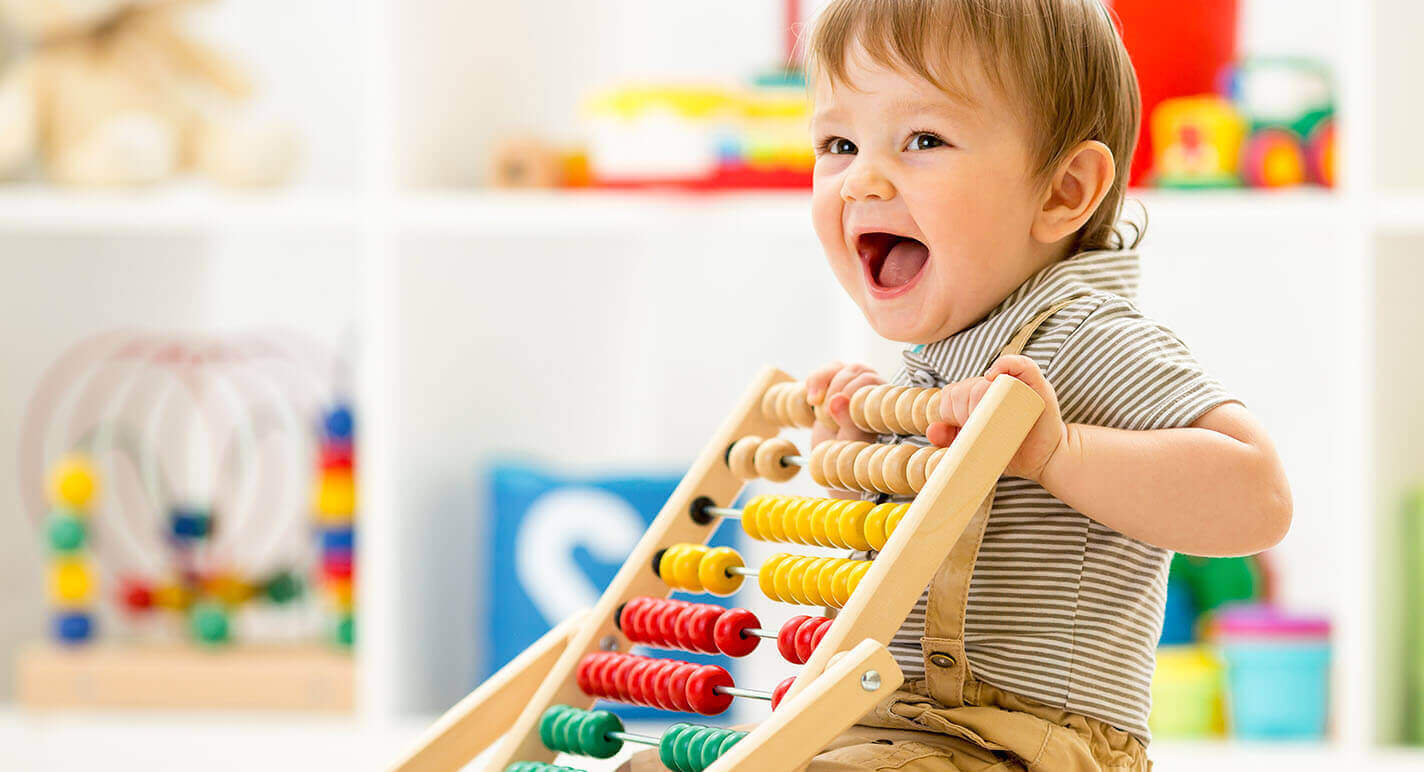
- Multi-Sensory Anchors: Pair abstract numbers with tactile input. Trace numbers in sand trays, count using textured felt balls or natural items, and pair counting songs with clapping rhythms.
- Language-Free Visuals: Support understanding with visual schedules, clear picture cues, and demonstration. At Fantasy Island Schools for Kids, our multilingual teachers provide instructions in Polish and English, pairing spoken words with gestures and concrete manipulatives so language differences never create barriers to math discovery.
- Support Fine Motor Needs: If a toddler finds picking up small buttons or coins frustrating, switch to chunky wooden blocks, large pine cones, or plastic rings that are easy for small hands to grasp.
- Calm, Structured Pacing: Keep activities brief and pressure-free. Five minutes of focused, joyful play is more beneficial than prolonged drills. As children navigate early learning, social-emotional development in toddlers plays a meaningful role in how they manage new challenges and build confidence.
Frequently Asked Questions About Toddler Math
What key math concepts should toddlers understand before starting school?
Toddlers entering preschool and kindergarten thrive when they have an intuitive grasp of basic spatial relationships (in, on, under, behind), can identify simple geometric shapes (circle, square, triangle, rectangle), recognize relative sizes (bigger, smaller, longer, heavier), verbally count to 10, and demonstrate one-to-one correspondence with small groups of items (up to 5). Formal addition and writing numbers are not required for early school entry.
How do counting, subitizing, and one-to-one correspondence develop?
Children typically progress through predictable stages:
- Acoustic/Rote Counting: Reciting number words in sequence from memory without connecting them to physical items.
- One-to-One Matching: Physically touching one object while saying one number word in sequence.
- Perceptual Subitizing: Recognizing small sets (1 to 3 items) instantly without counting them individually.
- Cardinality Understanding: Realizing that the final count represents the total quantity in the group.
How can parents tell if a toddler is ready for addition and subtraction?
Most children begin exploring formal addition between ages 4 and 7, after counting, one-to-one matching, subitizing, and number bonds feel steady. A toddler or young preschooler shows readiness for early operational concepts when they understand “joining” and “taking away” during imaginative play—such as noticing that putting two toy cars next to one car makes three cars in total, or that eating one cracker leaves fewer crackers on their plate.
Conclusion
Early childhood mathematics is about exploring relationships, noticing patterns, and making sense of the physical world. By swapping rigid flashcards for everyday conversations, kitchen measuring, shape hunts, and sensory counting games, you give your child a joyful, screen-free foundation that supports lifelong learning.
At Fantasy Island Schools for Kids, our play-based curriculum weaves early numeracy, creative STEM exploration, and weekly music classes into every child’s day. Founded in 2009 by Beata Bielic, our center is located at 6100 N Milwaukee Ave, Chicago, IL 60646.
We proudly welcome children ages 2 to 6 with full-time and part-time enrollment options, operating Monday through Friday from 7:00 AM to 6:00 PM. Our tuition runs approximately $300 to $400 per week and includes fresh on-site meals, specialized music education, and our gifted enrichment curriculum. We serve families across Chicago’s Northwest Side and nearby suburbs—including Norwood Park, Edison Park, Gladstone Park, Jefferson Park, Sauganash, Edgebrook, Portage Park, Niles, Park Ridge, Skokie, Norridge, and Harwood Heights. To help ensure high-quality early education is accessible for local families, we accept CCAP (Illinois Child Care Assistance Program) and Illinois Action for Children.
If you are looking for a warm, multilingual early learning community for your toddler or preschooler, we invite you to reach out and tour our classrooms.
