

Core Child Development Milestones 3 Year Old Children Reach
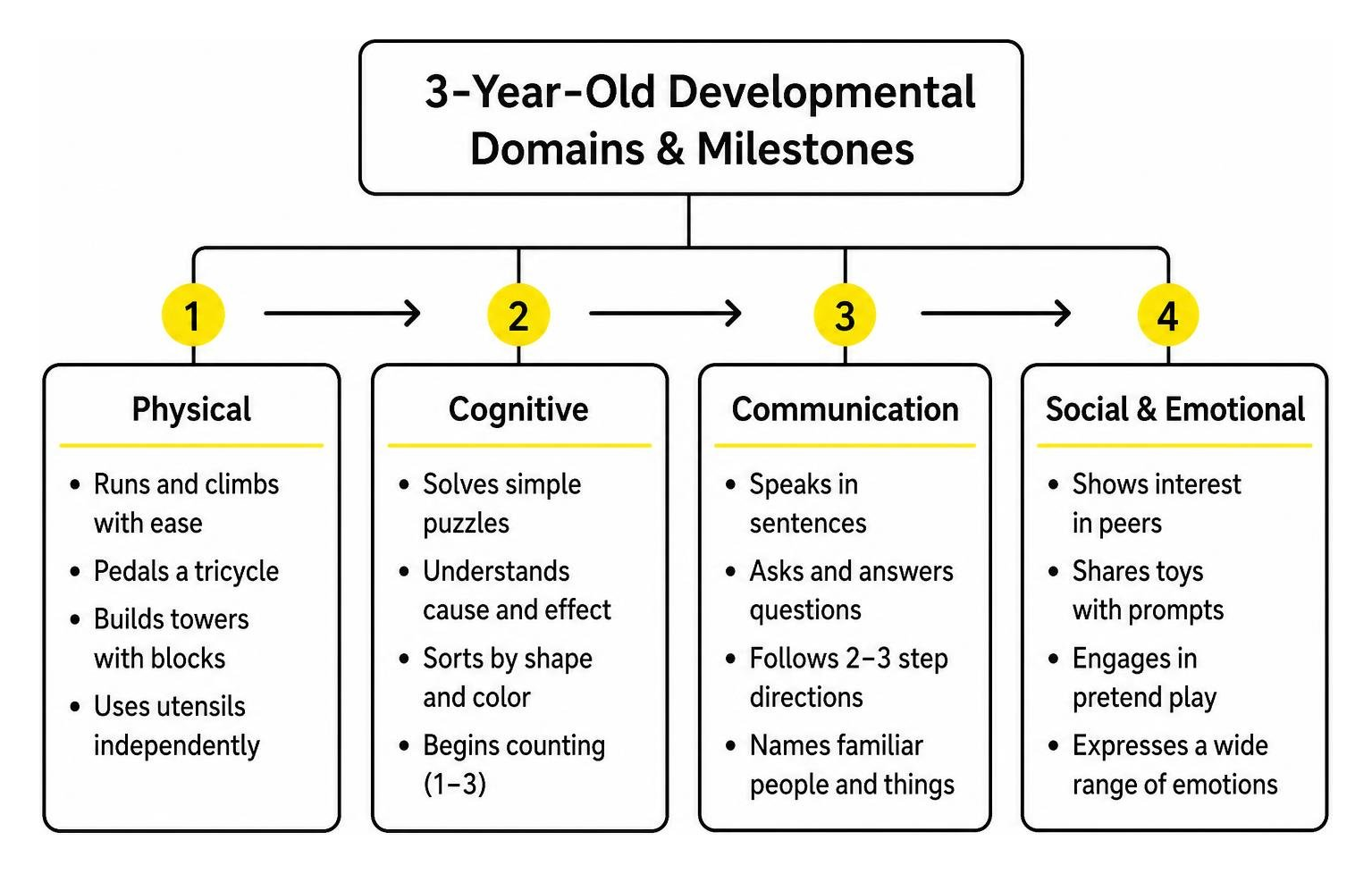
At age three, most children speak in 3- to 5-word sentences, climb stairs alternating feet, engage in imaginative play, and sort objects by color or shape. These core child development milestones 3 year old benchmarks span social, emotional, language, cognitive, and physical growth. Watching your little one turn three is an extraordinary experience. This stage marks the magical shift where toddlers blossom into curious, expressive preschoolers. The developmental journey is vast, covering physical, cognitive, communication, and emotional growth. When monitoring these foundational skills, pediatric guidelines look at what 75% or more of children achieve by age three.
Every child follows their own unique timeline. While one child might speak in elaborate paragraphs, another might excel at physical agility and balance. To keep track of these emerging capabilities, you can reference our ultimate checklist for 3-year-old milestones as a supportive roadmap for your child’s daily progress.
Social and Emotional Child Development Milestones 3 Year Old Benchmarks
At age three, the social world expands dramatically. Parallel play—where children simply play side-by-side without interacting—begins shifting toward associative and cooperative play. Your child will start showing genuine interest in peers, sharing toys with gentle prompts, and inventing rich pretend worlds together.
Key emotional and social markers include:
- Separation confidence: Calming down within approximately 10 minutes after saying goodbye to parents or caregivers.
- Empathy in action: Noticing when a classmate or sibling is sad and attempting to comfort them with a pat, hug, or favorite toy.
- Fantasy and pretend play: Engaging in imaginative games, such as pretending to cook meals, caring for stuffed animals, or acting out family roles.
- Expressing a spectrum of feelings: Learning to label emotions like happy, sad, mad, and scared instead of relying exclusively on physical meltdowns.
Nurturing these skills creates a secure base for future classroom learning. You can explore our detailed guide on social-emotional development in toddlers to learn how daily connection builds emotional resilience. Many of these benchmarks align closely with established CDC milestone guidelines, which emphasize growing autonomy alongside peer connection.
Language and Communication Child Development Milestones 3 Year Old Tracking
Between the second and third birthdays, your child’s expressive language experiences an explosive leap. A typical 3-year-old commands an expressive vocabulary of approximately 500 to 900 words and strings together sentences of 3 to 5 words.
Conversations become truly two-way. Your child can now describe what happened at the park, name actions shown in picture books, and state their first name and age. If you ever have concerns about clarity or articulation, review our guide to identify toddler speech delay signs to understand when professional speech-language guidance may be helpful.
Cognitive and Problem-Solving Milestones
The three-year-old brain is an active laboratory of inquiry and experimentation. Children at this stage can sustain focused attention on self-chosen tasks for roughly 8 to 9 minutes. They love categorizing objects, experimenting with cause-and-effect relationships, and asking questions that challenge adult logic.
Prominent cognitive milestones include:
- Sorting and grouping: Matching objects by color, shape, or size (such as separating big red buttons from small blue ones).
- Early number sense: Understanding the concept of “two” (e.g., holding two crackers) and reciting numbers by rote memorization.
- Visual problem solving: Completing 3- to 4-piece wooden puzzles and recognizing common signs or pictures.
- Safety awareness: Responding to basic safety warnings, such as avoiding a hot stove or staying on the sidewalk.
To learn more about nurturing your child’s emerging intellect, read our guide to toddler cognitive development. You can also integrate simple daily games, like our favorite toddler math activities, to build numeracy naturally through play.
Movement, Gross Motor, and Fine Motor Skills
Physical development at age three combines big, energetic movements with increasingly precise hand and finger dexterity. Children love testing their physical limits by jumping off bottom steps, pedaling tricycles, and balancing on one foot.
| Milestone Domain | Typical Gross Motor Skills | Typical Fine Motor & Self-Care Skills |
|---|---|---|
| Locomotion & Balance | • Runs smoothly without frequent falling • Climbs up and down stairs alternating feet • Hops and balances on one foot for 1–3 seconds |
• Strings large beads or macaroni noodles • Turns individual pages in paper storybooks • Screws and unscrews jar lids securely |
| Object Manipulation | • Kicks a ball forward with force • Throws a ball overhand toward a target • Catches a large bounced ball with two hands |
• Builds a stable tower of 6 to 9+ blocks • Holds crayons with fingers rather than a fist • Copies vertical lines, horizontal lines, and circles |
| Independence & Coordination | • Pedals a tricycle across flat ground • Climbs on and off playground equipment |
• Uses a child fork and spoon with minimal spills • Puts on simple clothing items like loose coats • Washes and dries hands independently |
These physical milestones reflect significant neurological integration. For comprehensive clinical insights on motor benchmarks, consult HealthLink BC developmental benchmarks for age three.
Physical Growth, Sleep, and Daily Wellness Benchmarks
Typical Height, Weight, and Dental Development
Physical growth stabilizes into a predictable, steady pace during the preschool years. Toddler body proportions gradually shift as limbs lengthen, posture straightens, and baby roundness leans out into a more athletic preschool build.
- Weight gain: A healthy 3-year-old typically gains about 4 to 6 pounds (1.8 to 2.7 kg) per year.
- Height growth: Expect your child to grow roughly 2 to 3 inches (5 to 7.5 cm) each year, reaching approximately half of their adult height.
- Dental development: Most children have a full set of 20 primary (baby) teeth by their third birthday.
- Visual acuity: Vision sharpens significantly, approaching near-adult 20/20 clarity.
Pediatricians track these numbers on standard growth charts during routine wellness checks. For a medical overview of these biological shifts, visit the MedlinePlus medical encyclopedia.
Healthy Sleep Patterns and Screen Time Guidelines
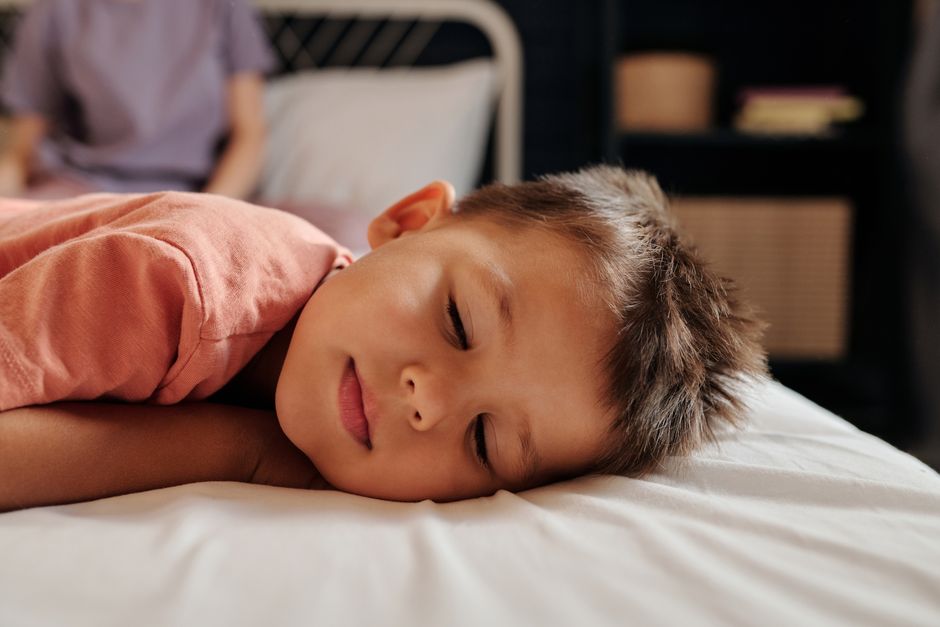
Rest is fundamental to cognitive consolidation and mood stability at this age. A typical 3-year-old requires 11 to 13 hours of total sleep in a 24-hour cycle. While some children continue taking a 1- to 2-hour afternoon nap, others begin phasing it out in favor of quiet resting time.
Limiting screens before bedtime protects natural melatonin production, reducing bedtime resistance and middle-of-the-night waking.
Supporting Your 3-Year-Old’s Learning and Emotional Growth at Home
Home is your child’s primary learning environment. You do not need expensive commercial kits to foster healthy development; everyday routines offer endless possibilities for rich learning.
- Narrate daily activities: Describe what you are doing while folding laundry, cooking dinner, or taking walks through the neighborhood.
- Read together every day: Ask open-ended questions like, “Why do you think the puppy is hiding?” to boost language comprehension.
- Assign simple household chores: 3-year-olds love feeling capable. Let them match socks, wipe placemats, or put toys into bins.
- Provide sensory materials: Offer playdough, water bins, finger paints, and sand to build fine motor strength and finger control.
Engaging in open-ended exploration builds lasting neural pathways. You can learn more about why hands-on discovery works by reading about play-based learning benefits in early childhood education.
Managing Big Feelings and Reducing Tantrums
At age three, big emotions collide with developing self-control. Tantrums are a normal developmental expression of frustration when a child’s desires exceed their verbal or physical abilities.
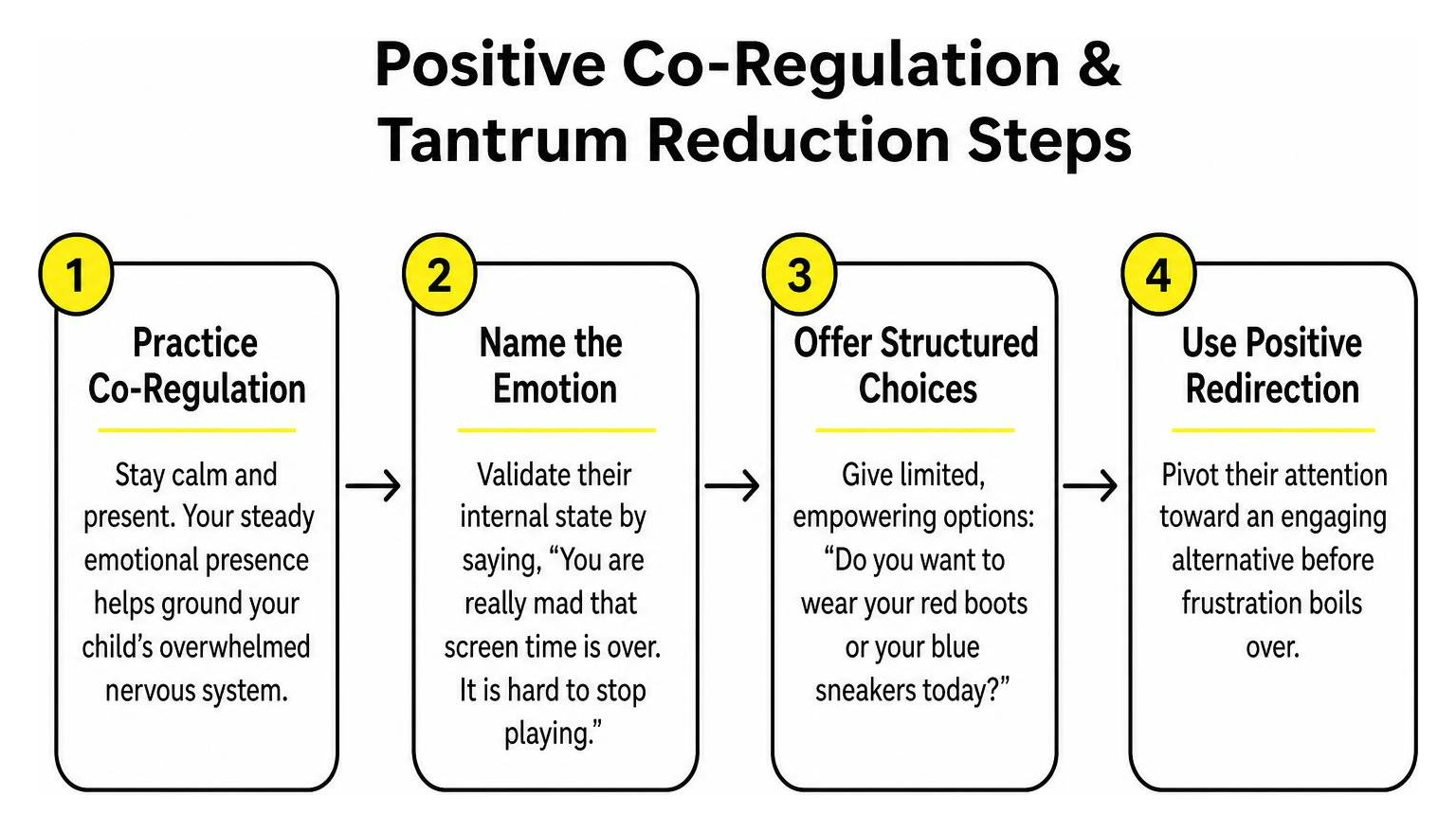
To manage meltdowns effectively:
- Practice co-regulation: Stay calm and present. Your steady emotional presence helps ground your child’s overwhelmed nervous system.
- Name the emotion: Validate their internal state by saying, “You are really mad that screen time is over. It is hard to stop playing.”
- Offer structured choices: Give limited, empowering options: “Do you want to wear your red boots or your blue sneakers today?”
- Use positive redirection: Pivot their attention toward an engaging alternative before frustration boils over.
Potty Training Progress and Readiness Indicators
By age three, many children exhibit signs of toilet readiness, though mastery varies widely. Most children achieve reliable daytime bladder and bowel control during their third year, while nighttime dryness often requires additional time.
Key readiness signals include staying dry for two hours at a time, telling you when their diaper is wet, showing curiosity about the bathroom, and being able to pull pants up and down independently. Approach toilet training with patience, celebratory praise for small wins, and zero pressure.
Red Flags: When to Seek Professional Advice for Developmental Delays

While children develop at different paces, certain signs indicate that a child could benefit from an evaluation by a pediatrician or an early intervention specialist.
Consult your healthcare provider if your 3-year-old exhibits any of the following:
- Milestone loss: Loses any previously acquired speech, motor, or social skills.
- Speech and language concerns: Cannot speak in 3-word sentences, does not understand simple multi-step instructions, or has speech that family members cannot understand.
- Motor difficulties: Falls frequently, struggles with stairs, cannot hold a large crayon, or cannot stack 4 blocks.
- Social detachment: Avoids eye contact, shows no interest in playing with peers or caregivers, or resists all physical comfort.
- Extreme tantrums: Experiences tantrums that regularly last longer than 15 minutes or occur more than 3 times per day.
Early intervention provides children with supportive tools early on, ensuring they thrive socially, emotionally, and academically.
Frequently Asked Questions About 3-Year-Old Development
How many words should a typical 3-year-old be able to say?
Most 3-year-olds use an expressive vocabulary between 500 and 900 words. They regularly speak in sentences of 3 to 5 words, ask frequent “why” questions, and should be understood by unfamiliar adults roughly 75% of the time.
How do I know if my 3-year-old’s temper tantrums are abnormal?
Occasional tantrums are completely normal at age three. However, tantrums that consistently last longer than 15 minutes, happen more than three times a day, or involve aggressive behavior toward themselves or others warrant a conversation with your pediatrician.
What should I do if my child misses multiple 3-year milestones?
If your child has not met several milestones across social, language, cognitive, or physical domains, schedule a developmental screening with your family pediatrician. Early childhood specialists can evaluate your child and connect you with supportive therapies if needed.
Conclusion
The third year of life is filled with rapid growth, curious questions, and wonderful milestones. From mastering tricycle rides and drawing circles to forming sweet friendships and expressing big ideas, your 3-year-old is laying the groundwork for future academic and life success. Providing loving support, consistent daily routines, and rich play opportunities will help them flourish across every developmental domain.
At Fantasy Island Schools for Kids, we partner with families across Chicago’s Northwest Side and surrounding communities to nurture each child’s potential. Founded in 2009 by owner Beata Bielic, our licensed early childhood center located at 6100 N Milwaukee Ave, Chicago, IL 60646 provides exceptional care for children ages 2 to 6. Our team of CPR/First Aid-certified educators, trained in trauma-informed care and Early Childhood Education, delivers a rich curriculum featuring our signature Gifted Enrichment Program, bilingual instruction in Polish and English, weekly music classes led by a qualified music teacher, dedicated multi-sensory play spaces, and fresh, on-site cooked meals included at no extra cost.
Whether you are seeking full-time or part-time enrollment, our tuition of approximately $300 to $400 per week offers comprehensive value, and we proudly accept CCAP (Illinois Child Care Assistance Program) and Illinois Action for Children. We invite families from Norwood Park, Edison Park, Gladstone Park, Jefferson Park, Sauganash, Edgebrook, Portage Park, Niles, Park Ridge, Skokie, Norridge, Harwood Heights, and surrounding neighborhoods to tour our classrooms. Discover our preschool and daycare programs in Norwood Park to learn how our programs support your child’s developmental journey.
