

What an Illinois Childcare Subsidy Can Cover for Your Family
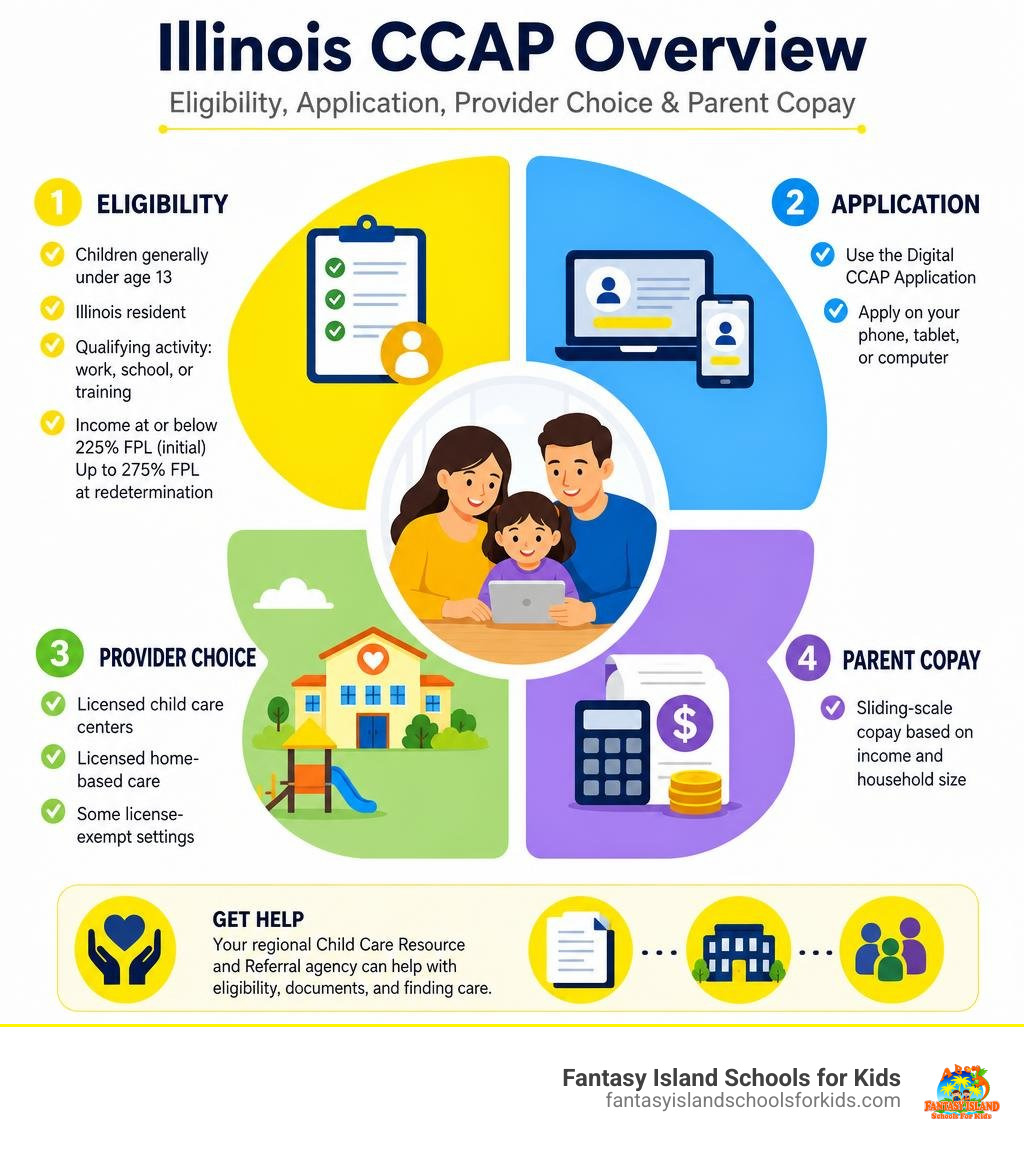
Childcare subsidy Illinois usually means the state’s Child Care Assistance Program (CCAP), which helps eligible families pay for care while a parent or guardian works, attends school, or participates in approved training. It can reduce the cost of licensed child care centers, licensed home-based care, and some license-exempt settings; families may still have a monthly copay based on income and household size.
| Quick answer | What it means |
|---|---|
| Main program | Illinois Child Care Assistance Program (CCAP) |
| Who it helps | Income-eligible families with children generally under age 13 who have qualifying work, school, or training needs |
| How to apply | First-time applicants can use the Digital CCAP Application on a phone, tablet, or computer |
| What you may pay | A sliding-scale parent copay, generally kept below 7% of family income |
| Where to get help | Your regional Child Care Resource and Referral agency can help with eligibility, documents, and finding care |
For many working parents, child care is one of the largest monthly costs. Illinois served an average of 199,724 children through CCAP each month in fiscal year 2023, showing how important this support is for families trying to keep work, school, and reliable care in balance.
The system is also changing. As of July 1, 2026, the Illinois Department of Early Childhood became the state’s lead agency for CCAP and related early childhood services. This guide explains what that means for eligibility, applications, copays, covered providers, and the other support programs that may help your family.
I am Beata Bielic, Executive Director of Fantasy Island Schools for Kids, founded in 2009 at 6100 N Milwaukee Ave in Chicago. After more than 17 years in early childhood education, I have helped families understand how childcare subsidy Illinois programs fit into the practical decision of choosing dependable, high-quality care.
Understanding Childcare Subsidy Illinois Eligibility and Income Limits
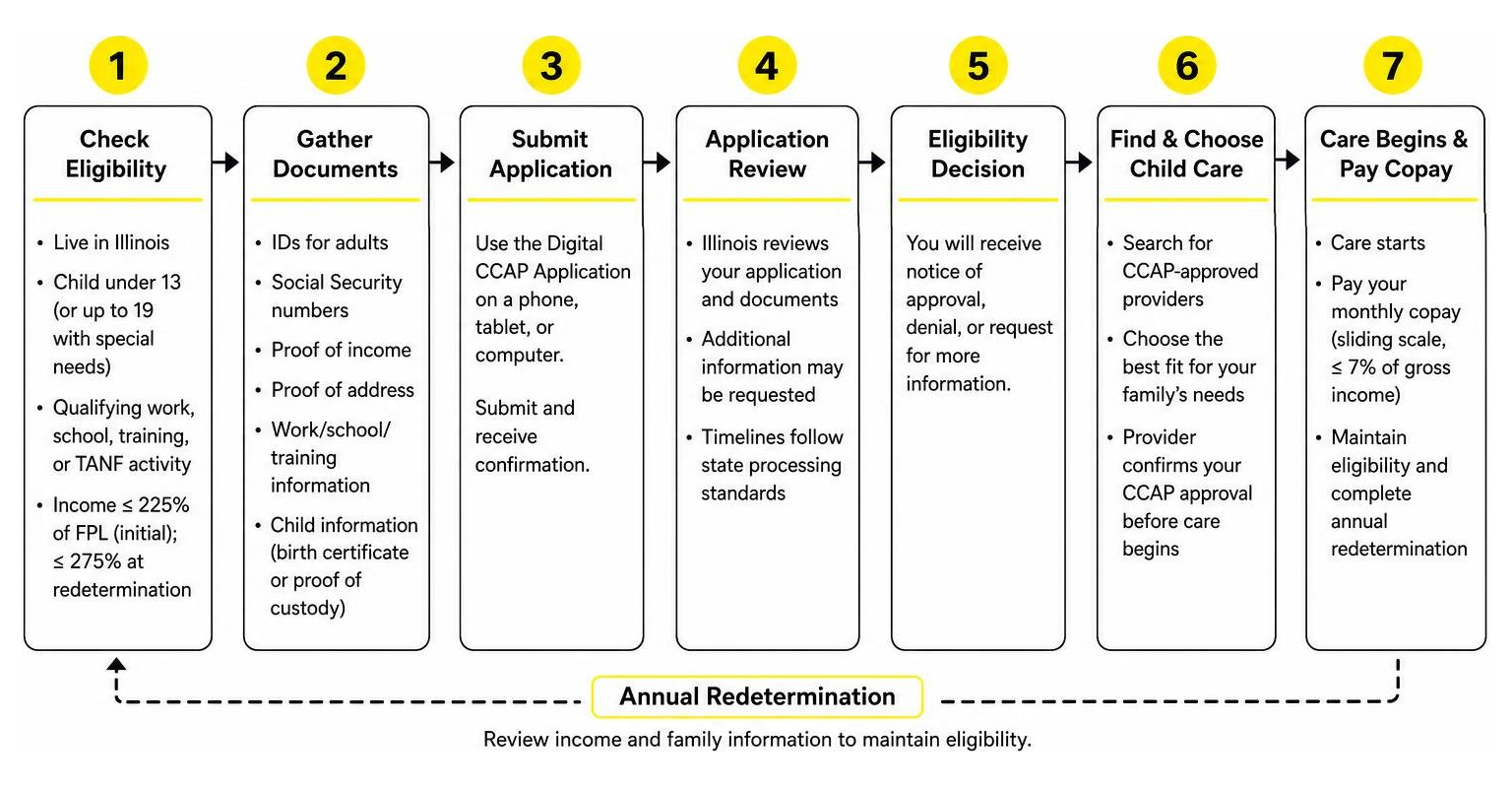
To qualify for a childcare subsidy Illinois grant under CCAP, families must meet core criteria set by the state. Primarily, the program serves children under age 13 (or up to age 19 if documented special needs exist). Parents or legal guardians must live in Illinois and show a qualifying activity—such as working, attending college or vocational training, or participating in approved TANF work activities.
Initial eligibility requires family income to be at or below 225% of the Federal Poverty Level (FPL). During annual redetermination, families can remain in the program up to 275% FPL, allowing working parents to accept modest wage increases without immediately losing their child care support.
Roughly 58% of all children enrolled in CCAP are between the ages of 0 and 5, while the remaining 42% are school-age children receiving care before or after school and during summer breaks. To check basic program requirements, parents can review the state’s guide on how to Get Help Paying for Child Care. At our school, we frequently guide working parents through these steps; we always remind families that Fantasy Island Schools for Kids accepts CCAP (Illinois Child Care Assistance Program) and Illinois Action for Children to ensure local high-quality care remains accessible.
Income Thresholds and Copay Rules for Childcare Subsidy Illinois Applicants
Calculating household size and gross monthly income determines both your eligibility tier and your monthly parent co-payment. Household size includes the applicant, co-resident biological or adoptive parents, children under 21, and dependent relatives receiving over 50% support.
Illinois caps family copayments below the federal benchmark of 7% of gross family income. Assigned monthly copays are set on a sliding scale starting as low as $1.00 per month for the lowest income brackets.
State rules divide copayment schedules into specific indicators:
- Co-Pay Indicator A: Applies to full-time care, non-school-age children, and summer schedule care.
- Co-Pay Indicator B: Provides a 50% discount on monthly parent copayments from September through May when all children in care are school-age and enrolled in part-day care.
- Graduated Phase Out: If a family’s income exceeds standard redetermination limits at the end of their 12-month period, a 3-month eligibility extension policy (CCAP Policy 02.03.01) helps smooth the transition off assistance.
| Household Size | Initial Entry Income Ceiling (225% FPL) | Redetermination Ceiling (275% FPL) | Sample Monthly Copay (Indicator A) |
|---|---|---|---|
| 2 | Approx. $3,800 – $4,058/mo | Approx. $4,800 – $4,950/mo | $1.00 – $150.00/mo |
| 3 | Approx. $4,800 – $5,000/mo | Approx. $5,900 – $6,100/mo | $1.00 – $210.00/mo |
| 4 | Approx. $5,800 – $6,000/mo | Approx. $7,100 – $7,300/mo | $1.00 – $270.00/mo |
For exact figures, families should consult the state’s official notice on Important Parent Co-Payment Information. Because exact state math varies based on household adjustments, we advise parents to contact our staff or Illinois Action for Children directly for help calculating exact family costs.
How Take-Up Rates Vary Across Childcare Subsidy Illinois Regions
Even though assistance is available statewide, program take-up rates vary significantly across different child age groups and geographic areas. Research using the Estimation of Local Populations Eligible for Programs (ELPEP) methodology shows distinct participation patterns:
- Infants and Toddlers (Ages 0-2): 42% take-up rate statewide.
- Preschoolers (Ages 3-5): 48% take-up rate statewide.
- School-Age Children (Ages 6-12): 22% take-up rate statewide.
Urban counties consistently exhibit the highest participation rates across all age brackets. Zip code data indicates that majority Black non-Hispanic communities record the highest take-up rates, followed by majority Hispanic and racially diverse neighborhoods, while majority white non-Hispanic zip codes record lower relative participation. Participation is closely connected to provider density: areas with a robust supply of licensed day care centers accepting state subsidies see substantially higher enrollment.
How to Apply for CCAP and Required Documentation
Applying for a childcare subsidy Illinois grant has become simpler with the launch of the Digital CCAP Application online portal. First-time applicants can complete the initial submission in about 20 minutes using any smartphone, tablet, or laptop.
For those needing personalized assistance, regional Child Care Resource and Referral (CCR&R) agencies offer 1:1 consultation appointments to help complete paperwork. Families in Cook County typically work through Illinois Action for Children. Paper applicants can download and submit the standard application via Form Name (Form Number).
Employment and Income Verification Guidelines
Accurate income verification is crucial to prevent application processing delays. Rules established under IDHS: 01.03.02 – Employment specify strict document recency requirements:
- Standard Pay Stubs: Must be dated within 60 days of application for weekly, biweekly, or semi-monthly pay schedules, or within 90 days for monthly pay.
- New Jobs: If two consecutive pay stubs are not yet available, parents may submit an employer verification letter (Form IL444-4831) signed by a company representative detailing start date, hourly pay rate, and weekly schedule.
- Self-Employed Parents: Must supply the most recent IRS Form 1040 with tax schedules, quarterly tax filings, or a detailed monthly earnings and expense log (Form IL 444-2790) accompanied by business receipts.
- Unverified Hours / Cash Payments: If work hours cannot be independently verified, approved child care hours are calculated mathematically by dividing total documented income by the current Illinois minimum wage.
Complementary Financial Support Programs
CCAP operates alongside several state and federal assistance initiatives to reduce total household stress:
- TANF (Temporary Assistance for Needy Families): Provides cash assistance and direct CCAP referral support for job training activities.
- SNAP & WIC: Provide critical grocery support and infant nutritional supplies.
- CACFP (Child and Adult Care Food Program): Reimburses participating early learning centers for serving nutritious daily meals. In FY23, CACFP served an average of 123,675 adults and children daily across Illinois.
- CHIP / Medicaid: Offers comprehensive healthcare coverage for qualifying children.
Covered Settings, Smart Start, and Governance Transitions
Illinois CCAP subsidies cover multiple types of child care providers, giving parents freedom of choice. In FY23, total CCAP expenditures reached $1.27 billion, funded by a mix of TANF block grants (61%), Child Care Development Fund (CCDF) federal grants (29%), and State General Revenue Funds (10%).
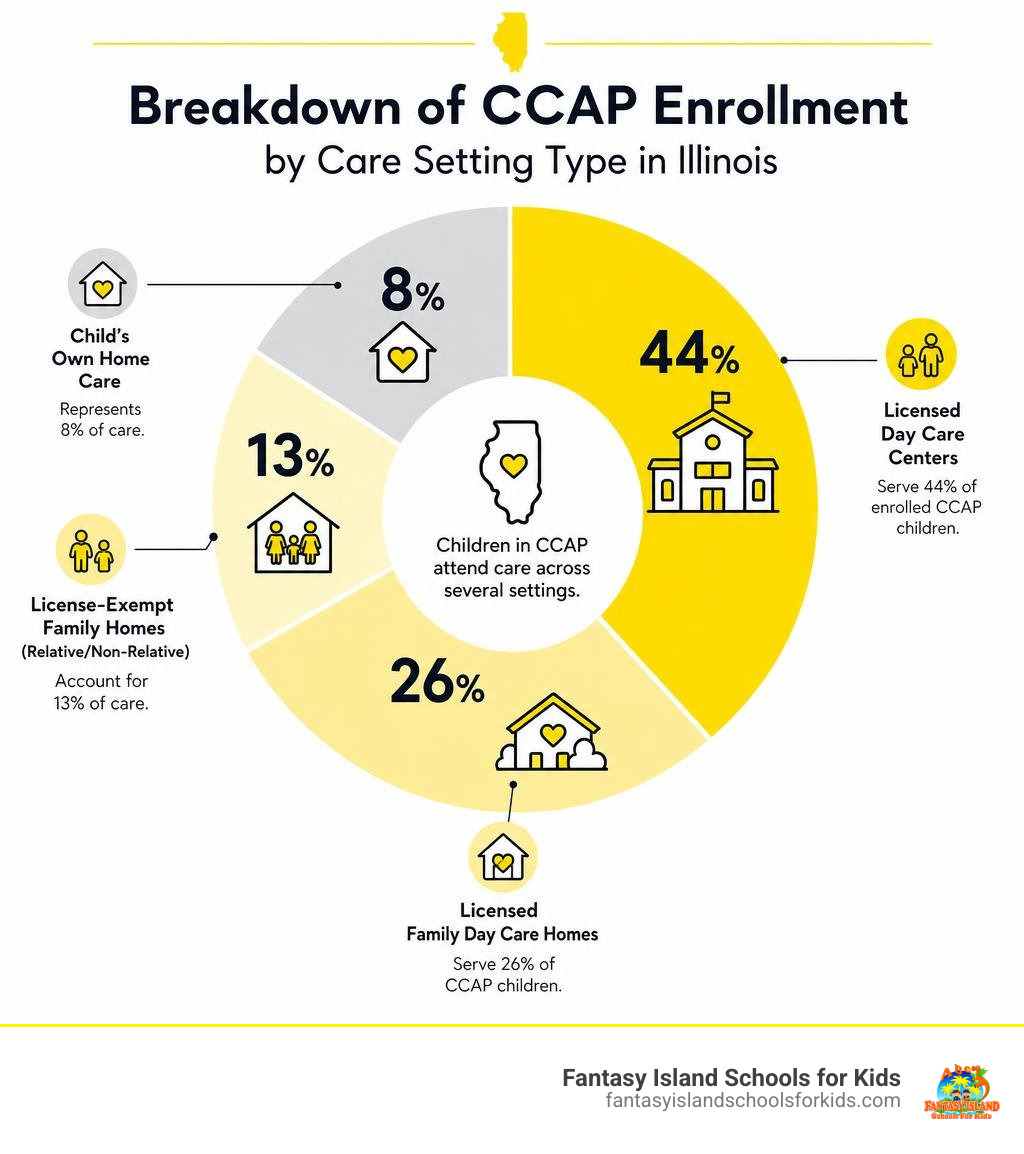
Children enrolled in CCAP attend care across several settings:
- Licensed Day Care Centers: Serve 44% of enrolled CCAP children.
- Licensed Family Day Care Homes: Serve 26% of CCAP children.
- License-Exempt Family Homes (Relative/Non-Relative): Account for 13% of care.
- Child’s Own Home Care: Represents 8%.
- Group Homes & License-Exempt Centers: Represent 4% and 3%, respectively.
Reimbursement rates paid to providers depend on county groupings. Group 1A counties—which include Cook, DuPage, Lake, Kane, McHenry, DeKalb, and Kendall—receive the state’s highest reimbursement tiers due to regional living costs. Provider rate schedules are detailed in official document Child Care Payment Rates for Child Care Providers. Care under 5 hours is reimbursed at a part-day rate, while 5 to 12 hours qualifies for the full-day rate.
Smart Start Workforce Grants and System Integration

Illinois has invested heavily in early childhood infrastructure through Smart Start Workforce Grants. Backed by $200 million in state funding, these grants help licensed centers increase teacher wages, stabilize early education staffing, and improve classroom quality. To qualify, centers must dedicate at least 15% of their licensed capacity to CCAP-enrolled children.
Smart Start aligns CCAP with other public early education investments, such as Head Start, Preschool for All, and the Early Childhood Block Grant. For complete program funding breakdowns, administrators can review the official Illinois Early Childhood Programs and Funding Streams Guide.
The 2026 IDEC Agency Consolidation
As of July 1, 2026, the state officially launched the Illinois Department of Early Childhood (IDEC). IDEC unifies programs previously spread across IDHS, ISBE, and DCFS—including CCAP child care subsidies, center licensing, Head Start collaboration, Home Visiting, and Early Intervention—under one cabinet-level agency. This structure streamlines parent applications, aligns provider standards, and simplifies state oversight.
Frequently Asked Questions about Illinois Child Care Subsidies
Who qualifies for CCAP in Illinois?
Qualifying families live in Illinois, meet initial income rules (at or below 225% FPL), and need care for children under 13 while parents work, attend college or training, or participate in approved job activities. Children qualify regardless of immigration status.
Can college students and self-employed parents get child care assistance?
Yes! Parents pursuing vocational certificates or 4-year undergraduate degrees can qualify, even if they report zero income. Self-employed parents can verify earnings using monthly profit-and-loss records (Form IL 444-2790) along with business receipts.
What happens if my family income increases after approval?
CCAP approvals guarantee 12 months of coverage. If family income rises during the year, assistance continues as long as income stays below 275% FPL during annual redetermination. If income exceeds that threshold, the Graduated Phase Out policy offers a 3-month transition period.
Conclusion
Securing a childcare subsidy Illinois grant through CCAP can open doors to safe, enriching early childhood education for your child while relieving financial strain on your household budget. With streamlined digital tools and unified state oversight under IDEC, applying for assistance is more accessible than ever.
At Fantasy Island Schools for Kids, founded in 2009 by Beata Bielic, we believe every child deserves an inspiring early education. Located at 6100 N Milwaukee Ave, Chicago, IL 60646, our school proudly serves families across Chicago’s Northwest Side and surrounding suburbs, including Norwood Park, Edison Park, Gladstone Park, Jefferson Park, Sauganash, Edgebrook, Portage Park, Niles, Park Ridge, Skokie, Norridge, and Harwood Heights.
We serve children ages 2-6 with full-time and part-time options, operating Monday through Friday from 7 AM to 6 PM. Our standard weekly tuition ranges from $300 to $400 per week, which includes freshly cooked daily meals, weekly music instruction, and our Gifted Enrichment Program. Instruction is in English, and children who speak Polish or Ukrainian at home get support from teachers who speak their language.
To ensure quality education remains affordable for local working parents, Fantasy Island Schools for Kids accepts CCAP (Illinois Child Care Assistance Program) and Illinois Action for Children. If you are evaluating program options or need help navigating your subsidy paperwork, stop by our Milwaukee Avenue campus today!