

What 3-Year-Olds Should Know: A Quick Development Guide
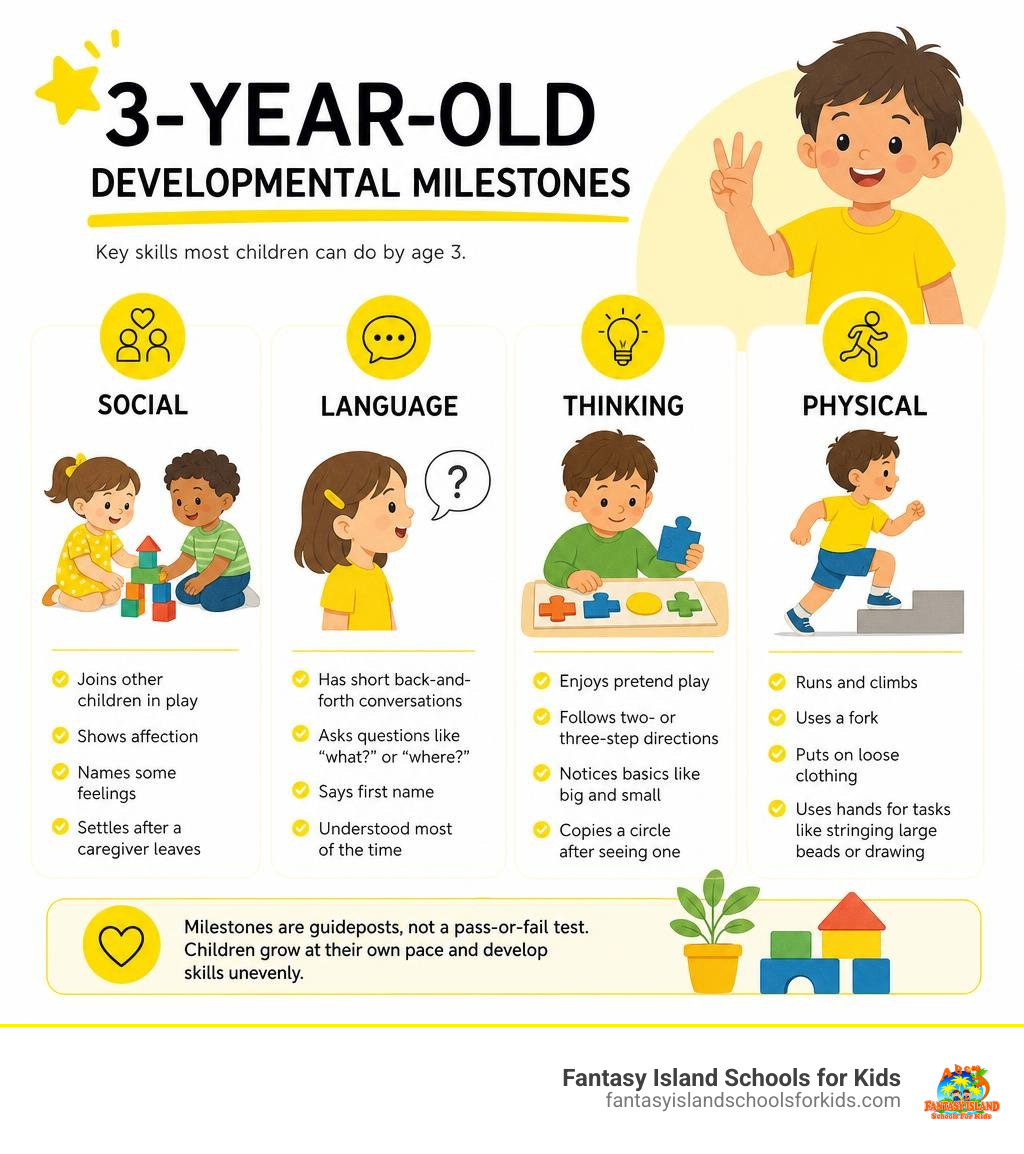
What a 3-year-old should know is less about memorizing letters or numbers and more about growing across everyday skills: communicating needs, playing with others, moving confidently, managing feelings with help, and exploring how the world works.
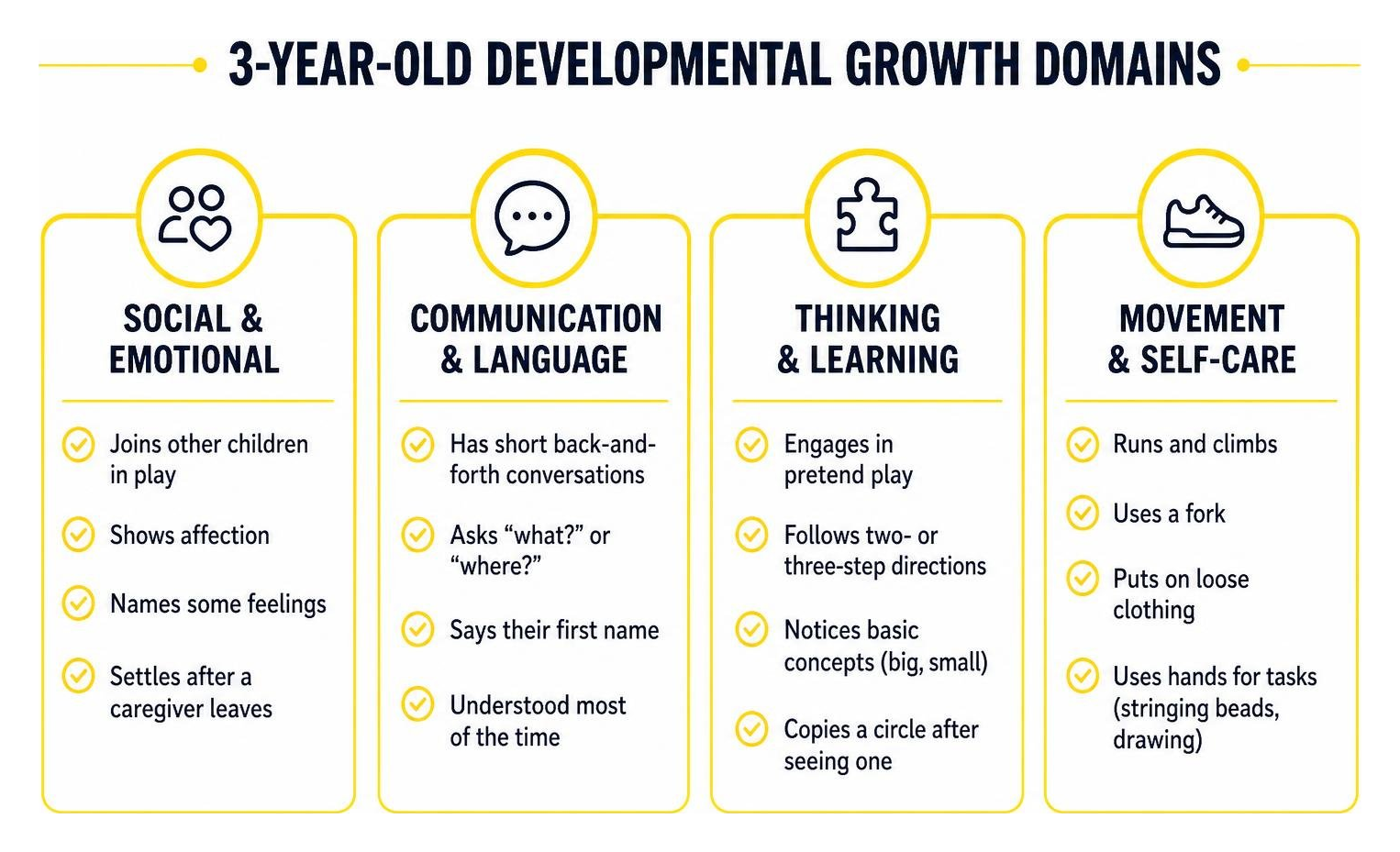
By age 3, most children can:
- Socially and emotionally: Join other children in play, show affection, name some feelings, and settle after a caregiver leaves.
- Communicate: Have short back-and-forth conversations, ask questions such as “what?” or “where?”, say their first name, and be understood most of the time.
- Think and learn: Pretend play, follow two- or three-step directions, notice basic concepts like big and small, and copy a circle after seeing one.
- Move and care for themselves: Run, climb, use a fork, put on loose clothing, and use their hands for tasks such as stringing large beads or drawing.
Developmental milestones are useful guideposts, not a pass-or-fail test. The CDC designs its milestones around skills that at least 75% of children can do by a given age. Children also develop unevenly: a child who talks nonstop may still be building confidence on stairs, while a skilled climber may need more time to speak clearly.
I’m Beata Bielic, Executive Director of Fantasy Island Schools for Kids and an early-childhood educator with more than 17 years of experience supporting young children’s learning and development. Fantasy Island Schools for Kids was founded in 2009 by Beata Bielic and is located at 6100 N Milwaukee Ave, Chicago, IL 60646 (Phone: 773-206-4627). In working with children ages 2-6, I have seen that understanding typical 3-year-old milestones helps parents notice progress, celebrate small wins, and ask for support early when something does not feel right.
Key Growth and Physical Milestones: What 3-Year-Olds Are Learning to Do
The third year of life brings dramatic physical changes. You might notice that your child is losing that soft baby belly and stretching into a taller, leaner preschooler. Their head and legs become more proportional to the rest of their body, and their balance improves dramatically.
Physically, understanding 3-year-old development involves observing how children navigate space, handle objects, and manage daily self-care tasks. For a complete medical reference on these benchmarks, you can consult the Developmental milestones record – 3 years resource.
Here is a quick look at physical developmental expectations:
Gross and Fine Motor Skill Benchmarks
Gross motor skills involve large muscle groups used for running, jumping, and climbing. Fine motor skills focus on smaller hand and finger movements required for drawing, eating, and dressing.
- Gross Motor Skills:
- Pedaling a tricycle: Most 3-year-olds can steer and pedal a small three-wheeled bike on flat ground.
- Stair climbing: They can walk up stairs alternating feet (one foot per step), though they may still place both feet on a step when coming down.
- Balance and movement: They can stand on one foot for 1 to 5 seconds, hop on one foot, jump in place with both feet leaving the ground, and catch a large thrown ball with both arms outstretched.
- Fine Motor Skills:
- Hand control and grip: Children start transitioning from a full-fist crayon grip to a three-finger tripod or four-finger quadrupod grip.
- Drawing and building: They can copy vertical and horizontal lines, draw a circle after being shown, and build a tower of 6 to 9 or more blocks.
- Self-care dexterity: They can string large beads or macaroni, turn single pages in a book, hold a fork or spoon to feed themselves, and unbutton large buttons.
Physical Development and Growth Tracking
While every child grows at their own pace based on genetics and health, pediatric guidelines highlight steady growth averages during the third year:
- Weight Gain: 3-year-olds typically gain about 4 to 6 pounds per year.
- Height Growth: They grow approximately 2 to 3 inches per year, reaching roughly half of their eventual adult height by their third birthday.
- Teeth: By age 3, most children have a complete set of 20 primary (“baby”) teeth.
- Sleep Needs: 3-year-olds require 11 to 13 hours of total sleep per day. This usually consists of 10 to 11 hours at night and a 1- to 2-hour afternoon nap.
- Physical Activity: Toddlers need at least 30 minutes of structured physical activity led by an adult and 60 minutes of unstructured active free play every day.
In our classrooms on Chicago’s Northwest Side, we see how crucial daily physical play is – especially during harsh Chicago winters when indoor multi-sensory spaces give kids the freedom to jump, balance, and burn off energy safely.
Cognitive and Language Development Standards
Between ages 3 and 4, a child’s brain goes through a massive burst of neural activity. Their curiosity blossoms, leading to the famous “why?” phase. They start linking ideas together, organizing concepts, and using expanded language to share their thoughts with the world.
For a broader overview of how these cognitive leaps fit into overall early childhood milestones, see the guide on 3-Year-Old Child: Development, Growth, Milestones & More.
Core Cognitive Skills for 3-Year-Olds
When parents ask what their 3-year-old should know academically, it is helpful to remember that early math and science for preschoolers are entirely play-based and experiential.
- Counting and Quantities: A 3-year-old can usually recite numbers up to 10 from memory. More importantly, they understand the true concept of “two” and can count out up to 3 or 4 physical objects accurately by touching each item.
- Shapes and Colors: They can identify basic colors (red, blue, yellow, green) and recognize core geometric shapes like circles and squares.
- Sorting and Matching: They can sort buttons, blocks, or socks by a single category, such as color or size (e.g., putting all red blocks together or separating big cars from small cars).
- Problem-Solving and Puzzles: They can complete simple 3- to 4-piece jigsaw puzzles, match pictures in a memory game, and solve basic spatial challenges during block play.
- Pretend Play: Cognitive progress shows up clearly when children engage in symbolic play – using a plastic banana as a telephone, pretending an empty cardboard box is a spaceship, or playing doctor with stuffed animals.
Speech and Communication Expectations at Age 3
Communication skills skyrocket during this year. A child moves from simple two-word requests to full conversational exchanges.
- Vocabulary Size: Between ages 3 and 4, a child’s vocabulary expands rapidly from around 250 words to anywhere between 500 and 900 words.
- Sentence Length: They consistently speak in sentences of 3 to 5 words (e.g., “I want to go outside now” or “Look at the big truck”).
- Speech Clarity: By age 3, strangers and unfamiliar adults should be able to understand about 75% of what the child says.
- Questioning: They frequently ask “who?”, “what?”, “where?”, and “why?” questions to gather information about their environment.
- Grammar and Pronouns: They use pronouns like I, you, me, we, and they, as well as basic plurals (cats, dogs) and simple past-tense words (walked, played).
- Multi-Step Instructions: A 3-year-old can follow 2- to 3-step sequential directions, such as “Put down your toy, get your shoes, and meet me at the front door.”
In multilingual learning environments, like our Polish and English dual-language programs, 3-year-olds absorb language patterns effortlessly. Speaking multiple languages at home or school builds flexible cognitive networks while maintaining strong communication benchmarks.
Social, Emotional, and Behavioral Milestones
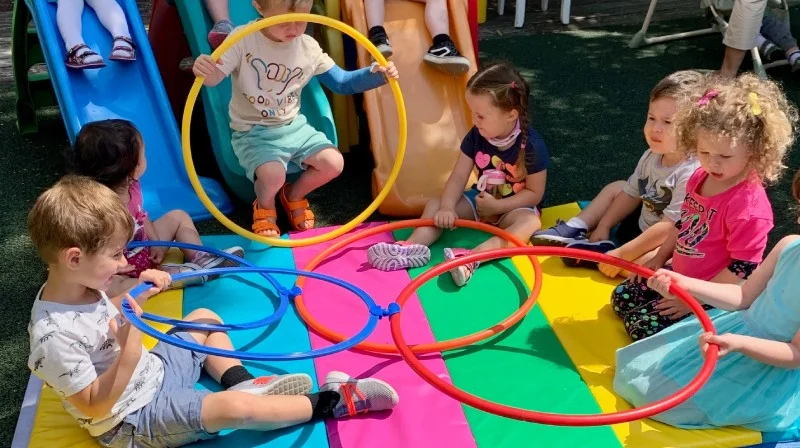
At age 3, children move from parallel play (playing next to another child without interacting) toward true cooperative play (playing with another child, sharing materials, and creating joint play scenarios). This shift requires new emotional tools and plenty of practice.
To explore additional provincial and international guidelines on social growth, check out the resources provided in Milestones for 3-Year-Olds.
Emotion Regulation and Managing Tantrums
Three-year-olds feel big emotions, but their prefrontal cortex—the area of the brain responsible for impulse control and logic—is still early in its development.
- Identifying Feelings: A 3-year-old can recognize and name basic feelings in themselves and others, such as happy, sad, angry, and scared.
- Separation Anxiety: While dropping off at daycare or preschool can still cause brief teary moments, a typical 3-year-old is able to calm down within 10 minutes after a parent leaves.
- Managing Big Feelings: When frustrated, 3-year-olds may still throw temper tantrums. However, tantrums should become less frequent as their verbal skills improve.
- Practical Behavioral Strategies:
- Offer Limited Choices: Instead of asking “What do you want to wear?”, ask “Do you want the red shirt or the blue shirt?” This satisfies their urge for independence without overwhelming them.
- Name the Emotion: Validate their feelings before correcting behavior: “I see you are angry because it’s time to clean up, but throwing blocks is not safe.”
- Teach Calming Techniques: Practice deep “balloon breathing” or hugging a favorite plush toy during quiet moments so they can use these tools when upset.
Early Social Skills and Peer Relationships
Building early friendships helps children learn empathy, negotiation, and cooperation.
- Sharing and Turn-Taking: While sharing is still a work in progress (and requires gentle adult reminders), 3-year-olds are beginning to understand taking turns during games.
- Showing Empathy: They show affection for friends and may offer a cuddle or blanket to a peer who is crying.
- Community and Self-Identity: A 3-year-old can tell you their full name, age, gender, and sometimes the names of family members or classmates.
- Preschool Transition: Attending a structured early childhood program gives toddlers an environment where social rules, daily group routines, and cooperative play happen naturally. If you are comparing neighborhood preschool programs, reading our article on Navigating Full-Day Preschool Options Across Chicago Neighborhoods offers helpful insights for local families.
Supporting Your Child’s Growth and When to Seek Early Intervention

Parents are a child’s first and most influential teachers. You do not need expensive toys or specialized flashcards to support healthy 3-year-old development. Simple, everyday interactions built around conversation, play, and household routines offer the richest learning experiences.
For official checklist tools and guidelines from public health authorities, refer to the Milestones by 3 Years | CDC page.
Evidence-Based Play Activities and Daily Routines
Integrating developmental learning into your daily schedule keeps play engaging and stress-free:
- Interactive Daily Reading: Read picture books together every day. Ask open-ended questions like “Why do you think the bear is wearing boots?” or “What do you think happens next?”
- Sensory and Fine Motor Play: Provide playdough, water play, finger paints, or child-safe scissors. Squishing and rolling playdough strengthens finger muscles needed for writing later on.
- Language Expansion: Model mature speech by repeating what your child says with complete grammar. If your toddler says “Car go fast,” respond with “Yes, that big red car is driving very fast down the street!”
- Involve Them in Household Chores: Assign 3-year-olds simple jobs like matching socks, placing plastic plates on the dinner table, or wiping the coffee table with a damp cloth. This builds confidence, spatial math skills, and self-reliance.
- Screen Time Limits: Pediatric recommendations advise capping screen time at a maximum of 1 hour per day of high-quality, educational programming, ideally viewed alongside an adult who can talk about what is happening on screen. Keep televisions and digital devices out of children’s bedrooms.
Recognizing Developmental Red Flags and Missing Milestones
It is natural to wonder if your child is on track. Because milestone checklists represent what 75% or more of children can do, missing a single skill temporarily is usually not a cause for alarm. However, noticing multiple missing milestones or a regression in skills warrants prompt discussion with your pediatrician.
Consult your child’s doctor or an early intervention specialist if your 3-year-old shows any of the following signs:
- Language & Hearing: Does not use sentences of 3 or more words; cannot follow simple 2-step instructions; does not make eye contact; or has speech that is extremely difficult for family members to understand.
- Motor Skills: Falls down frequently or struggles with stairs; cannot balance on one foot for even a second; or struggles significantly to manipulate small objects like large pegs or crayons.
- Social & Emotional: Does not engage in pretend or play-act games; shows no interest in other children; refuses to make eye contact; or experiences extreme separation anxiety that lasts well over 30 minutes every drop-off.
- Loss of Skills: Loses any speech, motor, or social skills they once possessed.
Acting early makes a tremendous difference. Early childhood professionals and state early intervention programs can offer simple screenings to ensure your child receives extra support if needed.
Frequently Asked Questions About 3-Year-Old Development
How many words should a 3-year-old be able to say?
Between 3 and 4 years of age, a typical child has a vocabulary ranging from 500 to 900 words. They frequently speak in sentences of 3 to 5 words and should be easily understood by familiar caregivers and understood roughly 75% of the time by strangers.
How do I know if my 3-year-old is ready for preschool?
Preschool readiness is less about academic skills and more about emotional and physical routines. Indications of readiness include being able to manage brief separations from parents, following simple group directions, communicating basic needs (like needing the bathroom or a drink), and demonstrating interest in playing alongside other children.
How much screen time is safe for a 3-year-old?
Leading early childhood guidelines recommend limiting passive screen time (TV, tablets, smartphones) to no more than 1 hour per day for 3-year-olds. Co-viewing content with an adult to discuss the story helps turn passive viewing into an interactive learning moment.
Conclusion: Nurturing Your 3-Year-Old’s Potential
Understanding 3-year-old developmental milestones gives you a clear map of your child’s growth across physical, cognitive, communication, and emotional domains. As you celebrate their expanding vocabulary, marvel at their creative pretend play, and navigate occasional big emotional waves, consistent love, responsive conversation, and playful exploration are the best tools you can provide.
At Fantasy Island Schools for Kids, founded in 2009 by Beata Bielic, we have spent nearly two decades partnering with parents to build strong early learning foundations. Located at 6100 N Milwaukee Ave, Chicago, IL 60646, our school serves children ages 2-6 with full-time and part-time enrollment options, operating Monday through Friday from 7 AM to 6 PM.
Families from Chicago’s Northwest Side and nearby suburbs, including areas such as Norwood Park, Jefferson Park, Park Ridge, and Niles, choose our program for a balanced early learning experience close to home. Our program features a Gifted Enrichment Program, a multilingual staff offering English, Polish, and additional language exposure, a large multi-sensory indoor play space, weekly music classes, and freshly cooked on-site mealtimes. Our tuition rates sit around $300-$400/week and include all meals, music instruction, and gifted programming. We also accept CCAP (Illinois Child Care Assistance Program) and Illinois Action for Children; families can contact the school or Illinois Action for Children for details about assistance and enrollment support. Reach out to schedule a tour and see how our curriculum is designed to help your child thrive.