
Finding a dual language preschool in Chicago
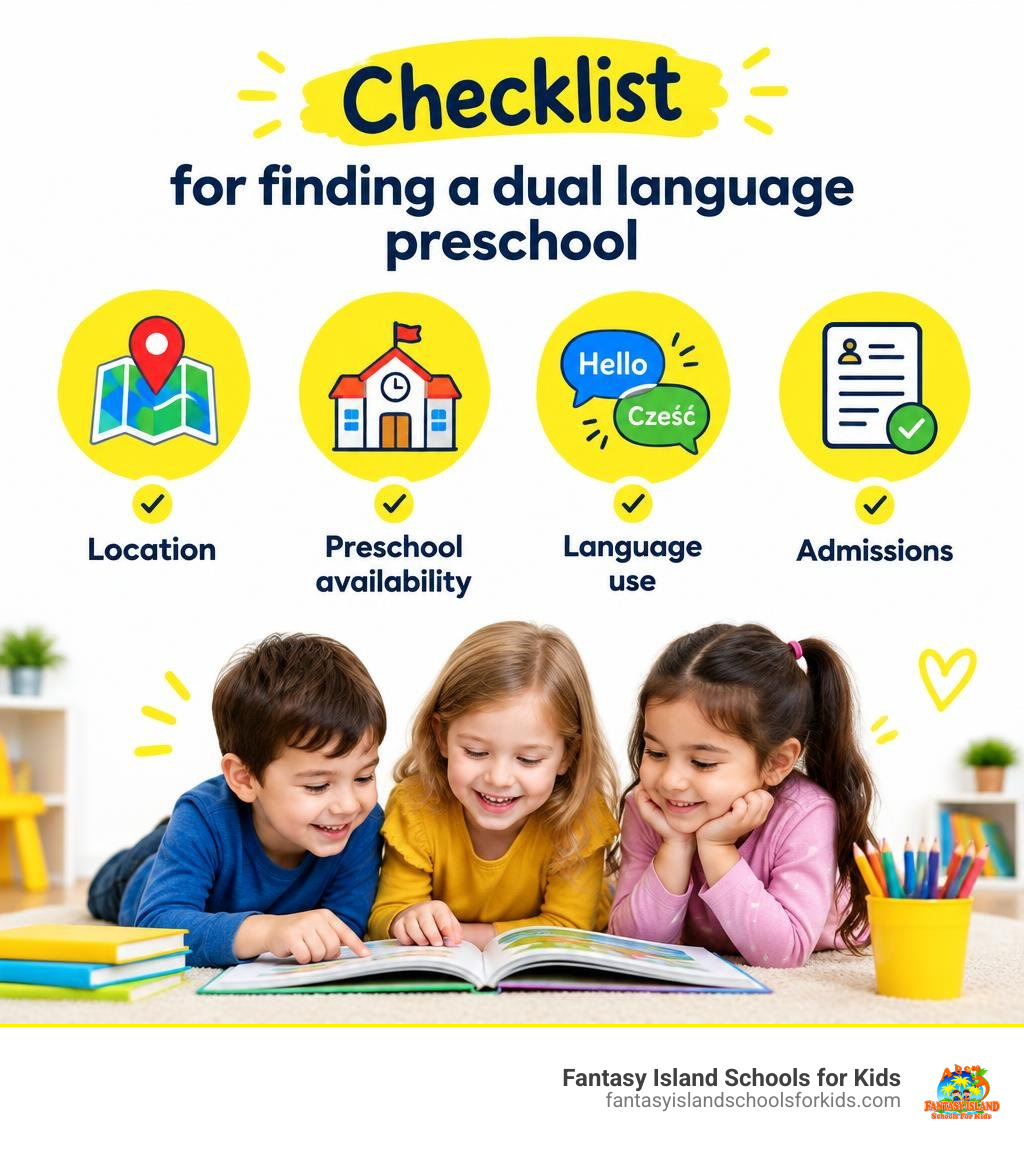
A dual language preschool in Chicago teaches children through English and another language. To find one near Chicago’s Northwest Side, check which public and private programs offer preschool, ask how each language is used during the day, and confirm age rules and admissions directly with the school.
I’m Beata Bielic, founder of Fantasy Island Schools for Kids, with over 17 years of early childhood education experience. If your search for “dual language preschool Chicago” brought you here, I’ll help you compare programs and understand how they differ from our English-language program with Polish and Ukrainian language support.
Dual language preschool Chicago: program types and learning models
Dual language education teaches academic content through two languages, with the goal of developing language skills and academic learning in both. Chicago Public Schools (CPS) describes two main models: one-way and two-way. Programs may differ in which children they serve, how they divide instruction between languages, and what language criteria apply for entry.
| Program model | Typical student group | How instruction works | Admissions considerations |
|---|---|---|---|
| One-way | Students who share a partner-language background, including English Learners (ELs) and heritage-language learners | Core learning includes instruction in English and the partner language | Schools may require students to meet language eligibility criteria |
| Two-way | ELs and students who are not ELs, including English-dominant children | Students learn with peers who can model each language; programs aim to balance the language groups | Open to different language backgrounds, but school-specific entry requirements still apply |
CPS programs currently pair English with a partner language. The district’s Dual Language Education overview explains the models, goals, and school directory. Not every listed school offers preschool, so confirm that the specific program accepts preschool-age children.
What does a dual language preschool in Chicago teach?
A dual language classroom teaches more than vocabulary. Depending on the program and age group, children may learn language arts and early literacy, math concepts, science, and social studies through both languages. Teachers build understanding through conversation, stories, play, classroom routines, and other age-appropriate activities.
The long-term goals are bilingualism, biliteracy, and cultural understanding. For preschoolers, that means building a foundation for communicating and learning in both languages; it does not mean every child will progress at the same pace or become equally proficient in both right away.
How do public and private or Catholic programs differ?
Public programs are district-run and follow district enrollment procedures. CPS uses one-way and two-way models, and public preschool availability depends on the school and current program structure. Families should ask whether the preschool classroom is part of the dual language pathway and how children continue into kindergarten.
Private programs set their own tuition, schedules, admissions procedures, and program details. A private or Catholic school may include faith-based learning alongside language instruction, but that varies by school. Ask whether its model is true dual language instruction or language classes added to an otherwise English-language day. Also confirm the tuition and available financial assistance, school-day length, and requirements for entering preschool.
Public schools with dual language options for preschool-age children
CPS lists dual language programs across the district, but that does not mean every school has a dual language preschool. Preschool options and language models vary by school and may change. Use the CPS Dual Language Education directory, then contact each school to confirm whether it offers a preschool classroom, which model it follows, and how enrollment works.
Some CPS schools with early childhood programs may also have a dual language pathway, but preschool participation does not automatically guarantee a kindergarten seat in that pathway. Ask about both the preschool classroom and the next step before applying.
When contacting a school, check:
- Whether dual language instruction is offered at the preschool level
- Whether the program is one-way or two-way
- Which language pair is used
- How much instruction children receive in each language
- Whether the pathway continues into kindergarten
- Whether the school has language eligibility requirements
How a dual language preschool in Chicago supports different learners
Programs may support children differently depending on their language background. In a one-way program, many students are English Learners or heritage-language learners who share the partner language. In a two-way classroom, English Learners and children who are not English Learners learn together and can serve as language models for one another.
According to the CPS Dual Language Education overview, English Learner students in dual language programs receive English Language Development instruction. Native English speakers receive development in the partner language. Two-way programs aim for a balance of language groups, and application information helps the district consider that balance. Families should describe the languages their child understands and uses accurately, rather than trying to qualify for a particular seat.
The Office of Multilingual-Multicultural Education (OMME) supports CPS multilingual education, including dual language programming. It can help families understand district program models and connect with relevant information. CPS lists OMME at 773-553-1930 and OMME@CPS.EDU.
Enrollment, age requirements, and choosing a program
Preschool age requirements depend on the school and program. CPS preschool classrooms serve eligible young children, but eligibility, classroom availability, and application procedures can vary. Private schools set their own age and admission rules. Confirm the current requirements directly with the program before planning around a particular start date.
For public programs, families may need to use the district’s early learning or school application process. Neighborhood-school enrollment and application requirements can differ. If you are considering a CPS dual language preschool, ask the school whether it is your neighborhood option, whether a separate application is needed, and how language eligibility is checked. For private programs, contact admissions directly about forms, visits, tuition, and any readiness requirements.
| Enrollment step | Public-school program | Private-school program |
|---|---|---|
| Confirm preschool availability | Check the district and school; a dual language option may not include preschool | Ask admissions whether preschool is included in the language program |
| Check age and eligibility | Confirm current district requirements with the school or district | Ask the school about its age and readiness rules |
| Apply | Follow the current district process and deadlines | Follow the school’s application and enrollment process |
| Clarify language criteria | Ask about model-specific eligibility and assessments | Ask how the school considers a child’s language background |
| Plan for kindergarten | Confirm whether continuation is automatic or requires an application | Ask how the school handles progression into kindergarten |
As you compare options, consider your daily commute, schedule, and the languages your family uses at home. During a school visit, ask to see how language is used in ordinary activities, not only during a language lesson. Ask how teachers communicate with families and how caregivers can support language development outside school.
What language proficiency does a child need?
There is no single citywide language proficiency rule for every dual language preschool or kindergarten. Requirements depend on the school, program model, and entry grade. One-way programs may have language eligibility criteria, while two-way programs bring together children with different language backgrounds. A school may assess language skills or use family language information as part of placement.
Before applying, ask whether a preschooler needs to speak or understand the partner language, how the school assesses language, and whether the same criteria apply at kindergarten entry. Answer language-history questions honestly. This helps schools determine whether the program is appropriate and, for two-way programs, understand the language mix of applicants.
How families can compare programs and prepare to apply
A short list of practical questions can make school visits more useful:
- What languages are used during the day, and when?
- How does the school support children who are new to the partner language?
- What language goals are appropriate for preschool and kindergarten?
- How do teachers share progress with families?
- What are the class schedule, meals, and family involvement expectations?
- What documents and application steps are required?
- How does the school help children transition to kindergarten?
Keep a simple record of application requirements and follow-up dates for each program. Since public-school processes and private admissions timelines differ, verify current dates directly rather than relying on an older calendar or another family’s experience.
Benefits, English Learner support, and long-term outcomes
A well-structured dual language program can give children regular opportunities to communicate and learn in two languages. Its aims may include bilingualism, biliteracy, literacy development, cultural awareness, and communication skills. The CPS Dual Language Education overview also identifies cognitive flexibility and sociocultural competence as program goals.
In a two-way classroom, children with different language strengths may learn from one another. In a one-way setting, instruction can affirm students’ home language while developing English skills. CPS describes this approach as additive: the goal is to build English without treating a child’s other language as a deficit.
The district’s pathway can extend beyond preschool and elementary school. CPS aims for students to develop grade-level competencies in both languages, with the possibility of continuing language study through high school and pursuing the Illinois State Seal of Biliteracy. These are program goals, not guaranteed outcomes for every student. Progress depends on factors such as continued instruction, attendance, the child’s learning needs, and opportunities to use both languages.
What long-term outcomes can families reasonably expect?
Families can look for growth in a child’s ability to understand and use both languages, participate in classroom learning, and communicate with people from different backgrounds. Continued instruction can help children build literacy in both languages over time. A dual language pathway may also provide a route toward the State Seal of Biliteracy in high school.
Children develop at different rates, and preschool exposure alone does not determine a long-term result. Ask the school how it measures progress, supports students who need additional language development, and helps families understand the next grade’s expectations.
Frequently Asked Questions about dual language preschool in Chicago
Can a child who speaks only English apply to a two-way program?
Often, yes. Two-way programs are designed for children with different language backgrounds, including English-dominant learners. Eligibility and available seats depend on the school and grade, so check the program’s current requirements.
Can a child continue from a public-school dual language Pre-K into kindergarten?
Continuation rules vary. According to the CPS Dual Language Education overview, some students may continue without a separate application at their neighborhood school or Inter-American, while others need to apply through the district process. Confirm the current rule with your child’s preschool and the receiving school.
Does every public-school dual language preschool require proficiency in the partner language?
No single rule applies to every program. Requirements can depend on whether the school uses a one-way or two-way model and on the child’s entry grade. Ask the school or CPS whether it assesses language proficiency and what criteria apply.
Conclusion
Start with your family’s priorities: the languages you want your child to learn, the preschool schedule, the commute, and the program’s approach to language development. Then confirm preschool availability, eligibility, and current admissions steps directly with each school.
At Fantasy Island Schools for Kids, we offer an English-language program with Polish and Ukrainian language support for children ages 2-6. If you are comparing early learning options near Norwood Park, our preschool program information explains our approach. You can also schedule a tour to see whether our program fits your family’s needs.