

Why Multilingual Education Benefits Matter Early
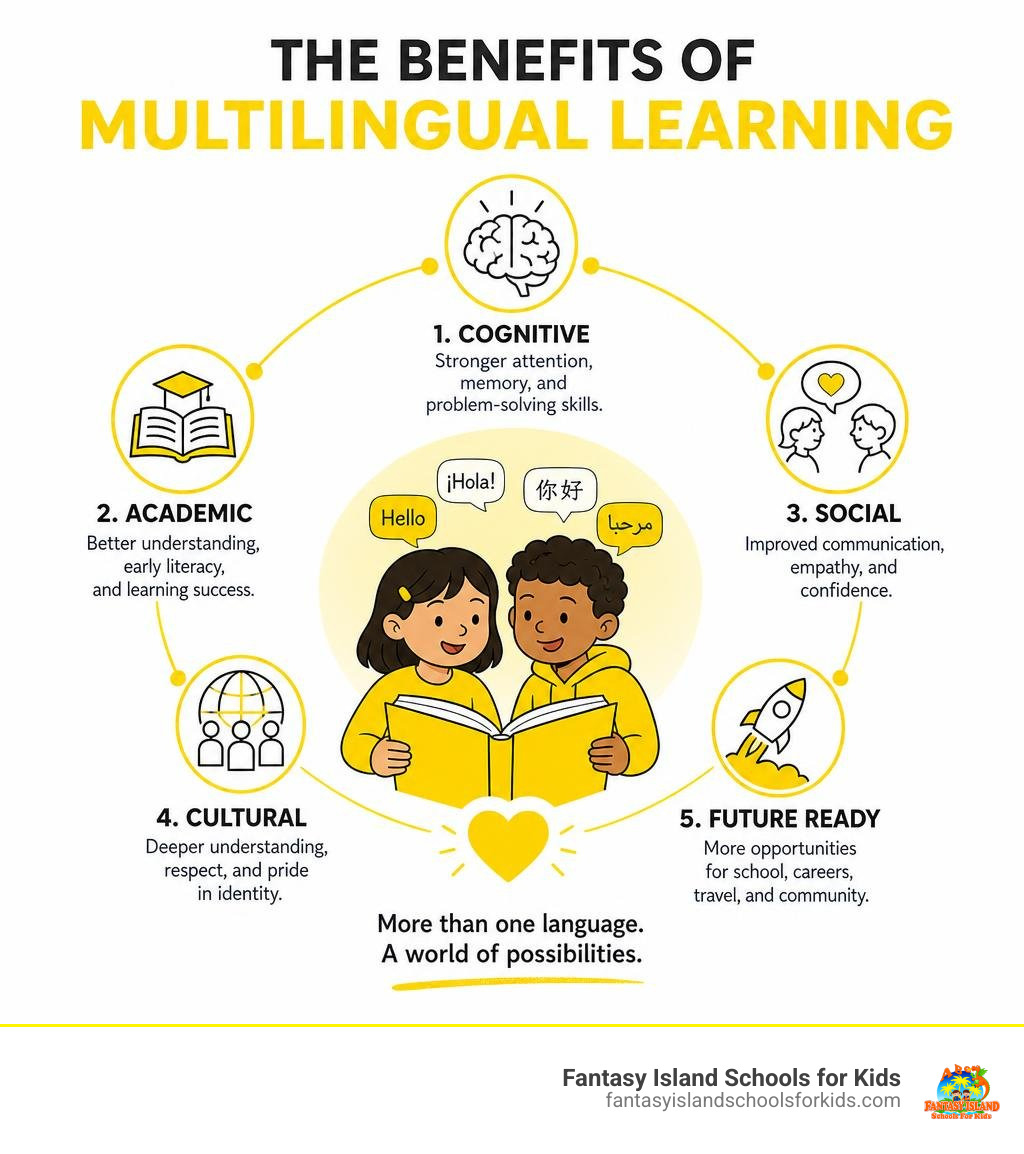
The multilingual education benefits for young children can include stronger communication, early literacy, flexible thinking, cultural understanding, and a deeper connection to family heritage.
- Cognitive growth: Using more than one language can build attention, memory, and problem-solving skills.
- Academic learning: Children learn best when they understand the language used around them. UNESCO reports that many students without access to education in a familiar language face major barriers to reading with understanding.
- Social-emotional development: Multiple languages can help children express themselves, understand different perspectives, and feel proud of their identity.
- Future readiness: Language skills can support later school, career, travel, and community opportunities.
For parents, the key point is simple: multilingual learning is not about replacing a child’s home language. It is about adding new ways to communicate, learn, and connect. This matters because language is tied to confidence, belonging, and how comfortably a child can participate in the classroom.
At Fantasy Island Schools for Kids, we see early childhood as a valuable time to make language learning active, warm, and playful. English is our language of instruction, and with Polish and Ukrainian support our setting helps children ages 2-6 explore language through hands-on experiences, relationships, music, and everyday classroom routines.
I am Beata Bielic, Executive Director of Fantasy Island Schools for Kids and an early-childhood educator with more than 17 years of experience. Since founding the school in 2009, I have seen how thoughtful, age-appropriate multilingual education benefits can support children’s confidence, curiosity, and readiness to learn.
Cognitive and Academic Multilingual Education Benefits for Young Learners
When young children learn to process two or more languages, their brain undergoes unique structural and functional development. Early childhood is a critical window of neuroplasticity, during which young minds process language intuitively rather than through mechanical grammar memorization. Research consistently shows that dual-language processing engages the brain’s executive control center, building cognitive pathways that aid long-term learning performance across all academic subjects.
Navigating multiple linguistic systems requires the brain to continuously select the appropriate vocabulary while inhibiting the non-target language. This active neural practice serves as mental exercise, strengthening working memory, attentional focus, and cognitive agility. Children educated in multilingual environments demonstrate superior ability to filter out classroom distractions, follow multi-step directions, and shift smoothly between tasks.
According to global research summarized in Multilingual Education: A Key to Quality and Inclusive Learning, providing instruction in a familiar language significantly lifts literacy and general educational outcomes. Across high- and middle-income nations alike, early instruction that honors a child’s native tongue leads to marked increases in primary reading comprehension. When foundational concepts are established in a language the child thoroughly understands, those skills transfer smoothly into secondary language acquisition, preventing learning gaps in core subjects such as reading, mathematics, and science.
Metalinguistic Awareness and Core Academic Skills
One of the greatest multilingual education benefits is the rapid enhancement of metalinguistic awareness—the ability to think about language as an abstract system rather than just a tool for speaking. Multilingual children come to realize early on that words are symbolic representations of ideas. For example, a young child learning English and Polish realizes that a physical item can be called “chair” or “krzesło” without changing the underlying object.
This structural realization accelerates foundational academic skills:
- Enhanced Pattern Recognition: Dual-language learners recognize phonetic and grammatical patterns more quickly, which aids in decoding new words and acquiring early reading fluency.
- Mathematical Reasoning: The abstract symbolic thinking developed through bilingualism directly enhances spatial and numerical reasoning. In countries like Mozambique, studies show students in dual-language curriculum scored 15% higher in foundational mathematics and reading.
- Comparative Vocabulary Growth: A study of multilingual youth aged 11 to 16 revealed that 56.2% enjoyed reading across all their known languages specifically because it introduced them to new words, enriching their total conceptual vocabulary.
Long-Term Cognitive Health and Executive Function
The cognitive advantages of multilingualism extend far beyond early literacy gains. Regular engagement with multiple languages builds cognitive reserve, reinforcing decision-making objectivity and mental flexibility throughout life.
Studies in decision science reveal that evaluating problems in a second language creates a subtle emotional distance, enabling individuals to rely more on logic and objective reasoning. For young children, this manifests as improved impulse control, creative problem-solving agility, and heightened change detection. When presented with complex visual or conceptual puzzles, multilingual students frequently display faster pattern-matching and task-switching responses than their monolingual peers, creating a strong foundation for future STEM and humanities learning.
Social, Emotional, and Cultural Advantages of Early Dual-Language Learning
Language is intimately connected to emotion, identity, and social connection. Beyond test scores and brain development, multilingual education equips children with profound socio-emotional capabilities. In an increasingly interconnected world, the ability to step outside one’s primary linguistic framework nurtures emotional intelligence and deep cross-cultural empathy.
When children encounter diverse languages early, they realize from a young age that different people express thoughts, feelings, and customs in unique ways. This exposure reduces ethnocentric bias and builds perspective-taking abilities—a key component of emotional intelligence. In mixed-language classrooms, children naturally learn patience, active listening, and inclusive play strategies.
Cultural Heritage and Identity Preservation
For many families across Chicago’s Northwest Side, preserving heritage languages like Polish, Spanish, or Ukrainian is a primary motivation for seeking dual-language programs. When schools embrace a child’s home language alongside English, it sends a powerful message: your culture, family traditions, and identity are valuable assets.
Research highlights the emotional impact of native language validation:
- Identity Pride: Survey data demonstrates that 73.6% of multilingual children aged 11 to 16 consider their non-English language to be a crucial component of their personal identity and self-worth.
- Intergenerational Connection: Maintaining fluent communication in a home language fosters deep bonds with parents, grandparents, and extended family members, keeping oral histories, culinary traditions, and family values vibrant across generations.
- School Belonging: Children whose native tongue is recognized in their early learning environment express higher levels of classroom engagement and confidence.
Enhancing Social-Emotional Learning Through Translanguaging
Modern educational research highlights the immense social-emotional benefits of “translanguaging”—the natural practice where multilingual speakers draw upon all their known languages flexibly to communicate and solve problems. Rather than viewing code-mixing as confusion, expert educators recognize it as a sophisticated communication technique.
As noted in Challenges, benefits and policy implications of multilingualism in educational contexts, allowing students to utilize their complete linguistic repertoire fosters psychological safety, reduces anxiety, and elevates classroom participation. When young children are free to express an idea in whichever language offers the exact word they need, frustration decreases, peer collaboration flourishes, and creative problem-solving thrives.
Economic Impact and Future Career Opportunities Driven by Multilingual Competence
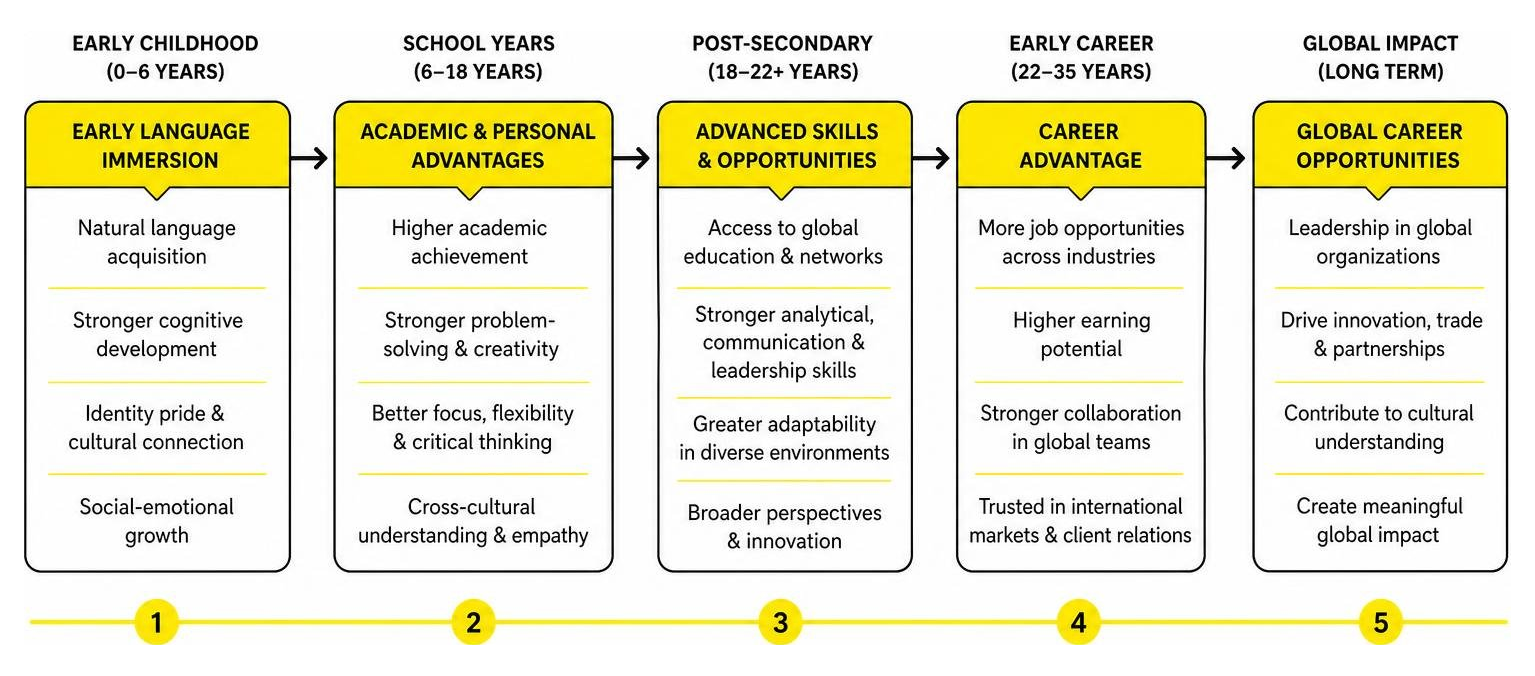
While the early childhood benefits focus on play, literacy, and social growth, the long-term economic outcomes of multilingualism are equally compelling. In today’s global economy, language competence is a major professional differentiator and a engine for macroeconomic productivity.
Macroeconomic Growth and Global Competitiveness
On a national and global scale, multilingualism directly correlates with economic strength and international trade efficiency:
- GDP Growth: Multilingual heritage accounts for approximately 10% of Switzerland’s gross domestic product (GDP). Conversely, estimates indicate the United Kingdom loses nearly 3.5% of its annual GDP due to a national deficit in second-language skills.
- Economic Value: Broader research attributes tens of billions of dollars in national economic expansion to language-proficient workforces, as international trade, diplomatic partnerships, and cross-border innovation flourish when citizens communicate fluently across cultural lines.
Career Readiness and Labor Market Demand
In the private sector, employer demand for multilingual professionals continues to surge. Over 90% of U.S. employers report relying on staff who speak languages other than English, with one in three reporting a significant language skills gap among existing staff.
| Metric / Outcome | Monolingual Workforce | Multilingual Workforce |
|---|---|---|
| U.S. Employer Demand | Baseline recruitment candidate pool | 90% of employers actively seek or rely on multilingual staff |
| Market Opportunities | Limited primarily to domestic English-speaking markets | High mobility across international trade, healthcare, and education |
| Cognitive Agility | Standard task-switching and problem-solving response times | Superior executive control, conflict resolution, and logical decision-making |
| Global Access | Constrained by translation tools for 75% of non-English world | Direct engagement with global partners and diverse client bases |
Starting language acquisition in early childhood gives children a distinct head start. While high school or university language courses require conscious, painstaking effort, early immersion builds effortless, accent-free communication and genuine bi-literacy that lasts a lifetime.
Overcoming Implementation Challenges and Policy Best Practices
Despite the extensive benefits, implementing effective dual-language programs presents operational challenges. Worldwide, approximately 40% of the global population lacks access to education in a language they speak or understand fluently. Overcoming structural barriers requires intentional planning, qualified staff, and community support.
Structural Barriers and Resource Allocation
Educational systems and childcare centers encounter specific operational obstacles when expanding multilingual opportunities:
- Teacher Shortages: Securing certified early childhood educators who are simultaneously fluent in target languages and trained in dual-language pedagogy remains a common challenge.
- Resource Availability: Developing context-adapted, culturally authentic learning materials, storybooks, and multi-sensory tools in non-English languages requires dedicated investment.
- Monolingual Misconceptions: Addressing outdated assumptions that early dual-language exposure delays speech development requires continuous family education. Modern research confirms that code-switching is a sign of cognitive organization, not confusion.
As outlined by Multilingual education | UNESCO, overcoming these barriers demands clear policy commitments, investments in local teacher training, and active engagement with diverse local communities.
Evidence-Based Multilingual Education Benefits in Early Childhood Pedagogy
To maximize learning outcomes, high-quality early childhood programs employ research-backed instructional models tailored to young minds:
- 50/50 and 90/10 Immersion Frameworks: Immersion programs balance target language exposure. 90/10 models begin with 90% target language immersion in early preschool, gradually balancing to 50/50 by early elementary grades.
- Assets-Oriented Instruction: Celebrating every child’s home language as a strength creates an additive environment where new languages expand a child’s capabilities without replacing their native heritage.
- Experiential, Multi-Sensory Play: Early childhood language acquisition thrives when linked to concrete experiences—cooking projects, storytelling, dramatic play, outdoor exploration, and structured music classes.
- Continuous Observational Assessment: Rather than standardized testing, young dual-language learners are evaluated through dynamic ongoing observation, tracking developmental milestones across all spoken languages.
Frequently Asked Questions About Multilingual Education
What are the primary cognitive multilingual education benefits for young children?
Early dual-language education enhances executive functioning, working memory, attentional control, and task-switching agility. Children exposed to multiple languages learn to analyze complex problems flexibly, filter out environmental distractions, and recognize abstract symbolic patterns faster than monolingual peers.
How does mother-tongue instruction improve overall learning outcomes?
When children receive early instruction in their primary home language, they comprehend foundational concepts without linguistic barriers. This solid cognitive and literacy foundation makes learning additional languages faster and more successful, reducing school dropouts and boosting achievement across mathematics, reading, and science.
When is the ideal age for children to begin dual-language instruction?
The ideal window for language acquisition is early childhood, from birth through age six. During this period, the brain’s heightened neuroplasticity enables toddlers and preschoolers to absorb phonetic structures, vocabulary, and grammar rules naturally through immersion, song, and conversational play without formal grammar drills.
Conclusion
The lifelong advantages of early dual-language learning are undeniable. From elevated executive function and metalinguistic awareness to rich cultural connection, emotional empathy, and expanded economic opportunities, multilingual education gives young children a remarkable foundation for life. Starting early transforms language learning from a difficult academic chore into an intuitive, joyful journey of discovery.
If you are exploring early learning options on Chicago’s Northwest Side, Fantasy Island Schools for Kids offers a warm, English-language program with Polish and Ukrainian language support, tailored for young minds. Fantasy Island Schools for Kids was founded in 2009 by Beata Bielic and is located at 6100 N Milwaukee Ave, Chicago, IL 60646.
Our school serves children ages 2 to 6 with full-time and part-time options, operating Monday through Friday from 7 AM to 6 PM. Our service area includes Chicago’s Northwest Side and surrounding communities such as Norwood Park, Edison Park, Gladstone Park, Jefferson Park, Sauganash, Edgebrook, Portage Park, Niles, Park Ridge, Skokie, Norridge, and Harwood Heights.
With weekly tuition around $300-$400, our program includes:
- A gifted experiential curriculum designed to foster critical thinking and school readiness.
- English-language instruction with Polish-speaking teachers, Polish classes every Friday, and support for Ukrainian-speaking children.
- Freshly cooked meals prepared on-site every day at no extra cost.
- Weekly music lessons led by a qualified music teacher to stimulate auditory discrimination and language rhythm.
- A large, multi-sensory indoor and outdoor play space.
- Certified early childhood educators trained in First Aid, CPR, and trauma-informed care.
Many of our parents frequently tell us how much they appreciate seeing their children transition seamlessly into competitive elementary programs, and our curriculum is designed to help every child feel confident, valued, and excited to learn. To make quality early childhood education accessible, we accept CCAP (Illinois Child Care Assistance Program) and Illinois Action for Children. We invite you to contact us directly or connect with Illinois Action for Children to discuss enrollment options and family assistance details.
Visit us at 6100 N Milwaukee Ave to schedule a private tour and see how our playful, nurturing environment can support your child’s early development!