

Core Principles of Experiential Learning Kindergarten Education
At its foundation, experiential learning relies on the insight that young children construct knowledge when they interact directly with their physical and social environments. Rather than viewing a child as an empty vessel to be filled with facts, educational theorists like John Dewey and Jean Piaget demonstrated that lasting learning happens through active inquiry. In early childhood education, this framework is often understood through David Kolb’s learning cycle, which moves through four vital stages:
- Concrete Experience: The child actively engages in a hands-on activity, such as planting a seed, mixing colors, or balancing blocks.
- Reflective Observation: The child pauses to observe what occurred, noticing changes, patterns, or unexpected outcomes.
- Abstract Conceptualization: With teacher guidance, the child links those observations to broader concepts (e.g., “Plants need water and light to grow”).
- Active Experimentation: The child applies this new understanding to a fresh challenge or scenario.
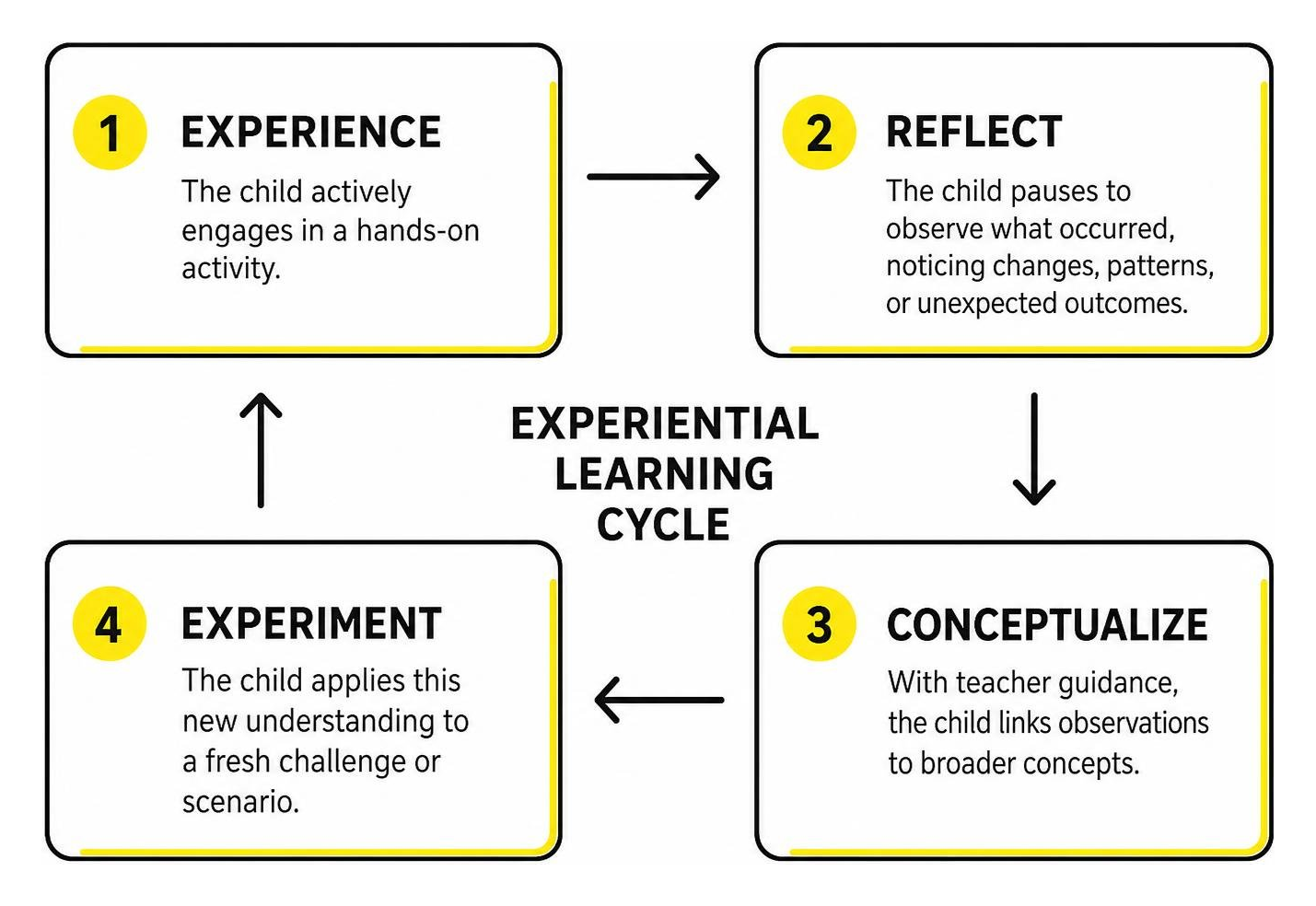
This natural cycle honors the developmental stage of five- and six-year-olds. In fact, research indicates that 90% of surveyed kindergarten teachers highlight experiential learning strategies as essential because they directly answer the developmental needs of young learners. When children are encouraged to lead inquiries, they build confidence and self-efficacy.
Before taking this step, parents often evaluate specific milestones; reviewing common signs of kindergarten readiness can help families determine if their child is prepared to thrive in an inquiry-rich classroom environment.
Experiential Learning Kindergarten vs Traditional Rote Instruction
Traditional early education often relies heavily on repetitive drills, static worksheets, and teacher-led lectures. While these methods aim to transmit information quickly, they frequently fall short of helping young minds internalize abstract principles. Experiential classrooms, by contrast, make learning tangible and deeply contextual.
| Feature | Traditional Rote Instruction | Experiential Kindergarten Learning |
|---|---|---|
| Instructional Focus | Teacher-directed, passive listening | Child-centered, active inquiry & manipulation |
| Primary Materials | Worksheets, flashcards, static textbooks | Concrete manipulatives, natural objects, sensory tools |
| Concept Delivery | Abstract rules memorized out of context | Real-world problem solving and contextual discovery |
| Engagement Style | Repetitive drill and seatwork | Collaborative investigations and physical exploration |
| Skill Assessment | Standardized paper quizzes | Observational documentation, portfolios, reflective dialogue |
When children learn through active engagement, they retain complex concepts far more effectively than through passive memorization. Understanding the broader play-based learning benefits illustrates why hands-on manipulation forms the cornerstone of healthy brain architecture in early childhood.
The Role of Scaffolding and Guided Reflection
Hands-on learning is not simply turning children loose in a room full of toys; it requires intentional teacher facilitation. From Lev Vygotsky’s concept of the Zone of Proximal Development, educators provide “scaffolding”—temporary, structured support that helps a child achieve a task they could not yet master independently.
Our teachers use open-ended prompts to deepen understanding during activities:
- “I notice your tower tilted to the left. What do you think caused that?”
- “How can we test if this object will float in our water table?”
- “What sound do you hear at the beginning of that word when we say it slowly?”
Equally important is the closing reflection. Structured routines like closing circles give children space to share discoveries, articulate challenges, and celebrate peer successes. Balancing these stimulating explorations with quiet solitude periods helps children develop emotional self-regulation, preventing over-activation fatigue and allowing newly formed neural connections to settle.
Developmental Benefits: How Hands-On Learning Nurtures the Whole Child
When kindergarteners touch, build, test, and discuss, they activate multiple areas of the brain simultaneously. Research comparing early childhood approaches shows that children from child-initiated, experiential programs excel in foundational academic skills while developing significantly more advanced fine and gross motor abilities than peers in strictly academically directed classrooms.
Tracking your child’s physical and mental progress alongside established toddler cognitive development milestones helps ensure they build the executive functioning, working memory, and physical coordination necessary for long-term school success.
Social-Emotional Growth and Cooperative Problem-Solving
Kindergarten is a critical window for social expansion. In an experiential setting, children do not sit in isolated rows; they work in small groups, negotiate roles in dramatic play, share tools during science experiments, and resolve disagreements in real time.
Cultivating social-emotional development in early childhood requires an environment where empathy and resilience are modeled daily. When children collaborate to build a cardboard community or tend a shared garden box, they practice patience, perspective-taking, and verbal negotiation. For children who have experienced stress or big transitions, trauma-informed early education ensures that experiential activities serve as safe, predictable spaces to express feelings and rebuild a sense of agency.
Fostering Lifelong Curiosity and Critical Thinking
Experiential learning transforms natural childhood curiosity into systematic inquiry. Rather than just asking “why,” children learn to formulate hypotheses: “If I add more water to the sand, will the castle stay up or slide down?”
This process builds intrinsic motivation—the internal joy of figuring something out—rather than a dependence on external rewards like gold stickers. For advanced or highly inquisitive learners, challenging projects serve as natural enrichment activities for gifted learners, providing open-ended complexity that prevents boredom and fuels deep, critical thinking.
Integrating Experiential Strategies into Core Literacy, Math, and Science
A common question parents ask is whether experiential learning prepares children for rigorous academic benchmarks. The answer is clear: hands-on methodologies can be mapped directly to Common Core and Next Generation Science Standards (NGSS). For instance, assessment data from the Wit & Wisdom literacy curriculum demonstrated significant gains in student learning and engagement after schools incorporated experiential, sensory-rich units compared to previous textbook-only years.
Experiential Learning Kindergarten Activities for Literacy and STEM
Literacy in an experiential classroom engages all the senses. Instead of tracing letters repeatedly on paper, children form alphabet shapes in kinetic sand, trace sandpaper letters, and make wearable mnemonic letter crafts. When schools implement structured multi-sensory programs like ABC BOOTCAMP, classrooms have documented an 80% mastery of all letters and sounds in as little as 26 instructional days.
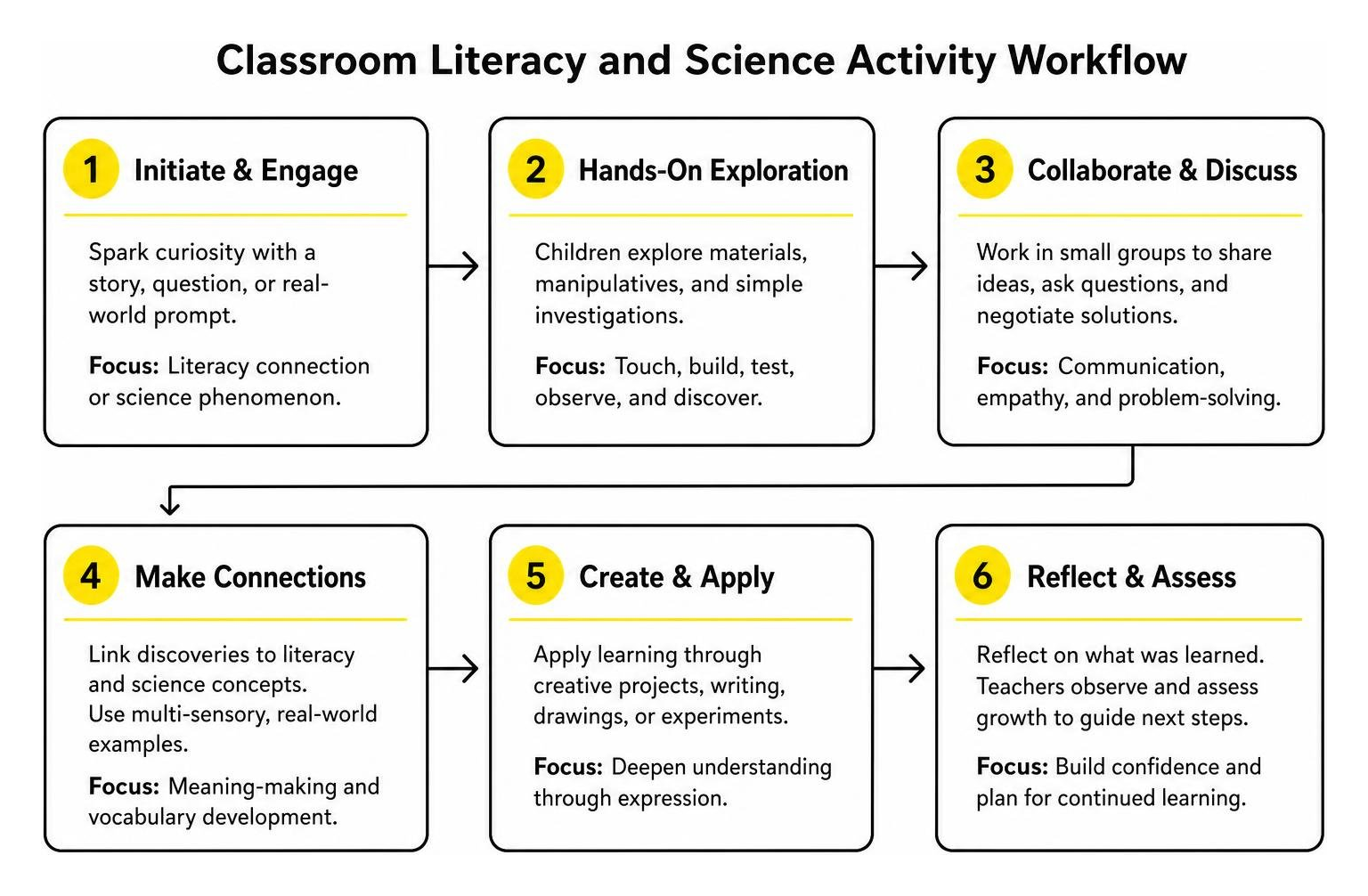
Creating intentional multi-sensory learning environments allows educators to connect abstract language and science concepts to concrete experiences. For example, teachers often use thematic investigations such as Five Senses Activities: Kindergarten Lesson Plans & Ideas to turn a reading lesson into a rich scientific exploration involving scent jars, texture matching, and sound identification. Similarly, using glow-soap experiments during health and hygiene units allows children to physically see how “germs” spread, transforming an invisible health concept into an unforgettable visual lesson.
Mathematics and Spatial Reasoning Through Tangible Manipulatives
Math concepts become intuitive when children can touch and rearrange quantities. Moving beyond abstract equations, kindergarteners use ten-frames, count physical items like buttons or counting bears, and assemble geometric pattern blocks.
Recent academic research has underscored the profound impact of hands-on spatial tools. In a study Investigating the Connection Between Spatial Reasoning Skills and Reggio Emilia-Inspired Kindergarten Mathematics Activities, researchers documented that engaging children in building physical, large-scale wooden bar graphs to represent counts significantly enhanced their spatial language, data interpretation, and mental transformation abilities. Spatial reasoning is one of the strongest early predictors of future success in STEAM disciplines, and manipulatives-rich projects ensure these skills are systematically nurtured.
Implementing Experiential Learning at Home and Overcoming Common Myths

Parents do not need expensive kits to foster hands-on learning at home. Everyday household routines offer fertile ground for meaningful discovery:
- Kitchen Chemistry and Measurement: Baking a simple snack teaches volume, fractions, sequencing, and chemical changes (watching dough rise).
- Nature Journaling: A walk through a local park or backyard can turn into a botany expedition. Collect leaves, sort them by shape and size, and press them into a homemade notebook.
- Sensory Sorting Bins: Fill a shallow plastic bin with dry rice, beans, or water. Hide magnetic numbers, letters, or textured fabrics inside for your child to find and categorize.
Addressing Common Misconceptions
A frequent myth is that experiential learning is unstructured chaos where children play without learning academic skills. In reality, effective experiential education is carefully planned. The teacher or parent establishes a specific learning objective, designs an environment rich in targeted materials, and uses deliberate questions to guide the child toward key academic and social concepts.
Another concern is child fatigue. Constantly stimulating young children without pauses can lead to over-activation. High-quality programs balance active, messy investigations with predictable routines, quiet reading, and reflective solitude so that children can recharge and process what they have experienced.
Frequently Asked Questions About Experiential Kindergarten
How does experiential learning support equity and children with diverse learning needs?
Experiential learning embraces Universal Design for Learning (UDL) principles. Because lessons rely on visual, auditory, and tactile modalities rather than language fluency alone, English language learners and multilingual children can demonstrate understanding through building, drawing, and actions. It levels the playing field for children from diverse socioeconomic backgrounds by providing rich, shared classroom experiences—such as examining real botanical specimens or testing physical pulleys—ensuring every child has the same experiential foundation for discussions.
Can experiential kindergarten programs meet district academic standards?
Yes. Experiential learning is a pedagogical method, not an absence of curriculum. District standards for literacy, numeracy, and scientific inquiry are woven directly into projects. Rather than memorizing addition facts from a chalkboard, children combine sets of tangible objects to meet math standards, yielding high retention and strong assessment outcomes.
What is the difference between pure play and structured experiential learning?
While unstructured free play is vital for healthy childhood development, structured experiential learning includes intentional educational targets, adult scaffolding, and systematic reflection. Educators design the environment with specific learning goals in mind, prompting children to analyze their discoveries and connect them to broader academic concepts.
Experience the Power of Hands-On Learning at Fantasy Island Schools for Kids
A child’s kindergarten year sets the tone for their entire educational journey. By choosing an experiential approach, you provide your child with a joyful, intellectually vibrant foundation that turns abstract academic benchmarks into memorable, real-world discoveries.
At Fantasy Island Schools for Kids, we have proudly served families across Chicago’s Northwest Side and surrounding communities—including Norwood Park, Edison Park, Gladstone Park, Jefferson Park, Sauganash, Edgebrook, Portage Park, Niles, Park Ridge, Skokie, Norridge, and Harwood Heights—since 2009. Founded and directed by Beata Bielic, our licensed center brings more than 17 years of early childhood leadership to every classroom.
Our comprehensive programs feature:
- Gifted Enrichment Program: Designed to challenge active minds, resulting in a strong track record of graduates successfully entering selective and gifted elementary programs.
- Bilingual & Multilingual Education: Immersive language learning in Polish and English that enhances cognitive flexibility.
- Multi-Sensory Environments: Expansive play and learning spaces equipped for tactile science, construction, and creative arts.
- Weekly Music Classes: Led by a qualified music teacher to foster rhythm, phonemic awareness, and self-expression.
- Math Tutoring & Numeracy Support: Targeted math tutoring and hands-on manipulatives to build strong foundational problem-solving and spatial skills.
- All-Inclusive Tuition: Weekly tuition of approximately $300–$400 covers all educational programming, enrichment classes, and daily on-site freshly cooked meals prepared from scratch at no extra cost.
- Certified, Caring Staff: Every educator holds Early Childhood Education credentials, CPR/First Aid certifications, and ongoing training in trauma-informed care.
- Affordable Access: We proudly accept CCAP (Illinois Child Care Assistance Program) and Illinois Action for Children to support working families.
We invite you to explore our multilingual preschool and kindergarten programs to see our experiential classrooms in action.
- Location: 6100 N Milwaukee Ave, Chicago, IL 60646
- Hours: Monday – Friday, 7:00 AM – 6:00 PM (Flexible full-time and part-time enrollment available)
Schedule a tour today and discover how our hands-on kindergarten environment can nurture your child’s natural love for learning!
