

School Readiness Activities at Home Start With Play
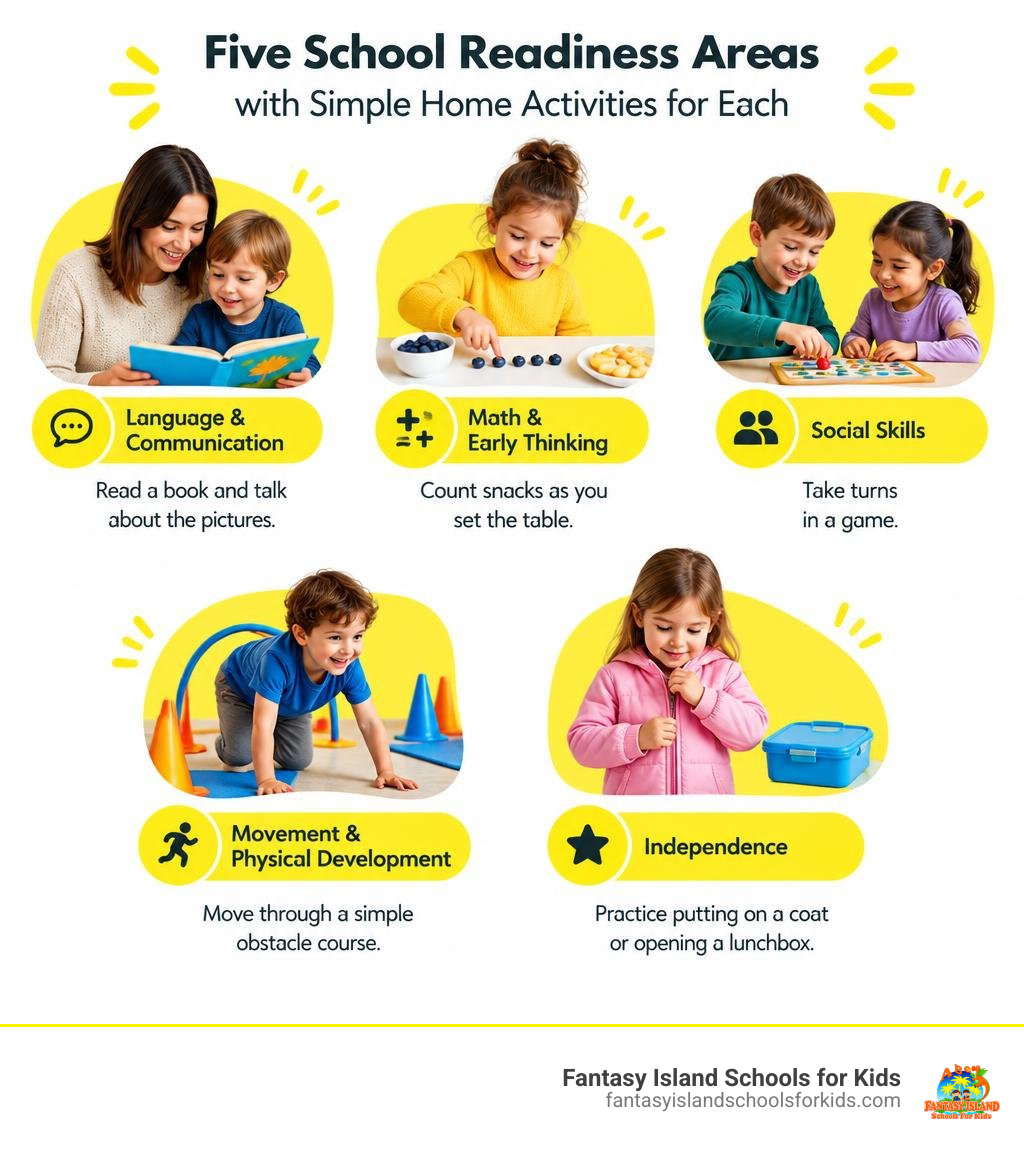
The easiest school readiness activities at home fit into what you already do. Read a book and talk about the pictures. Count snacks as you set the table. Take turns in a game, move through a simple obstacle course, and let your child practice putting on a coat or opening a lunchbox.
These small moments help your child build language, movement, problem-solving, social skills, and independence. You do not need to turn them into lessons. Follow your child’s interests and give them time to try.
I’m Beata Bielic, founder of Fantasy Island Schools for Kids and an early childhood educator with more than 17 years of experience. I’ll share school readiness activities at home that you can adapt to your child’s pace.
School readiness activities at home vocabulary:
What School Readiness Means—and Why It Matters
School readiness is the collection of skills, relationships, and routines that help a child feel secure, participate, communicate, and learn in a school setting. It includes more than knowing letters or numbers. Children develop these skills at different rates, and there is no single checklist that every child must complete before starting school.
Readiness includes several connected areas:
- Social development: Playing alongside or with other children, taking turns, and learning how to join a group.
- Emotional development: Recognizing feelings, expressing needs, managing small frustrations, and feeling safe with trusted adults.
- Physical development: Moving with growing coordination and building hand strength for activities such as drawing, handling classroom materials, and using child-safe scissors.
- Cognitive development: Exploring, noticing patterns, remembering simple directions, and trying different ways to solve a problem.
- Language and communication: Listening, asking questions, sharing ideas, and expressing wants and needs. Children can communicate with speech, gestures, signs, pictures, or assistive tools.
- Early literacy and numeracy: Enjoying books, noticing sounds and letters, counting, sorting, and exploring shapes.
- Independence: Practicing self-care, such as dressing, eating, washing hands, and asking for help.
Play brings these areas together. A pretend restaurant, for example, can involve conversation, counting, sharing roles, following steps, and handling play food. Families, early learning programs, and schools can work together to help children feel a sense of belonging. Your child does not need to master everything at once.
10 Easy School Readiness Activities at Home
Keep activities short and enjoyable, and use materials you already have when possible. Your child may want to repeat a favorite game rather than try something new, and that repetition can give them another chance to practice.
Language and literacy school readiness activities at home
1. Share an interactive read-aloud
Let your child choose a book and take time to explore each page together. Talk about the pictures, ask what might happen next, and invite your child to turn pages. Point out interesting words and connect them to something familiar.
If your child uses an incorrect word or sentence, model the standard form naturally instead of interrupting to correct them. If they say, “Her is happy,” you might respond, “Yes, she looks happy. What do you think made her happy?”
For more family-friendly ideas across early learning areas, see this kindergarten readiness guide.
2. Go on a name and sound treasure hunt
Write your child’s name on a card and look for its letters on food packages, signs, books, or mail. Start with the first letter or sound. You can also clap the beats in family members’ names, or find two words that rhyme.
Keep it playful: “I spy something that starts with ‘b’.” If your child is not interested in naming letters, invite them to find a matching shape or picture instead.
3. Pretend to go to school
Use stuffed animals, dolls, or other toys as classmates. Take turns being the teacher and the child. Practice saying hello, asking to join a game, listening for a direction, packing a pretend bag, or finding a place to sit.
A toy kitchen can also spark useful conversation. Narrate what you are doing as you pretend to prepare food, and let your child tell a story about what happens next. Picture cards or a simple visual schedule can help make the steps easier to follow.
Social, emotional, and physical school readiness activities
4. Play with feelings and empathy
Draw simple faces showing feelings such as happy, worried, surprised, frustrated, or proud. Take turns guessing the feeling and talking about what might have caused it. When reading together, ask how a character might feel and what could help.
You can also make a “feelings tree” by drawing a tree and adding emotion faces. Let your child choose a face to show how they feel, without pressuring them to explain before they are ready.
5. Play board games and cooperative games
Choose a simple game that gives everyone a turn. Practice waiting, sharing pieces, following rules, and responding when the game does not go your child’s way. Keep the focus on playing together rather than winning.
Building a tower as a team or passing a ball back and forth offers similar opportunities. Playdates or time at a playground can give your child a chance to practice interacting with other children at their own pace.
6. Build hand strength through crafts and practical play
Offer playdough to roll, pinch, flatten, and squish. Drawing, sticking stickers, and child-safe cutting and pasting can also help your child practice using their hands with control. Stay nearby when scissors or small craft materials are in use.
Try adding tongs to a sorting game, or let your child open and close safe containers to reach a toy. These everyday hand movements can build strength and coordination for classroom tasks.
7. Make a movement course
Use cushions, taped floor lines, or household objects to create a simple route for stepping over, crawling under, balancing, or tossing a soft ball into a basket. Try animal walks, such as moving like a bear or frog, and add a freeze game to practice stopping and starting when they hear a cue.
Adapt the course to your space and your child’s abilities. Keep pathways clear and supervise movement play.
Math, science, and self-care school readiness activities at home
8. Do snack math or cook together
Count pieces of fruit as you put them on a plate. Sort snacks by color or shape, and use words such as “more,” “less,” “full,” and “empty.” When cooking together, let your child help measure, stir, or pour with close supervision.
Following a few steps in a simple recipe also gives you a chance to talk about what comes first and next. Adjust the task to suit your child and take care with hot surfaces and kitchen tools.
9. Explore shapes, patterns, and simple science
Look for circles, squares, and triangles around the home. Sort toys by shape, color, size, or another feature, then ask your child how they decided what belongs together. Try making a simple pattern with blocks or socks.
For a science activity, invite your child to predict which safe household objects might float or sink, then test them in a bowl of water with an adult supervising. You could also place a seed on a damp paper towel and observe it over time. Ask what your child notices and what they think may happen next. Keep small objects and water out of reach when the activity is finished.
For more playful family activity ideas, see the Sesame Workshop activity booklet.
10. Practice school-day independence
Give your child time to try everyday tasks, even if they need help finishing. Practice putting on a coat and shoes, washing hands, using the toilet as appropriate for your child, and eating with the utensils they are comfortable using.
You can also rehearse opening a lunchbox or carrying a small bag. If a task is difficult, break it into smaller steps and let your child try one part at a time. Practice asking for help, too, using words, gestures, a picture card, or another communication method that works for your child.
Turn Everyday Moments Into Practice
You do not need a separate activity period to support learning. Ordinary routines offer chances to talk, listen, count, notice, and practice.
- Getting dressed: Name clothing and describe steps: “First socks, then shoes.” Invite your child to follow one or two directions at a time, adding steps as they are ready.
- Mealtimes: Count plates, talk about colors and shapes, and use position words such as “beside,” “between,” and “on top.” Let your child help set the table, matching one place setting to each person.
- Walks: Talk about the weather, point out things your child notices, and count steps or birds if they are interested. Follow their questions rather than turning the walk into a quiz.
- Daily routines: Use a simple picture schedule or calendar to show what comes next. Visual reminders can help children understand routines and transitions.
- Short play periods: A shared book, puzzle, or simple game can give your child practice focusing on an activity. Follow their attention and allow breaks.
Balance screen use with chances to talk, read, play, and spend time moving. Predictable routines can also make the day easier to understand for young children.
How to Notice Readiness and Ease Common Worries
Rather than looking for a perfect score, notice what your child is learning to do and what support helps. Does your child try to communicate needs in a way that works for them? Can they join a brief activity, explore play alongside others, or attempt parts of a self-care routine? Can they ask a trusted adult for help, or show you when they need support?
These abilities may look different from one child to another. A child may need reminders, extra time, visual cues, or adult help. That does not mean they cannot make progress or take part in school life.
Separation can also take practice. Start with short periods with a trusted adult, and keep your goodbye routine predictable and warm. A hug, wave, and calm reminder that you will return can help make the transition familiar. Avoid stretching out the goodbye if it makes leaving harder, and share useful settling strategies with your child’s teacher.
Friendships develop at different paces. Some children approach new playmates quickly; others prefer to watch before joining in. Small play opportunities and role-play at home can help your child rehearse greetings and ways to ask to join. There is no need to force a particular response.
If you have concerns about your child’s communication, movement, behavior, or learning, talk with their teacher, pediatrician, or a qualified specialist. They can help you understand what support may be useful. Families preparing for kindergarten can also explore our kindergarten program and discuss how a child’s needs and strengths can be supported.
Frequently Asked Questions About School Readiness Activities at Home
What if my child cannot do all of these activities yet?
That is okay. Children develop at different rates, and readiness is not a pass-or-fail checklist. Focus on your child’s strengths, offer low-pressure chances to practice, and share helpful routines or communication strategies with their school.
How can I help my child who feels nervous about separating from me?
Use a calm, consistent goodbye and reassure your child that you will return. Practice short separations with trusted adults and talk with the teacher about what helps your child feel secure. Adjust the approach based on how your child responds.
Does my child need to read or write before starting school?
Formal reading and writing are not the only measures of readiness. Sharing books, noticing letters, drawing, and talking about stories are useful ways to explore early literacy without pressure. Ask your child’s school about its expectations and share any questions you have.
Conclusion
Small, playful moments can help your child build the communication, confidence, independence, and curiosity they will use at school. Keep practice encouraging, adapt activities to your child, and remember that readiness grows over time.
At Fantasy Island Schools for Kids, we welcome families exploring early learning options on Chicago’s Northwest Side. Schedule a tour to visit us and talk about your child’s next steps.