

Is Kindergarten Mandatory in Illinois? The Quick Answer
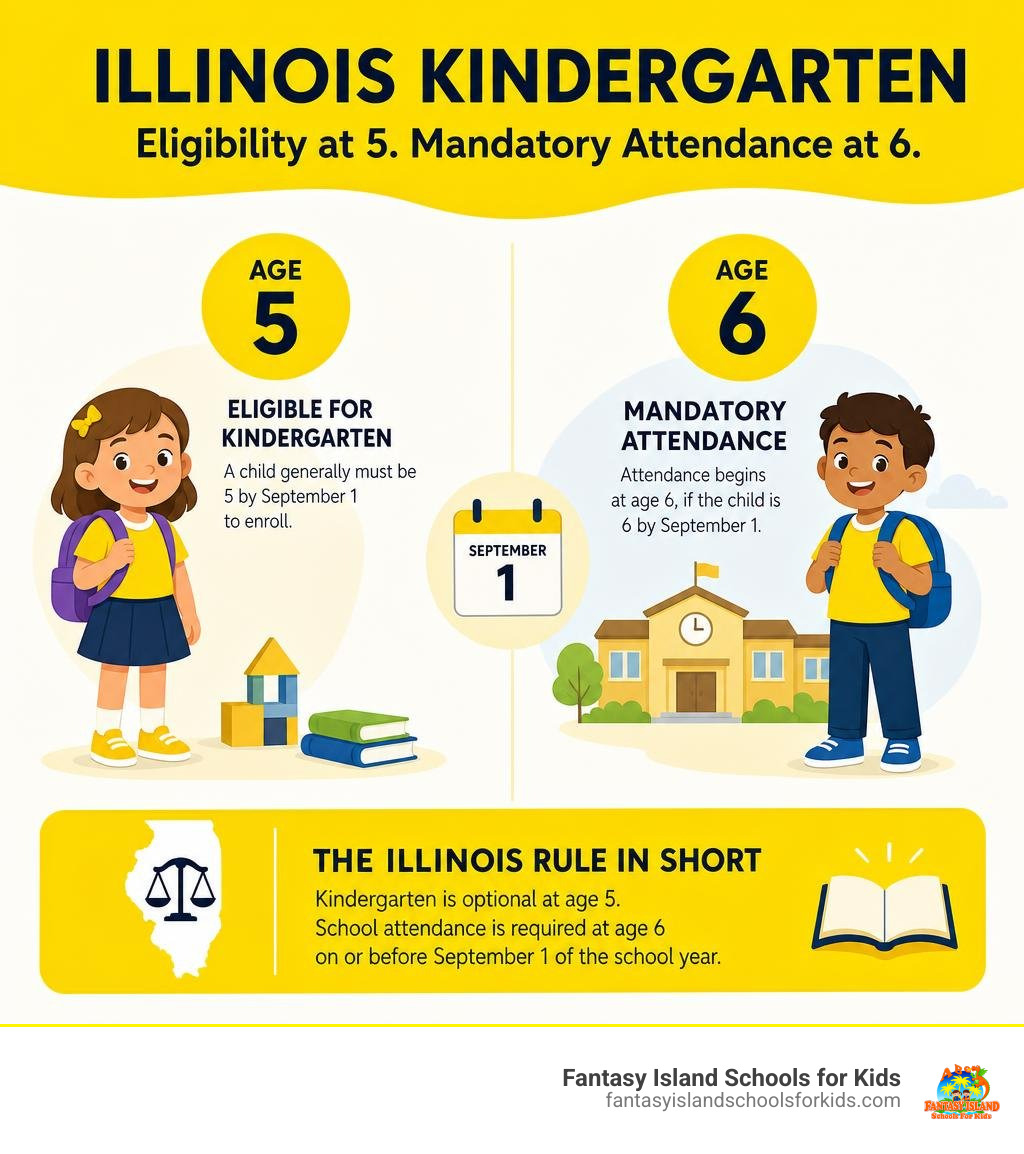
Is kindergarten mandatory in Illinois? No. Illinois does not require children to attend kindergarten at age 5. However, school attendance becomes compulsory when a child turns 6 on or before September 1 of the school year.
| Illinois rule | What it means for your family |
|---|---|
| Kindergarten eligibility | A child generally must be 5 by September 1 to enroll. |
| Mandatory school age | Attendance begins at age 6, if the child is 6 by September 1. |
| Kindergarten before first grade | Under current law, a child does not have to complete kindergarten before entering first grade. |
| Full-day programs | Public districts must offer full-day kindergarten beginning in the 2027-2028 school year, with limited extensions for qualifying districts. |
That one-year gap between eligibility and compulsory attendance can make the choice feel more complicated than it sounds. Your child’s birthday, social-emotional development, childcare needs, district rules, and preferred schedule can all shape the best next step. This guide explains the rules in plain language, including delayed entry, early admission, full-day and half-day options, and how to help your child feel ready.
I’m Beata Bielic, Executive Director of Fantasy Island Schools for Kids, which I founded in 2009 at 6100 N Milwaukee Ave, Chicago, IL 60646. With more than 17 years in early childhood education, I regularly help families understand questions such as is kindergarten mandatory in illinois while they consider the right learning path for their child.
Is Kindergarten Mandatory in Illinois? State Laws and Requirements

To directly answer the question: is kindergarten mandatory in illinois? Under current state statutes, public kindergarten attendance is optional for 5-year-olds. Illinois law guarantees that public school districts must make kindergarten available to eligible children, but parents retain the ultimate legal right to decide whether to enroll their 5-year-old child.
Compulsory school attendance in Illinois officially begins at age 6. Specifically, any child who reaches 6 years of age on or before September 1 of a given school year must be enrolled in a public, private, parochial, or approved home-school program. Because the statutory eligibility age for kindergarten is 5 (turning 5 on or before September 1), there is a distinct one-year legal window between when a child can enter school and when they must enter school.
Despite kindergarten being legally optional, the overwhelming majority of families choose to enroll their eligible 5-year-olds. According to official data from the Illinois State Board of Education (ISBE), Illinois recorded 121,812 kindergarten students in fall 2022. Nationally, roughly 84% of 5-year-old children are enrolled in formal early education or kindergarten programs. Families can review detailed statutory breakdowns through the Kindergarten FAQ provided by ISBE and overview resources such as Is Kindergarten Required in Illinois? Age and Rules – LegalClarity.
While school districts are required to open their doors to 5-year-olds, state code gives parents full discretion during this initial year. You can choose to send your child to public kindergarten, enroll them in a private or parochial program, keep them in a high-quality preschool, or educate them at home until compulsory education takes effect at age 6.
Age Cutoffs, Academic Redshirting, and Early Kindergarten Admission

The universal birthdate cutoff across Illinois public school districts is September 1. If your child turns 5 years old on or before September 1, they meet the standard legal cutoff for kindergarten entry for that academic year. If their 5th birthday falls on September 2 or later, they generally must wait until the following fall to enter traditional kindergarten, unless granted early admission under special state frameworks.
Because eligibility is determined strictly by chronological age rather than formal testing, parents often find themselves navigating complex choices near this September cutoff date. Guidance from state platforms like Starting Kindergarten in Illinois highlights that families frequently weigh academic skills, social maturity, and schedule logistics when deciding whether to enroll their child on time. Parents preparing their children for this milestone often explore resources like Full Time Kindergarten Jefferson Park Readiness to evaluate classroom expectations.
Understanding Academic Redshirting and Its Pros and Cons
“Academic redshirting” refers to the practice of voluntarily holding back an age-eligible child (typically one with a late spring or summer birthday) from entering kindergarten at age 5, waiting instead until age 6. Parents often consider redshirting if they feel their child needs additional time to build emotional resilience, self-regulation, or fine motor skills.
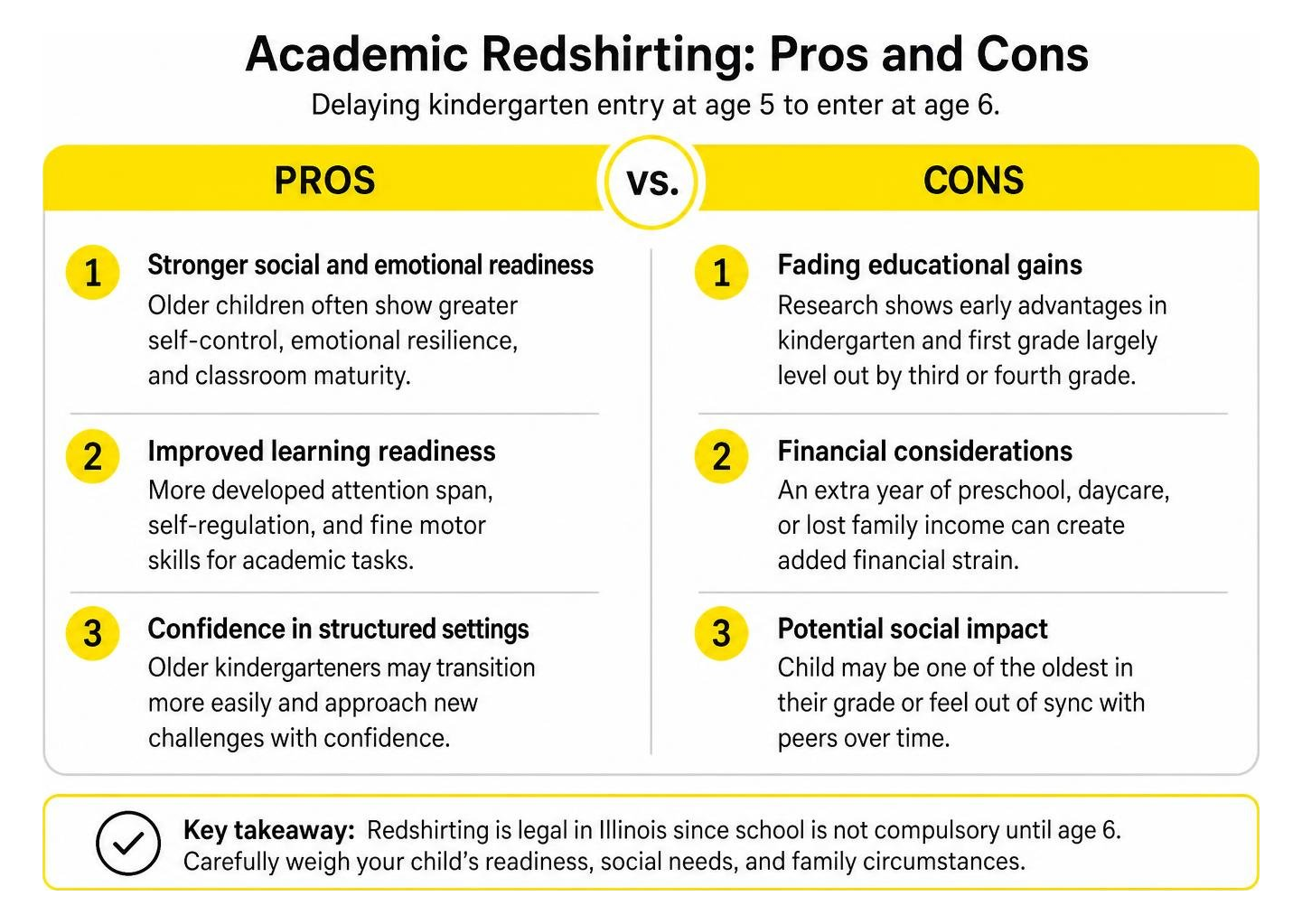
While redshirting is legal in Illinois because school is not compulsory until age 6, parents should carefully weigh both sides of the decision:
- Potential Advantages: Older children in a kindergarten classroom often demonstrate stronger social self-control, longer attention spans, and immediate confidence when handling structured tasks.
- Fading Educational Gains: Educational research demonstrates that while redshirted children often enjoy slight initial skill advantages in kindergarten and first grade, these academic differences largely level out by third or fourth grade.
- Financial Considerations: Delaying kindergarten entry means an extra year of private preschool, daycare, or lost family income if a parent stays home.
- Loss of State-Funded Preschool Eligibility: Under Illinois rules, once a child reaches the statutory kindergarten eligibility age of 5 by September 1, they are no longer eligible for state-funded Preschool for All (PFA) slots, even if parents opt out of kindergarten.
Accelerated Placement: Can Advanced 4-Year-Olds Start Early?
What if your child turns 5 shortly after September 1 and already displays advanced reading, math, and social abilities? Under Illinois Public Act 100-0421, every public school district in Illinois is required to maintain an official Accelerated Placement Policy. This law allows advanced 4-year-olds to seek early entrance into kindergarten if they demonstrate exceptional intellectual and social-emotional readiness.
The evaluation process for early entrance is intentionally rigorous. Public school districts evaluate candidates across multiple developmental areas rather than relying on standard academic tests alone. For instance, some local Illinois districts require early applicants to sit for comprehensive evaluations like the DIAL-4 screening or WIAT-4 assessment, often requiring composite performance at or above the 90th percentile across motor, language, concepts, self-help, and social-emotional subtests.
Parents interested in accelerated kindergarten entry must adhere to strict administrative deadlines. Most school districts require formal early entrance requests and application forms to be submitted early—frequently by May 15 prior to the upcoming school year—to allow evaluation teams sufficient time to conduct screenings before summer.
Illinois Full-Day Kindergarten Law and Half-Day Options
Big structural changes have arrived for Illinois early education. State legislation—Public Act 103-0410 (originating as House Bill 2396)—mandates that every public school district in Illinois must establish a full-day kindergarten program by the 2027-2028 academic year.
Historically, approximately 150 out of Illinois’ 852 public school districts did not offer full-day kindergarten, forcing working parents to balance mid-day transportation and expensive afternoon childcare. Under the state code:
- Full-Day Standard: A full day of public kindergarten consists of at least 4 clock hours of instructional time daily.
- Implementation Timeline: All districts are expected to launch full-day programs by 2027-2028.
- Districts with Grace Periods: Underfunded districts (those funded below 76% of their Evidence-Based Funding adequacy target or ranked in the top 25% of capital facility need) can apply to ISBE for up to a two-year extension.
For detailed background on this statutory shift, parents can review Gov. Pritzker Signs Bill Establishing Full Day Kindergarten.
Crucially, the full-day mandate applies to school districts, not to parents. Illinois law explicitly protects parental choice: even when a school district offers a full-day program, the district must continue to provide a half-day option (requiring 2 clock hours of daily attendance) for any family that requests it. Families exploring local neighborhood options can reference guides such as the Kindergarten Enrollment Sauganash Guide.
What Happens When Skipping Kindergarten Before First Grade?
Because kindergarten is not currently mandatory in Illinois, some parents wonder: Can my child skip kindergarten altogether and enter first grade directly at age 6?
Under current law, the answer is yes. When a child reaches the compulsory age of 6 on or before September 1, they must enroll in school. Under current Illinois School Code, a child is eligible to enter first grade if they turn 6 by September 1, regardless of whether they attended kindergarten. However, jumping straight into first grade without prior kindergarten experience can present real developmental and academic hurdles.
Statewide assessment metrics reveal that early readiness is vital for long-term school success. In 2019, state baseline data showed that only 29% of all entering kindergarteners in Illinois demonstrated full school readiness across target learning standards. Readiness rates were lower among historically underserved groups—including Black children (21%), Latinx children (17%), English Learners (14%), and children with IEPs (14%). Children who miss structured kindergarten instruction often face steep learning curves in first grade classrooms that assume established literacy and social skills.
| Pathway Option | Enrollment Age | Kindergarten Mandatory? | Prerequisites for First Grade |
|---|---|---|---|
| Standard Kindergarten Entry | Age 5 (by Sept 1) | No (Optional under current law) | None; direct enrollment into kindergarten |
| Delayed Kindergarten Entry (Redshirting) | Age 6 (by Sept 1) | No (Compulsory school age reached) | District decides placement (Kindergarten vs 1st Grade) |
| Direct First Grade Entry | Age 6 (by Sept 1) | No (Current law) | Age 6 requirement met; no mandatory Pre-K/K completion |
| Future Proposed Law (HB4253) | Age 5/6 | Yes (Starting 2028-2029 if passed) | Satisfactory completion of public or private kindergarten |
Parents should also note active legislative efforts to change current laws. Pending legislation, such as Full Text of HB4253, proposes amending the Illinois School Code (105 ILCS 5/26-1) beginning in the 2028-2029 school year. If enacted, this bill would officially mandate that students satisfactorily complete a public, private, or parochial kindergarten program prior to advancing into first grade. Building a solid educational foundation early remains the safest approach, as explained in Kindergarten Jefferson Park Strong Foundation.
Key Factors and Parent Strategies for Kindergarten Readiness
Whether you choose to enroll your child in kindergarten at age 5 or wait until compulsory age 6, preparing your child for the transition involves far more than practicing ABCs. Success in early learning relies heavily on emotional security, independence, and social comfort.
Here are practical strategies we encourage families on Chicago’s Northwest Side to focus on before day one:
- Build Independent Self-Help Skills: Teach your child how to zip their coat, put on shoes, open lunch bags, unlatch water bottles, and manage bathroom needs without assistance. Classroom teachers manage dozens of students, and self-help independence gives children immediate confidence.
- Practice Daily Routines and Nap Transitions: Transitioning to a 4-hour or full-day schedule can be exhausting for young children. Shift bedtime schedules several weeks before school begins and gradually taper off afternoon naps if your child’s program is full-day.
- Foster Social Interaction and Group Play: Expose your child to peer environments where they practice sharing, taking turns, listening when an adult speaks, and expressing feelings with words.
- Strengthen Dual-Language and Multilingual Abilities: For bilingual and immigrant households across Chicago, nurturing native language skills alongside English builds cognitive flexibility. Multilingual exposure helps children absorb complex phonics and vocabulary concepts faster.
- Collaborate with Early Learning Educators: Talk with your child’s preschool or daycare teachers. Experienced early childhood educators observe your child in group settings and provide objective insights into their listening stamina, fine motor control, and peer interactions.
Frequently Asked Questions
Is Kindergarten Mandatory in Illinois for 5-Year-Olds?
No, kindergarten is not legally mandatory for 5-year-olds in Illinois. While public school districts must offer kindergarten to eligible children turning 5 on or before September 1, parents are not legally required to send their children to school until they reach the compulsory age of 6.
How Proposed Legislation Changes Whether Is Kindergarten Mandatory in Illinois
Under proposed state legislation like HB4253, Illinois lawmakers are seeking to require public school students to satisfactorily complete an accredited public, private, or parochial kindergarten program before entering first grade, beginning in the 2028-2029 academic year. Parents should monitor statutory updates as these proposals progress through the General Assembly.
Can Parents Choose Half-Day Schedules If Full-Day Kindergarten Is Offered?
Yes. Under Illinois School Code (105 ILCS 5/10-22.18), if a public school district offers a full-day kindergarten program, it is legally obligated to maintain a half-day option (consisting of at least 2 clock hours daily) for any parent or guardian who requests a reduced schedule for their child.
Conclusion
Understanding school enrollment rules helps you make confident, informed decisions for your child’s early education. While asking is kindergarten mandatory in illinois reveals that school attendance is officially optional at age 5 and compulsory at age 6, providing a rich, structured early learning experience before first grade gives your child a huge developmental head start.
At Fantasy Island Schools for Kids, founded in 2009 by Beata Bielic and located at 6100 N Milwaukee Ave, Chicago, IL 60646, we are dedicated to preparing young children for lifelong academic success. We serve children ages 2 to 6 across Chicago’s Northwest Side and nearby suburbs, including Norwood Park, Edison Park, Gladstone Park, Jefferson Park, Sauganash, Edgebrook, Portage Park, Niles, Park Ridge, Skokie, Norridge, and Harwood Heights.
Our center operates Monday through Friday from 7 AM to 6 PM, offering flexible full-time and part-time enrollment options. With tuition ranging from approximately $300 to $400 per week, our programs include freshly prepared daily meals, weekly music instruction, and a specialized Gifted Enrichment Program. We proudly offer a multilingual learning environment featuring Polish and English instruction, helping many of our graduates successfully enter prestigious gifted and selective enrollment elementary programs.
To ensure high-quality early education remains accessible to local families, we accept CCAP (Illinois Child Care Assistance Program) and Illinois Action for Children subsidies. Whether you are seeking a full-time preschool, early learning foundation, or specialized Polish-language kindergarten program, our curriculum is designed to help your child thrive.
Visit Fantasy Island Schools for Kids to schedule a tour and discuss how we can partner in your child’s education.
