

Finding the Right Bilingual Preschool in Chicago, IL
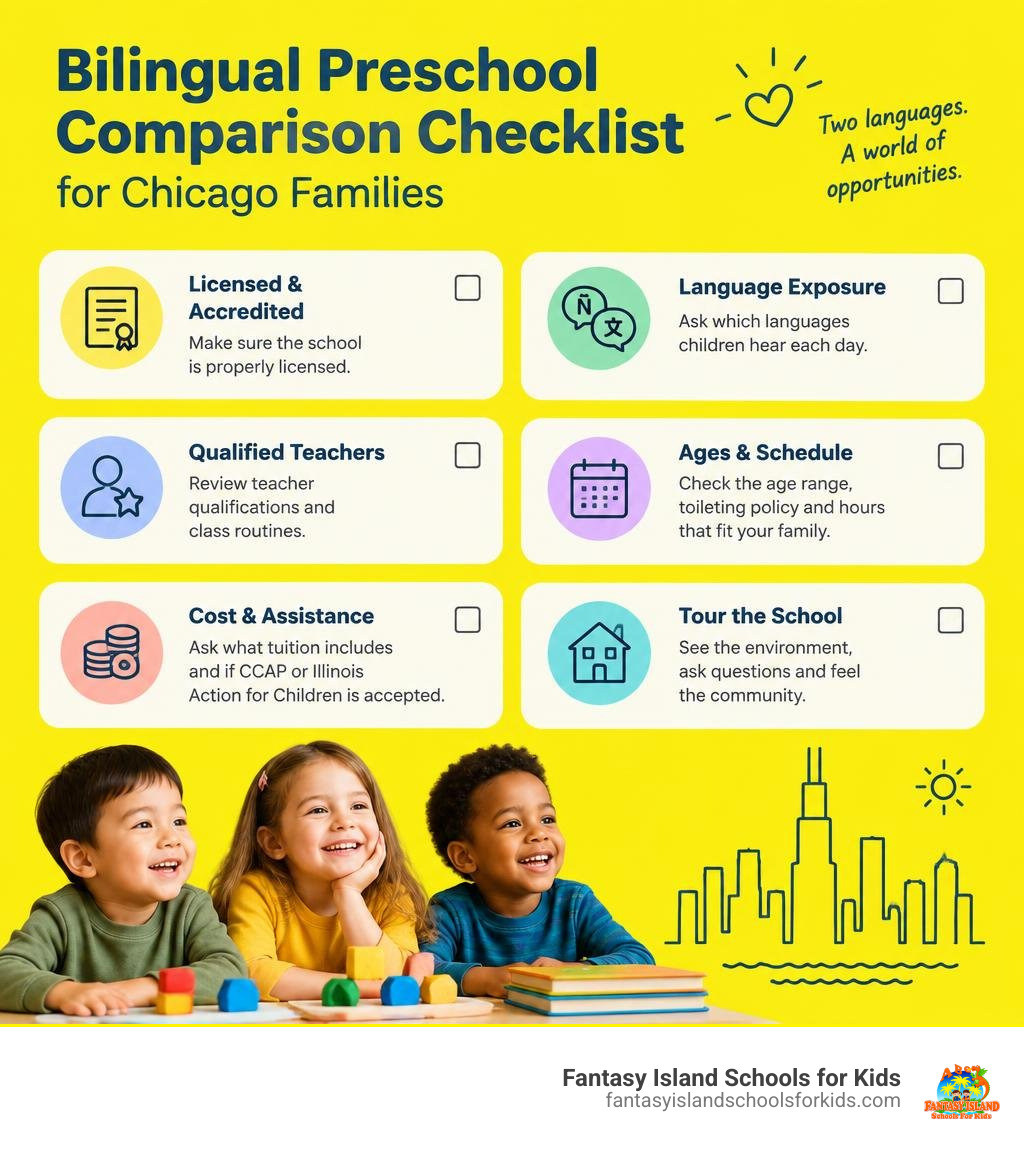
When comparing a bilingual preschool Chicago IL families can trust, start with the basics: confirm the school is licensed, ask which languages children hear each day, review teacher qualifications and class routines, and schedule a tour. The best fit should offer a warm environment where your child can learn through play, music, stories, conversation, and hands-on activities – without needing prior second-language experience.
For families on Chicago’s Northwest Side and nearby suburbs, it also helps to compare practical details before enrolling:
- Ages served and toileting policy: Many programs begin around age 2; ask how teachers support each stage of independence.
- Schedule: Look for full-time and part-time care that works with your family. Fantasy Island Schools for Kids is open Monday through Friday, 7 AM to 6 PM.
- Language approach: Chicago programs may offer Spanish, Polish, French, Mandarin, or other language experiences. A heritage-language setting can be especially meaningful for multicultural and Polish-American families.
- Cost and assistance: Ask what tuition includes and whether the school accepts CCAP or works with Illinois Action for Children.
A strong multilingual preschool does more than introduce vocabulary. It gives children regular, low-pressure chances to listen, communicate, collaborate, and become comfortable with different cultures. At Fantasy Island Schools for Kids, children ages 2 to 6 learn in a multilingual setting through an experiential curriculum, with freshly prepared meals, weekly music, and enrichment included in tuition.
I am Beata Bielic, owner and Executive Director of Fantasy Island Schools for Kids, and I have worked in early childhood education since joining the school as a teacher in 2009. With a master’s degree in psychology and more than 17 years of experience, I help Chicago families evaluate what matters most in a bilingual preschool Chicago IL parents can choose with confidence.
Bilingual preschool chicago il terms at a glance:
Cognitive and Social Benefits of Early Language Immersion
Early childhood is a unique window of rapid brain development. When young children are exposed to more than one language, their brains build dense neural pathways that support lifelong learning. Research shows that early bilingualism enhances executive function—the mental toolkit responsible for working memory, flexible thinking, task switching, and self-regulation.
Beyond cognitive agility, there are deep interpersonal rewards. Exploring the social benefits of bilingual preschool education shows how learning another language fosters natural empathy and social awareness. Young learners quickly realize that there are multiple ways to describe an object, express an emotion, or share an idea. This perspective-taking helps them navigate peer conflicts, share cooperatively, and embrace cultural diversity with openness.
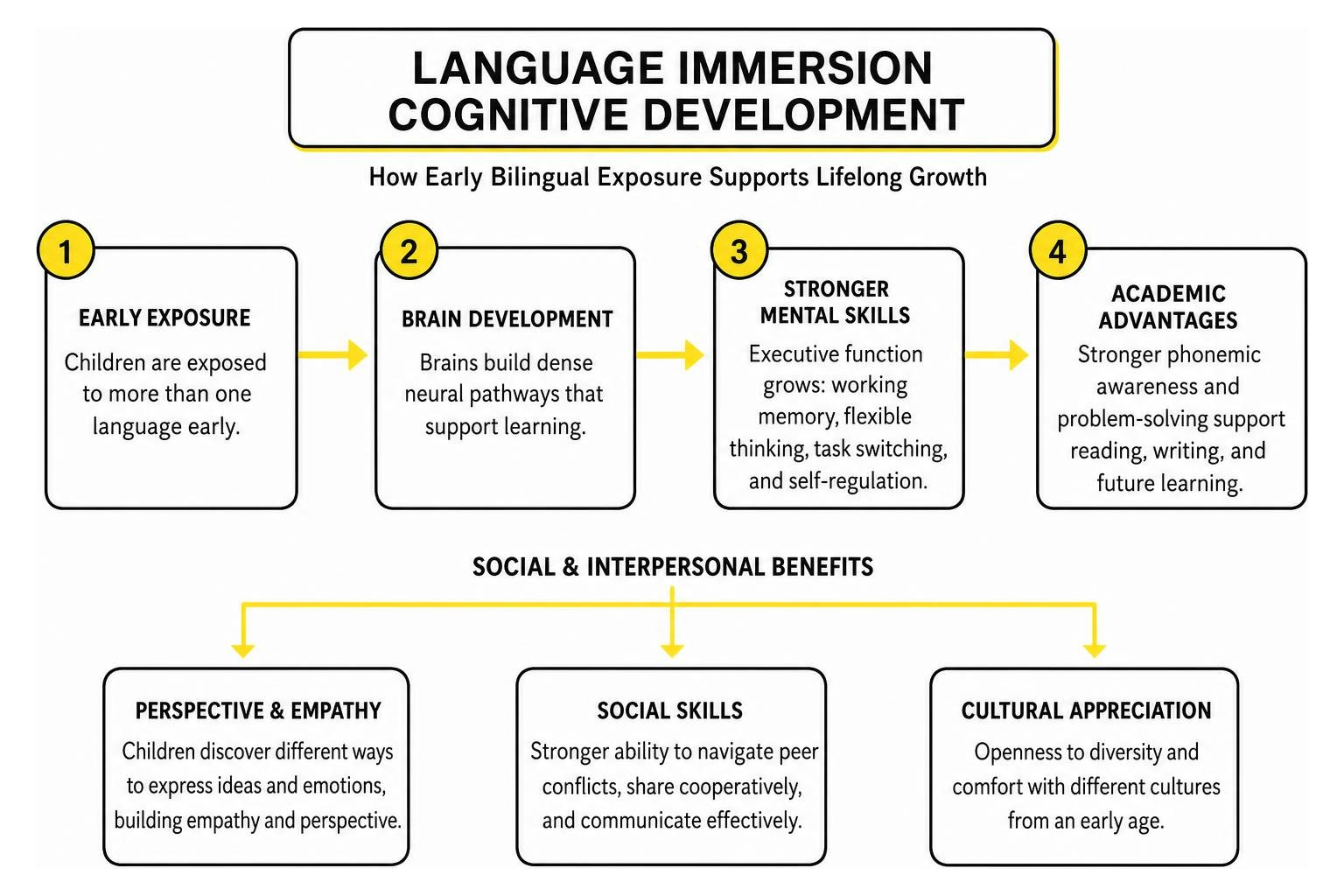
When you look at the complete guide to multilingual education benefits, it becomes clear that dual-language exposure also strengthens early phonemic awareness and problem-solving skills. Children who learn to distinguish between different phonetic systems early on tend to grasp reading and writing concepts smoothly when transitioning into primary grades.
Choosing the Best Bilingual Preschool Chicago IL Options for Your Child
Finding the right program involves understanding how different immersion models structure daily language exposure. Chicago families encounter several approaches:
- Full Immersion: The classroom conducts almost all instruction, conversations, and routines in the target language.
- Dual-Language (50/50 or Partial Immersion): Classroom time is split between English and a target language, balancing receptive and expressive skills in both.
- Multilingual & Heritage Models: Programs weave two or more languages alongside English throughout daily play, structured learning, and cultural celebrations.
| Program Type | Primary Languages | Typical Daily Model | Cultural & Community Focus |
|---|---|---|---|
| Spanish Immersion | Spanish & English | 50/50 Dual Language or 90/10 Full Immersion | Latin American cultural activities, bilingual storytelling, daily conversation |
| Polish Multilingual | Polish & English | Experiential multilingual immersion & heritage preservation | Polish traditions, seasonal celebrations, strong Northwest Side community roots |
| French Immersion | French & English | Partial or Full Immersion | Francophone literature, sensory storytelling, arts integration |
| Mandarin Immersion | Mandarin & English | Dual-Language Immersion | Tonal phonetic play, character recognition, cultural festivals |
Whether you are exploring the 5 best Spanish immersion preschools near me compared or looking for a European language environment, selecting a program that aligns with your family’s routine and values ensures your child thrives.
Core Curriculum Standards in a Bilingual Preschool Chicago IL
A high-quality bilingual curriculum balances structured language acquisition with open-ended, experiential exploration. Young children acquire language most naturally when it is tied to tactile experiences—such as mixing ingredients, building block towers, planting seeds, or engaging in multi-sensory play.
Understanding how multilingual daycare in Chicago sparks early brilliance reveals how active exploration bridges vocabulary and real-world comprehension. Rather than relying on rote memorization, native-speaking educators narrate activities in real time. For instance, when teachers implement 10 unique solutions to Spanish preschool activities or interactive Polish games, children absorb grammar and vocabulary seamlessly through play.
Strong early childhood programs also align their learning goals with neighborhood educational standards, such as the Norwood Park – School Overview framework. At Fantasy Island Schools for Kids, our curriculum combines language development with our dedicated Gifted Enrichment Program, targeted math tutoring, and a large multi-sensory play space to build solid foundational skills.
Language Offerings and Heritage Connections in Chicago
Chicago’s rich cultural tapestry makes it an ideal setting for dual-language early education. The Northwest Side—including neighborhoods like Norwood Park, Edison Park, Gladstone Park, Jefferson Park, Sauganash, Edgebrook, and Portage Park, as well as nearby suburbs like Niles, Park Ridge, Skokie, Norridge, and Harwood Heights—is home to a vibrant, multi-generational Polish-American community.
Families exploring Polish preschools and multilingualism: raising global citizens often want to preserve their heritage language while preparing children for English-dominant elementary schools. Enrolling in a program with deep community ties allows children to celebrate cultural traditions, folk music, and classic literature. As discussed in growing up multilingual: Polish daycare’s impact on kids, early dual-language environments validate a child’s family identity while helping them grow into confident global citizens.
Practical Enrollment Logistics: Ages, Schedules, and Ratios
When selecting a center, practical day-to-day operations are just as vital as the educational philosophy:
- Ages Served & Potty Training: Programs typically welcome children ages 2 to 6. Look for schools that meet children where they are developmentally and offer gentle, routine-based toilet training support rather than strict cut-offs.
- Operating Hours & Flexibility: Dual-income households need reliable schedules. Fantasy Island Schools for Kids provides care Monday through Friday from 7:00 AM to 6:00 PM, offering both full-time and part-time enrollment options.
- Teacher-to-Student Ratios & Class Sizes: Illinois Department of Children and Family Services (DCFS) sets licensing limits to safeguard child safety. Quality centers often maintain smaller groups (typically 8 to 16 children depending on age) to ensure attentive supervision and individualized language modeling.
- Year-Round Schedules & Summer Programs: Consistent routines support young children. Year-round operations and engaging summer enrichment prevent learning regression and keep children active.
- Enrichment Integration: Look for programs that weave specialized activities into the standard day. For example, our students participate in weekly music classes led by a qualified music teacher, reinforcing linguistic rhythm and auditory discrimination.
Tuition, Subsidies, and Illinois Childcare Licensing
Investing in early childhood education requires transparency around tuition and value. In the Chicago area, private bilingual preschool tuition averages between $300 and $400 per week. When reviewing fees, confirm what is covered; some programs charge extra for food, materials, or specialized instruction. At Fantasy Island Schools for Kids, weekly tuition includes our comprehensive educational programming, the Gifted Enrichment Program, weekly music instruction, and on-site freshly cooked meals prepared daily.
Affordability options are available for eligible families. We proudly accept the Child Care Assistance Program (CCAP) and collaborate with Illinois Action for Children to help ensure high-quality early childhood education is accessible.
Licensing and Quality Verification Checklist
Before signing an enrollment agreement, verify that the center meets these essential benchmarks:
- State Licensing: Active DCFS licensing ensuring adherence to strict health, space, and safety regulations.
- Teacher Certifications: Lead educators with Early Childhood Education (ECE) credentials and native or near-native language proficiency.
- Safety Protocols: All staff members hold up-to-date First Aid and CPR certifications and complete background checks.
- Trauma-Informed Care: Ongoing professional development in supportive, trauma-informed classroom strategies.
- Nutritional Standards: Balanced, freshly prepared daily meals and snacks meeting state dietary guidelines.
Checklist for Touring a Bilingual Preschool Chicago IL Facility
Visiting a school in person gives you insight into its daily environment. During your tour, consider the following observations:
- Classroom Tone: Are teachers interacting at eye level, speaking warmly in both languages, and actively listening to the children?
- Play & Sensory Spaces: Is there an expansive indoor multi-sensory play space where children can build gross motor skills during cold Chicago winters?
- Dining Facilities: Are meals prepared on-site, offering fresh and nutritious options?
- Parent Communication: How do teachers share daily updates, milestones, and routine notes with families?
To see how these elements come together, take a look at the future speaks two languages: inside our bilingual preschool in Chicago IL to visualize a typical day in a nurturing dual-language classroom.
Frequently Asked Questions About Bilingual Preschools in Chicago
Do children need previous second-language exposure before enrolling?
No prior second-language exposure is needed. Early childhood educators use immersion techniques such as gestures, visual aids, music, and peer modeling. Young children naturally absorb second-language vocabulary and grammatical patterns through context and routine play.
Are children required to be potty-trained before starting preschool?
Many centers do not require full potty training for children entering at age 2. Dedicated educators partner with parents to maintain consistent routines and positive reinforcement, helping children transition to independent bathroom habits at their own developmental pace.
What financial assistance programs help cover preschool tuition in Illinois?
Illinois offers the Child Care Assistance Program (CCAP) administered through Illinois Action for Children. This program helps income-eligible working parents and student guardians pay for licensed childcare and preschool services. Families are encouraged to speak directly with center administrators or Illinois Action for Children for guidance on application requirements.
Conclusion
Enrolling your child in a bilingual preschool provides lifelong cognitive advantages, builds natural social empathy, and lays a sturdy groundwork for elementary school success. By choosing a licensed center that combines structured enrichment with warm, culturally rich instruction, you give your child a joyful start to their academic journey.
Founded in 2009 by Beata Bielic, Fantasy Island Schools for Kids (located at 6100 N Milwaukee Ave, Chicago, IL 60646) has spent more than 15 years nurturing young learners across Chicago’s Northwest Side, including Norwood Park, Edison Park, Gladstone Park, Jefferson Park, Sauganash, Edgebrook, and Portage Park, as well as suburban communities like Niles, Park Ridge, Skokie, Norridge, and Harwood Heights.
Our programs serve children ages 2 to 6 with full-time and part-time options (open Monday through Friday, 7 AM to 6 PM). Tuition ranges from approximately $300 to $400 per week and includes educational programming, our Gifted Enrichment Program, weekly music classes with a qualified teacher, and freshly cooked on-site meals, with CCAP and Illinois Action for Children accepted.
Whether you are seeking full-time bilingual preschool or our dedicated Polish kindergarten: nurturing multilingual skills in young learners, our certified team is here to support your family. To learn more about our curriculum and elementary readiness, explore our comprehensive kindergarten preparation programs or contact us to schedule your personal tour.
